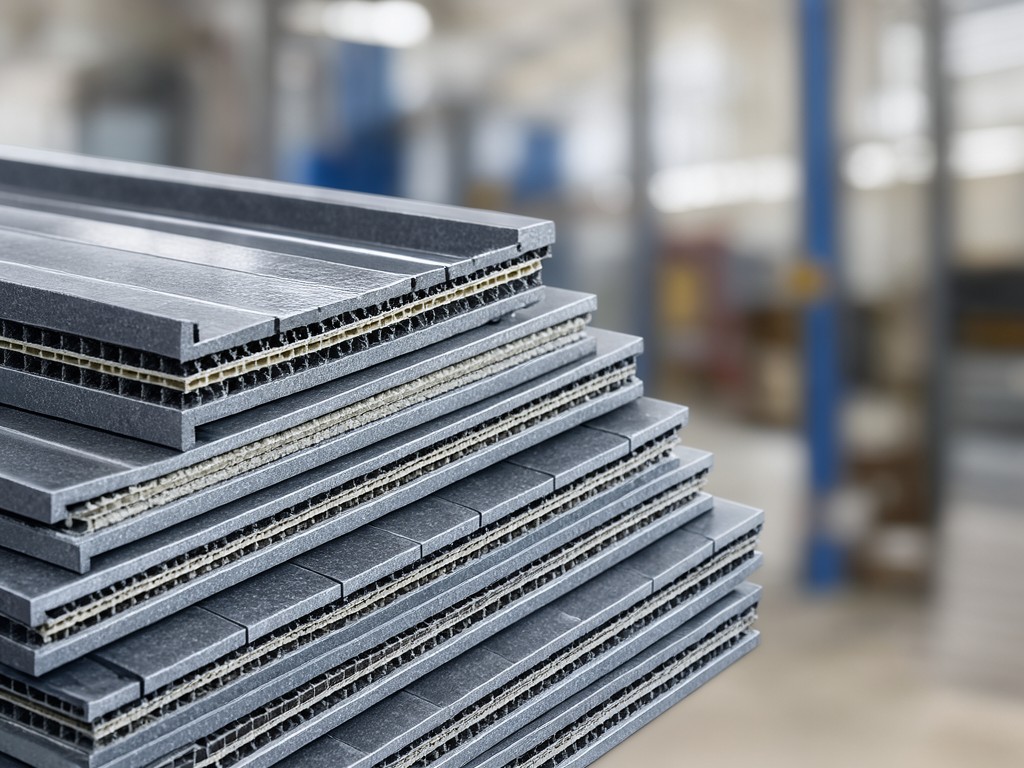
Affordable Exterior Steel Wall Cladding Panels Factory for Wholesale and OEM Orders
Selecting exterior cladding requires a balance between immediate material costs and the long-term stability of the building envelope. In large-scale projects, the primary failure point is rarely the core material itself, but rather the mechanical deformation of the steel skins under thermal expansion. Low-grade profiles often lack sufficient tensile strength, leading to oil-canning or visible buckling after the first two seasons of temperature fluctuation.
Our production focuses on maintaining the structural integrity of the skin-to-core bond. By regulating the pressure and temperature during the continuous lamination process, we ensure that the panels maintain their flat profile even when subjected to wind-load pressure differentials. This prevents the fatigue at the fastener points that typically leads to water ingress and subsequent internal corrosion in cheaper assemblies.
Technical Specification Note
Thickness is critical for long-span applications; while 0.45mm steel is standard for internal partitions, 0.5mmmm minimum provides the necessary rigidity to prevent deflection in high-wind-velocity exterior zones.
What This Product Is and Where It Fits
These panels consist of two pre-painted galvanized steel sheets bonded to a rigid insulating core. They are engineered for industrial perimeters, commercial warehouses, and rapid-build facilities where speed of installation and thermal resistance are the primary metrics. The interlocking profile design creates a weather-tight seal that reduces the labor hours compared to traditional multi-layered systems.
- Industrial cold storage perimeters requiring high R-values per mm of thickness.
- Commercial retail hubs needing a clean aesthetic finish with minimal maintenance cycles.
- Pre-fabricated housing units where lightweight properties reduce the structural steel frame requirements.
- Agricultural buildings requiring corrosion-resistant surfaces that are easily clean.
Materials and Trade-offs
The choice of core material dictates the thermal performance and fire safety profile. Expanded Polystyrene (EPS) offers the lowest cost point and lightest weight, but is susceptible to impact damage during transit and installation. Polyurethane foam (PUR) provides superior thermal insulation and higher compressive strength, though it increases the per-square-meter cost.
EPS Core
Best for budget-sensitive projects where thermal delta is secondary to rapid deployment. Lower density reduces freight costs.
PUR Core
Required for high-performance thermal envelopes. Higher density ensures better structural rigidity and moisture resistance.
| Parameter | Standard Range | Application Impact |
|---|---|---|
| Steel Skin Thickness | 0.4mm - 0.6mm | Wind resistance and surface stability. |
| Core Thickness | 50mm - 200mm | Thermal insulation (R-value). |
| Coating Grade | PVDF / Polyester | UV resistance and color fading life. |
Assumptions Buyers Should Stop
Procurement teams often overlook the impact of the edge coating on long-term oxidation. A standard galvanized edge in a coastal environment will show rust at the cut points within three years, regardless of the steel thickness. Furthermore, assuming that all sandwich panels are created equal ignores the adhesive strength of the bond; low-quality heat-pressed bonding leads to delamination under extreme thermal stress.
Another common misconception is that thicker steel always correlates to better durability. In reality, the quality of the coating system is the primary factor in preventing surface failure. A thick panel with a poor-grade coating will chalk and strip, exposing the substrate to atmospheric corrosion prematurely.
Inspection Items and Testing
To ensure batch consistency, every production run undergoes rigorous mechanical testing. We measure the shear strength of the adhesive bond to ensure the core does not separate from the skins under load. Dimensional stability is also verified to ensure the interlocking profiles remain within tolerance for seamless installation.
- Pull-off testing: Verifies the bond strength between steel and insulation.
- Salt spray testing: Evaluates the corrosion resistance of the specified coating.
- Thermal expansion analysis: Measures the panel's reaction to temperature cycles.
- Dimensional tolerance check: Ensures profile consistency for site-tight jointing.
Stock Availability and Reorder Planning
Lead times are dictated by raw material availability and custom coating requirements. Standard profiles in neutral colors are typically maintained for rapid dispatch, but bespoke extrusions or specific thicknesses require a dedicated production run. We recommend planning reorders based on project-phase milestones to ensure color-batch consistency across different shipping dates.
Request technical data sheets or volume pricing for your project specifications.
Contact our Engineering Team for a Technical Quote


