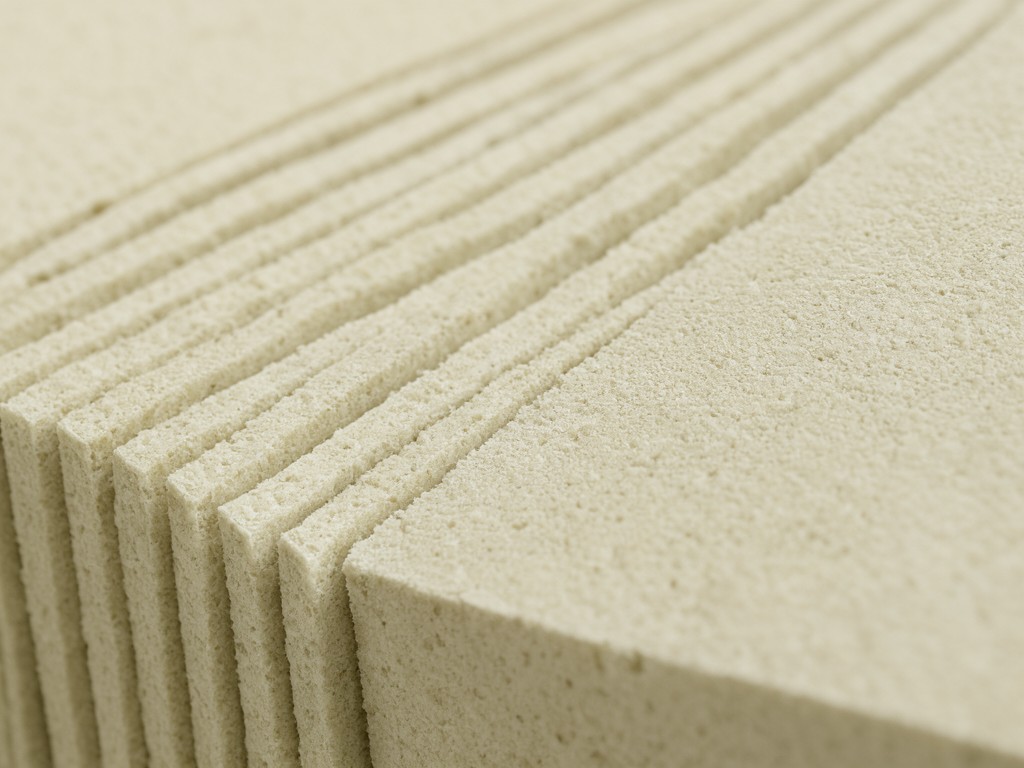
Affordable Sound Absorbing Rockwool Sandwich Panels Manufacturer - Bulk Supply and Specification Guide
Material performance depends on the density of the rockwool core and the structural integrity of the outer skins. For large-scale projects, the primary trade-off is between the noise reduction coefficient (NRC) and the weight-per-square-meter which dictates handling costs during transport. As a manufacturer, we focus on maintaining a consistent fiber density across the batch to ensure that the acoustic absorption remains uniform across the entire surface area.
Technical Note: Rockwool density typically ranges from 40kg/m³ to 100kg/m³. Higher densities improve acoustic damping but increase the mechanical load requirements for vertical mounting.
Materials and Construction Trade-offs
The sandwich process involves bonding pre-coated galvanized steel skins to a mineral wool core using polyurethane foam adhesives. If the skin gauge is below 0.45mm, the panel may suffer from buckling under thermal expansion, especially in high-temperature environments. We utilize a 0.5mm to 0.6mm steel specification for industrial applications to ensure the profile remains flat over a ten-year service life.
Acoustic performance is governed by the open porosity of the rockwool. A tightly wound core prevents sound waves from penetrating the material, where energy is converted to thermal energy through friction. For budget-grade acoustic solutions, a 50mm to 75mm thickness provides the best balance between material volume and mid-frequency attenuation.
How It Is Built
Production begins with the precision cutting of the steel sheets according to the profile geometry. The rockwool core is then die-cut to the exact width and fed between the two skins. The assembly line passes through a continuous press where heat and pressure ensure a bond that resists delamination—a common failure mode in low-cost panels.
- Galvanized steel skins with organic coating prevent edge corrosion in humid environments.
- Mineral wool core provides non-combustible properties compared to synthetic foams.
- Interlocking tongue and groove joints allow for rapid installation and eliminate thermal bridges between panels.
Option Comparison by Usage Level
| Feature | Standard Grade | Industrial Grade |
|---|---|---|
| Core Density | 40-60kg/m³ | 80-100kg/m³ |
| Skin Thickness | 0.45mm | 0.60mm |
| Primary Application | Internal Partitions | Factory/Cold Storage |
Assumptions Buyers Should Stop Making
Buyers often assume that thicker panels automatically yield better sound isolation. In reality, if the rockwool density is too low, the panel will allow low-frequency vibrations regardless of thickness. Furthermore, assuming a standard coating can withstand harsh chemical environments leads to premature fading and chalk within 24 months. We specify the coating resistance based on the specific frequency profile of the site noise.
Usage Scenarios and Buyer Segments
- Retail Distributors: Require high-turnover stock with standardized color finishes for residential-commercial projects.
- Industrial Contractors: Focus on fire-rating certifications and thermal resistance values for warehouse cladding.
- Importers: Prioritize dimensional stability and reinforced packaging to prevent edge damage during long-haul sea transit.
OEM and ODM Programme Structure
Our process starts with a technical drawing review where we define the profile depth and core composition. We provide physical samples for acoustic testing before mass production. Once approved, the batch-traceability system ensures that every panel in a shipment matches the approved density and skin-thickness specifications.
Quality Control
Consistency is maintained through automated dimensional checks on the line. We measure the width of the panels to a ±0.5mm tolerance to ensure the joints remain tight during installation. Shear bond strength is tested on random samples to verify the rockwool does not separate from the steel skins under mechanical stress.
Request technical data sheets and bulk pricing
Contact Our Engineering Team


