b2b exterior wall panels for industrial steel structure warehouses supplier: Specification, Ordering and Quality Notes
What Actually Determines Performance
Wear shows up at the same point every season: the horizontal joint line where thermal cycling pries the facing from the core. A 0.15 mm variance in adhesive bead placement — well within the tolerance on a standard spec sheet — creates a water path that freezes, expands, and delaminates a 12 m panel run within two winters.
The buyer who treats these panels as commodity sheet goods discovers the cost gap when the third reorder arrives 1.2 kg/m² lighter because the foam density drifted from 42 to 38 kg/m³. That 9% drop cuts the panel's span rating by 300 mm, forcing purlin redesign on a building already erected. Lot-to-lot consistency in core density, facing thickness, and adhesive cure profile is the only spec that protects the reorder.
Consistency Rule: Require the supplier to report core density, facing thickness, and adhesive weight per lot on the mill certificate. A 5% coefficient of variation on any of the three triggers a hold on shipment until root cause is documented.
Where This Product Beats Standard Alternatives
Standard catalog panels ship with a single adhesive formulation tuned for 15–35 °C assembly. On a 40 °C roof deck in July, that adhesive skins over before the facing seats, leaving voids. Our line runs three adhesive grades — low, mid, high reactivity — matched to the project's installation window. The same panel geometry, same core, same facing; only the cure profile changes.
Color hold is the other differentiator. A 25 µm PVDF coat on 0.5 mm G90 steel keeps ΔE < 2 after 15 years at 45° latitude. The catalog alternative uses 20 µm SMP on 0.45 mm G60; it hits ΔE 5 in seven years. The price delta is $1.80/m². The replacement delta is $42/m² installed.
How to Choose Before Requesting a Quote
Start with the decision tree below. Each branch locks a spec that the factory must hold across every production lot.
- Determine the design wind load (kPa) and required span (m).
- ≤ 2.4 kPa / ≤ 6 m span → 80 mm PIR core, 0.5 mm facing minimum.
- 2.4–3.6 kPa / 6–9 m span → 100 mm PIR core, 0.6 mm facing, high-reactivity adhesive.
- > 3.6 kPa / > 9 m span → 120–150 mm mineral wool core, 0.7 mm facing, concealed fastener profile.
- Select the fire rating the authority having jurisdiction demands.
- No rating required → PIR core, standard adhesive.
- 1-hour firewall → Mineral wool core, intumescent joint tape, high-reactivity adhesive.
- 2-hour firewall → 150 mm mineral wool, double facing, through-fastener excluded.
- Pick the coating system matched to the site environment.
- Inland, low UV → 20 µm SMP, 10-year color warranty.
- Coastal or high UV → 25 µm PVDF, 20-year color warranty.
- Chemical exposure (fertilizer, salt, acid) → 35 µm PVDF + clear coat, custom color match.
- Confirm the installation temperature window.
- 10–25 °C → Standard adhesive.
- 25–40 °C → High-reactivity adhesive, shaded staging required.
- < 10 °C → Low-reactivity adhesive, heated staging tent mandatory.
Buying Mistakes That Lead to Returns
The complaint that repeats across reorders: "Panels don't nest like the first shipment." First lot came from a line calibrated to 1000.0 mm cover width ± 0.3 mm. Second lot drifted to 1000.6 mm because the roll former's gap wasn't re-zeroed after a die change. On a 30 m wall, that 0.6 mm accumulates to 18 mm — the last panel won't engage the flashing.
Second mistake: specifying "PIR core" without density. A 35 kg/m³ core passes the thermal spec but crushes under foot traffic during roof installation. The installer walks the panels, cores compress 3 mm, joints gap, and the owner sees leaks at first rain. Minimum 40 kg/m³ for wall, 45 kg/m³ for roof traffic.
Third mistake: accepting "color match to RAL 9010" without a ΔE tolerance. One lot ships at ΔE 0.8, the next at ΔE 2.4. Both are "RAL 9010." The building looks two-tone. Write ΔE ≤ 1.5 vs. master panel into the purchase order.
Working as a Production Partner, Not a Catalogue Supplier
We run a pre-production lot of 200 m² on your actual steel coil, your actual foam batch, your actual adhesive drum. You get three panels cut from the head, middle, and tail of that run. Measure thickness, weigh, destruct-test the bond. Sign off or we adjust. No charge for the trial lot if the order exceeds 5,000 m².
Every production lot thereafter ships with a certificate showing: core density (kg/m³, three points per panel), facing thickness (µm, five points), adhesive weight (g/m², gravimetric), cover width (mm, both ends), and color ΔE vs. master. If any value falls outside the agreed band, the lot is quarantined at our dock — not yours.
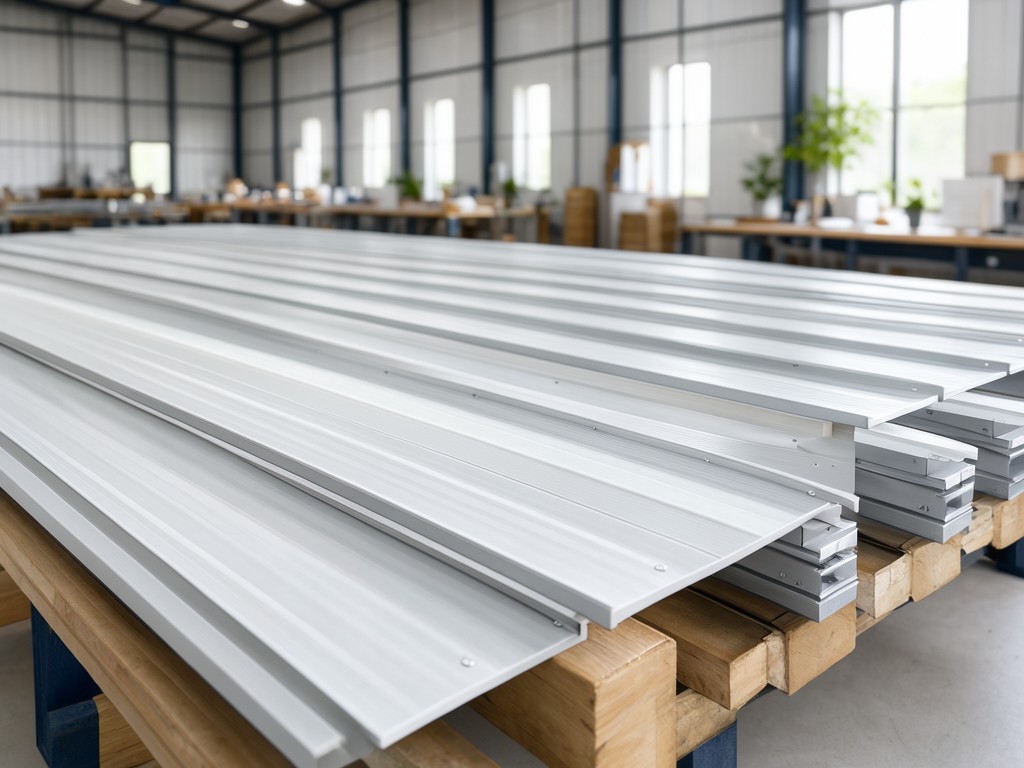
Custom lengths? Standard cut-to-length tolerance is ± 2 mm. Need ± 1 mm for modular wall systems? We slow the flying saw feed rate, add a laser check station, and quote the 8% throughput penalty upfront. You decide if the precision pays for itself in reduced field trim labor.
Capacity, Tooling and Scheduling
| Parameter | Standard Range | Extended Option | Lead-Time Impact |
|---|---|---|---|
| Core thickness | 50–200 mm (25 mm steps) | Custom ± 5 mm | +5 days for foam recipe |
| Cover width | 1000, 1150, 1200 mm | 950–1250 mm | +3 days die change |
| Facing gauge | 0.45, 0.50, 0.60, 0.70 mm | 0.40–0.80 mm | Coil availability |
| Coating system | Polyester, SMP, PVDF | PVDF+clear, Kynar 500® | +10 days coil coating |
| Length | 2.0–16.0 m | 16.0–18.5 m (shipping permit) | Standard |
| Monthly capacity | 45,000 m² | 60,000 m² (overtime) | Book 6 weeks out |
Tooling for non-standard joint profiles (deep rib, micro-rib, flat) requires a 4-week die build. If your project schedule can't absorb that, stay with the three stock profiles. We hold inventory of the stock-profile roll sets; changeover is 4 hours.
Next Steps
Send the project specification — wind load, fire rating, coating requirement, installation window, and total square meters. We return a marked-up spec sheet with the exact adhesive grade, core density, and facing gauge locked in, plus a lot-certification template for your quality file. No catalogue part numbers, just the build sheet your project needs.



