Specifying b2b Modular Cleanroom Wall Panel System Suppliers for Wholesale and OEM Orders
Maintaining a controlled environment depends on the mechanical stability of joints and the surface integrity of the panel skins. When procurement officers evaluate modular cleanroom systems, the primary technical concern is the bond strength between the steel skins and the core material—typically mineral wool or PET. Poor-grade assemblies often fail through delamination when subjected to repeated cleaning cycles with aggressive agents like hydrogen peroxide or ozone-based sterilization. A factory-integrated system utilizes high-pressure bonding to ensure the core does not shift under thermal expansion or mechanical vibration in high-traffic corridors.
Material Options and Trade-offs
The choice of core material dictates the thermal resistance and the fire rating of the entire facility. Mineral wool cores offer superior fire- and acoustic damping but add significant weight, increasing the structural load on the support framing. In contrast, PET foam or polystyrene cores provide lower thermal conductivity and easier handling, though they may require specific considerations regarding load-bearing capacity for wall-mounted fixtures.
| Feature | Mineral Wool Core | PET/Foam Core |
|---|---|---|
| Fire Rating | Non-combustible (A1) | Combustible (B-s1) |
| Density | High (80-120 kg/m³) | Low (3-40 kg/m³) |
| Thermal Conductivity | Moderate | Excellent |
Where This Beats Standard Alternatives
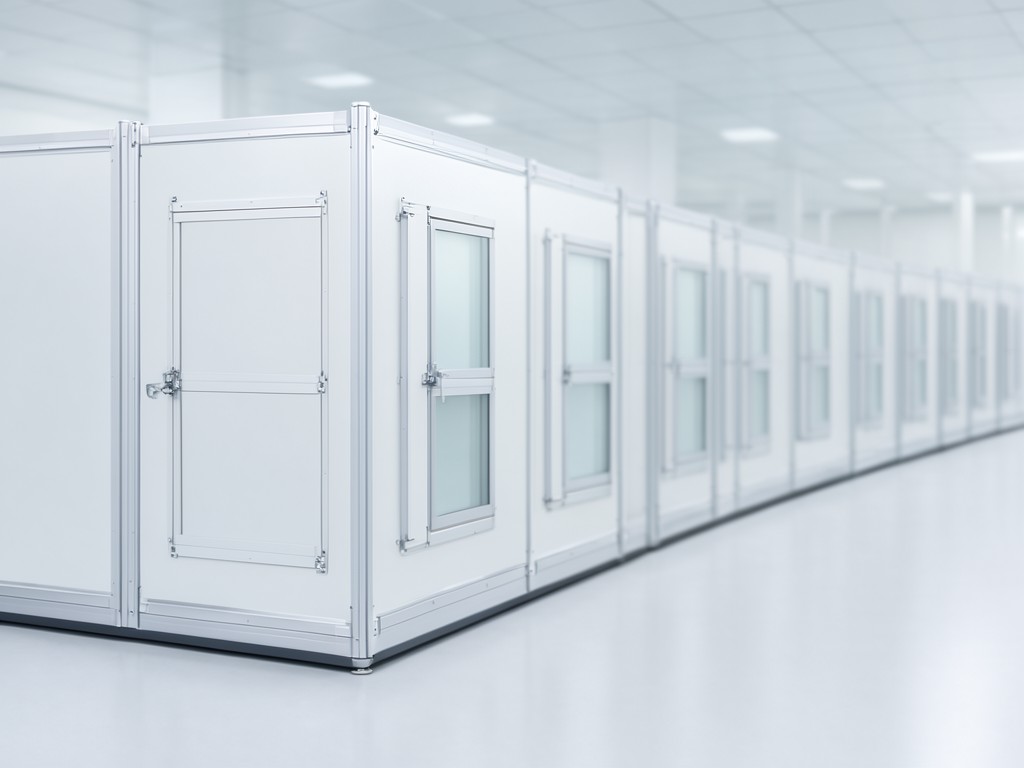
Traditional fixed partitions rely on sealant-heavy joints that degrade over time and harbor particulate matter. Modular systems utilize interlocking tongue-and-groove aluminum extrusions that create a mechanical seal. This construction allows for the rapid disassembly and reconfiguration of the floor plan without damaging the panels, a critical requirement for pharmaceutical plants or semiconductor labs where production lines change annually.
- Flush-mounted aluminum profiles eliminate dust accumulation points in corners.
- Anti-static powder coatings (ESD compliant) prevent electrostatic discharge in sensitive electronics assembly zones.
- Integrated coved-ceiling channels allow for HEPA filter integration without structural penetration.
Customisation Options and Limits
Surface Treatments and Dimensions
Buyers can specify various powder coating finishes, from standard high-gloss white to medical-grade antimicrobial designed for chemical resistance. However, panel widths are typically limited by transport logistics; widths exceeding 1200mm often require specialized oversized packaging which significantly increases shipping costs per square-meter. Length spans require internal structural reinforcement if the ceiling height exceeds 4000mm to prevent deflection under pressure differentials.
Usage Scenarios and Segments
In pharmaceutical manufacturing, the focus is on panel compatibility with vaporized hydrogen peroxide (VHP). The skins must withstand high-pressure wash cycles without the paint chalking or pitting.
Food processing environments prioritize food-grade certifications and resistance to high-pressure water hosing, ensuring no organic matter remains within the modular joint system.
Segment-Specific Requirements
| Usage Condition | Typical Failure | Preventative Specification |
|---|---|---|
| High Pressure Differential | Joint leakage/Air bypass | Double-gasketed EPDM extrusions |
| Chemical Cleaning | Surface corrosion/pitting | 60-micron polyester powder coating |
| Heavy Equipment Load | Panel buckling/bowing | Reinforced steel-core ribs |
Stock Availability and Order Planning
Lead times for modular systems vary based on the complexity of the aluminum profiles and the volume of core material required. Standard white-coated panels are often available for rapid-deployment projects, but custom-sized panels or specialized ESD coatings require a 6-to-8 week production window. Procurement officers should account for the sample-approval phase, where technical drawings must be verified against the site's CAD layout before the manufacturing run commences.
Questions Ask Before Ordering
What is the tolerance for panel width across large batches?
Typically, we maintain a ±0.5mm tolerance to ensure the tongue-and-groove joints remain tight without requiring on-site modification.
Can the panels be integrated with existing flooring systems?
Yes, provided the base track profile is specified to match the floor finish height and material to ensure a seamless, coved transition.
Request technical data sheets or material samples for your specific project.
Contact our Engineering Team for a Quote


