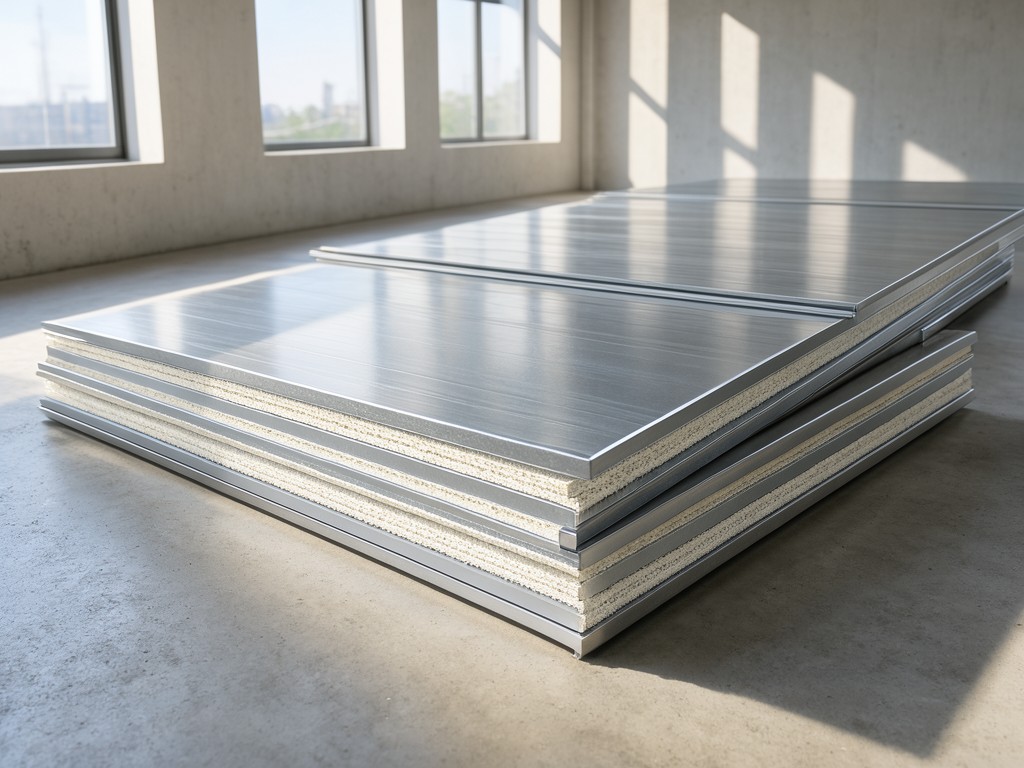
B2B Steel Structure Insulated Envelope Sandwich Panels Manufacturer: Specification and Ordering
What Actually Determines Performance
The lifecycle of a steel structure envelope is dictated by the gauge of the galvanized steel skins and the density of the core material. Thinner steel profiles, typically 0.4mm to 0.7mmmm, reduce dead load but increase the risk of oil-canning or buckling under high wind loads. For large-scale procurement, the trade-off lies between minimizing initial material cost and ensuring the resistance to permanent deformation over a 20-year service life.
Insulation core selection impacts the R-value and fire-rating capabilities respectively. Polyurethane (PUR) and Polyisocyanurate (PIR) offer the highest thermal resistance per millimeter but are sensitive to UV degradation during installation if not immediately covered. Mineral wool provides superior fire stability and acoustic damping but requires a thicker profile to achieve equivalent thermal barriers, which increases the total weight of the steel support structure.
Specification Range and Limits
| Parameter | Standard Range |
|---|---|
| Steel Skin Thickness | 0.4mm - 0.85mm (Galvanized) |
| Panel Thickness | 50mm - 300mm |
| Core Density | PUR/PIR: 40-45kg/m³; Mineral Wool: 80-120kg/m³ |
| Effective Span Width | 600mm - 1200mm |
| Thermal Conductivity | 0.022 - 0.045 W/mK |
How to Choose Before Requesting a Quote
Surface treatment determines the maintenance frequency. In coastal or high-humidity environments, a PVDF or high-durability polyester coating is mandatory to prevent premature corrosion of the zinc coating substrate. For standard industrial storage, a basic polyester paint (PE) is often sufficient, though it remains prone to chalking if exposed to direct UV radiation for extended periods.
Joint geometry affects the installation speed and water-tightness. A hidden-bolt locking system reduces the risk of water ingress compared to exposed-lap joints but requires more precise on-site framing. If the project demands tight thermal tolerances, the panel profile must be calculated to account for the expansion coefficients of steel across the entire envelope.
What Can Be Customised and What
Customization is focused on the profile shape of the ribs and the specific finish of the steel skin. We adjust the rib height to increase structural load-bearing capacity without increasing the total material volume. However, the core insulation material's chemical properties are fixed by the manufacturing batch to ensure consistent fire ratings and thermal performance across the entire production order.
Who Uses It and Where Matters
Cold storage facilities prioritize high-density PIR cores to maintain internal temperature gradients and minimize compressor load. In contrast, manufacturing plants often select mineral wool panels to meet fire safety regulations for heavy industrial zones. The procurement officer must balance the energy cost savings of thicker insulation against the capital expenditure of a more robust steel frame system.
Requirements by Segment
Retail buyers for modular-build kits focus on dimensional consistency to ensure rapid assembly without on-site cutting. Large-scale infrastructure managers require batch traceability to verify that every panel in the envelope meets the specific structural load rating defined in the engineering schematics.
Volume Planning and Lead Time
Lead times are influenced by the availability of specialized steel coils and the throughput capacity of the production lines. Standard profiles are typically produced within a 3-4 week window, whereas custom-rib configurations or non-standard mineral wool thicknesses may extend this period due to tooling setup and specialized material sourcing.
Request technical specifications and bulk pricing schedules
Contact our engineering team for a project review


