B2B Thermal Acoustic Mineral Wool Sandwich Panels Supplier: What Buyers Should Check Before Ordering
Inconsistent panel performance often stems from poor adhesive bond strength between the mineral wool core and the metal skins. When the density of the mineral wool fluctuates across batches, the thermal R-value becomes unpredictable, leading to thermal bridging in large-scale installations. Procurement officers must evaluate the mechanical fixation method of the core to ensure that the structural integrity of the panel remains stable under wind load.
Technical Note: Mineral wool density typically ranges from 40kg/m³ to 120kg/m³ depending on acoustic absorption requirements.
Material Options and Trade-offs
| Configuration Type | Primary Benefit | Commercial Trade-off |
|---|---|---|
| High-Density Mineral Wool | Superior fire rating and acoustic damping | Increased weight and higher logistics costs |
| Polymer Coated Skin | Chemical resistance and vapor barrier | Lower impact resistance compared to steel |
| Pre-painted Steel Skin | Maximum structural rigidity and span capability | Risk of denting during transport |
How It Built and What Changes
The manufacturing process relies on a continuous production line where the mineral wool blanket is fed between two profiled sheets. If the temperature of the adhesive application is not precisely calibrated, the panels will delaminate when exposed to thermal cycling. We utilize high-pressure forming systems to ensure the core remains centered, preventing air pockets that compromise the thermal resistance.
Core Integrity
The density of the mineral wool directly dictates the sound reduction index (NRC). A denser core reduces low-frequency noise transmission but increases the load on the supporting structure, which may require heavier steel framing.
Surface Finish
Coating thickness determines the longevity against UV degradation. For exterior applications, PVDF finishes are often necessary to prevent chalking and premature corrosion of the metal substrate.
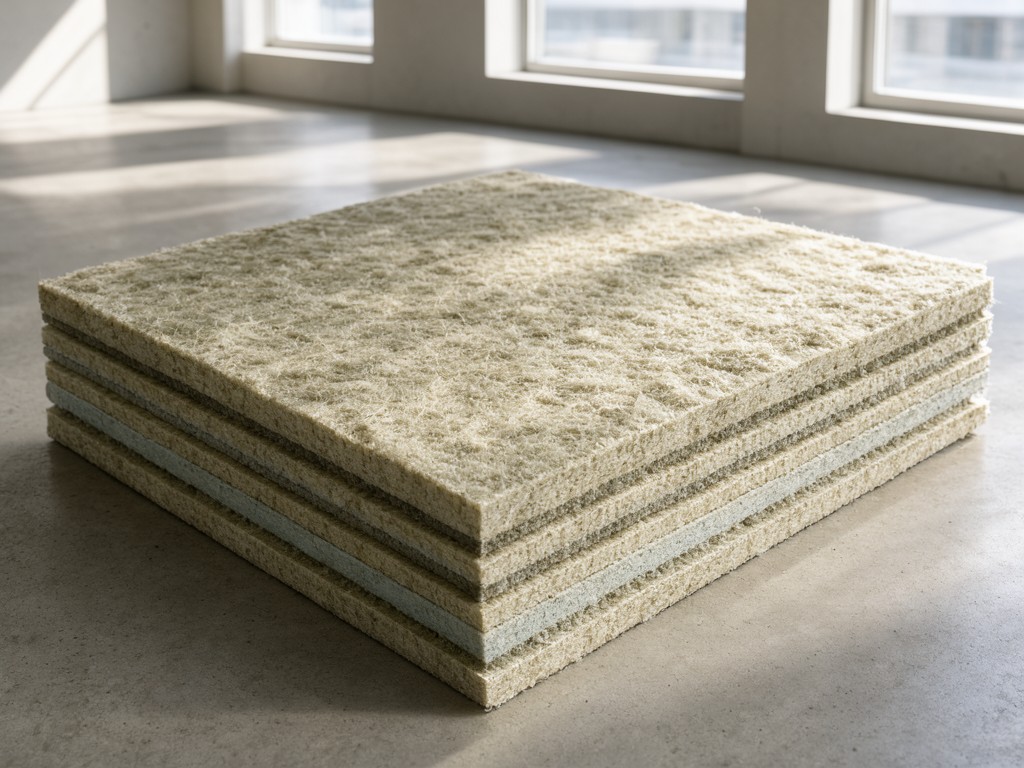
Comparing Standard Configurations
Selecting between specialized acoustic insulation and standard thermal barriers requires balancing the thickness-to-weight ratio. A 50mm panel provides sufficient insulation for internal partitions, whereas a 150mm configuration is required for industrial-grade cold storage.
- Acoustic-focused cores utilize open-fiber structures to maximize sound wave energy dissipation.
- Thermal-focused cores prioritize closed-cell structures or high-density to prevent vapor migration.
- Structural-profile panels utilize interlocking locking systems to eliminate thermal leakage at the joints.
Inspection Items and Test Methods
To ensure batch consistency, every shipment undergoes dimensional checks and pull testing. We measure the thickness variance within a ±0.5mm tolerance to ensure interlocking joints fit correctly on-site.
| Test Parameter | Method |
|---|---|
| Adhesion Strength | Pull-off force testing |
| Thermal Conductivity | Heat flow meter (K-value) |
| Water Absorption | Hydrostatic pressure test |
Capacity, Tooling and Scheduling
Lead times are dictated by the availability of specialized mineral wool fibers and custom coating colors. Standard profiles are typically available within a 4-week window, while custom extrusions or specific skin thicknesses require additional tooling time.
Care, Storage and Service Life
Proper storage prevents moisture ingress into the mineral wool core, which permanently degrades its thermal properties. Panels should be stored vertically on edge supports to avoid permanent deformation of the metal skins under their own weight.
Request technical data sheets or bulk pricing for your project.
Contact our Engineering Team for a Quote


