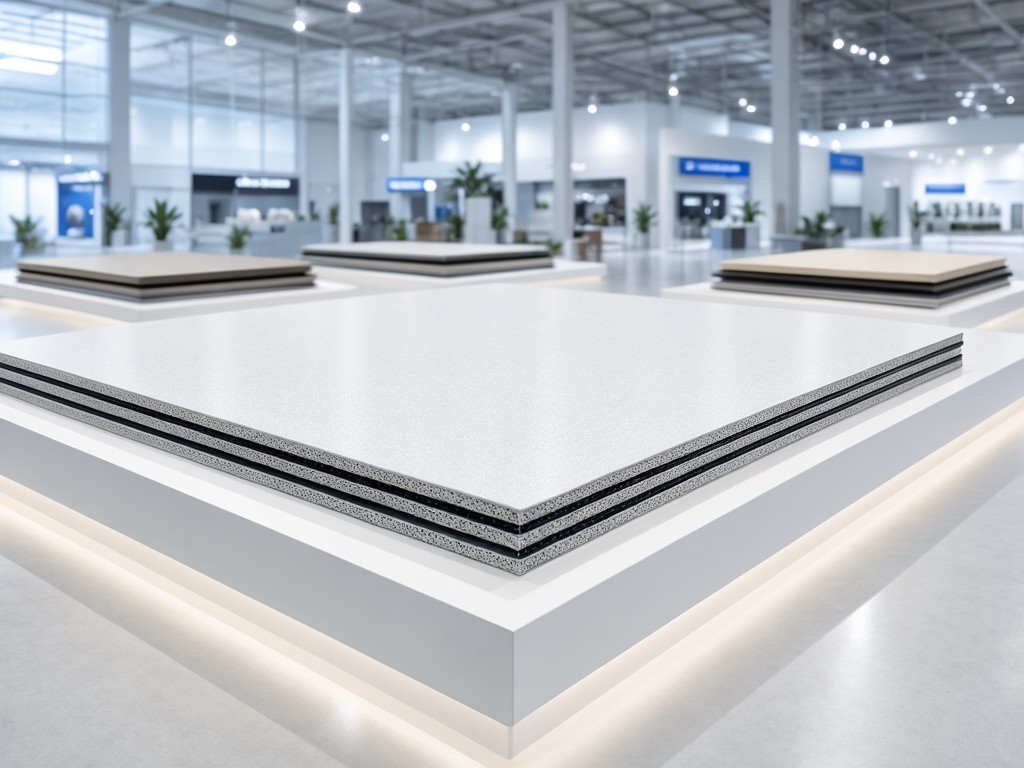
ce certification polyurethane ceiling sandwich panels factory: What Buyers Should Check Before Ordering
Deflection under load governs whether a ceiling panel stays flat for the warranty period or sags into a visible bow within two heating seasons. The core density, facing adhesion, and joint detail each carry a cost, and skipping any one of them shifts the risk from the factory to the installer — and ultimately to the project owner who files the claim.
Where Cheaper Alternatives Fall Short
A panel priced 12–15 % below the market median typically saves money in three places: core density drops from 40 kg/m³ to 35 kg/m³, the facing steel thins from 0.5 mm to 0.4 mm, and the adhesive line changes from a two-component polyurethane system to a single-component moisture-cure. Each cut looks harmless on a datasheet; together they halve the panel's resistance to creep at 50 °C roof-surface temperatures.
Specification rule: For spans over 3 m, require ≥ 40 kg/m³ core density and 0.5 mm minimum facing thickness. Anything less voids the deflection warranty on most European project specifications.
| Usage Condition | Typical Complaint / Failure | Specification That Prevents It |
|---|---|---|
| Cold-storage ceiling, -25 °C to +15 °C cycling | Core shrinkage → joint gaps → frost buildup | Closed-cell PU, ≥ 92 % cell closure, dimensional stability ≤ 1 % at -30 °C / 48 h |
| Retail atrium, 4 m span, solar gain 60 °C surface | Mid-span bow > L/200, visual rejection | 40 kg/m³ core, 0.5 mm steel, two-component adhesive, screw fix at ≤ 300 mm centres |
| Food-processing plant, daily wash-down, 80 °C steam | Facing delamination, coating blister | PVDF 25 µm coating, adhesive shear ≥ 0.12 MPa after 1000 h humidity ageing |
Material Options and Their Trade-offs
Consistency depends on the facing-to-core bond more than any other single variable. The factory can run three adhesive chemistries on the same line, but only the two-component polyurethane gives repeatable shear values above 0.1 MPa after the 28-day ageing test that mimics a summer on a metal roof.
Facing Materials
0.5 mm galvanized steel, polyester 25 µm
Standard for indoor ceilings. Lowest cost. Colour stability 5–7 years under UV. Not for exterior or high-humidity zones.
0.5 mm galvanized steel, PVDF 25 µm
Adds 8–10 % to panel price. Colour hold 15+ years, chemical resistance for wash-down. Required for food, pharma, and any exterior canopy.
0.6 mm aluminum, PVDF 25 µm
Lightest option, non-magnetic, corrosion-proof. Cost premium 18–22 %. Specified for clean-rooms and coastal projects where steel coating damage is a risk.
Core Density Grades
PU core density is the lever that moves both thermal performance and structural stiffness. The table below shows the practical range the factory holds in stock for immediate scheduling.
| Core Density (kg/m³) | Thermal Conductivity λ (W/m·K) | Max Recommended Span (m) at 0.5 mm Steel | Typical Application |
|---|---|---|---|
| 35 | 0.022–0.024 | 2.5 | Non-structural soffits, decorative ceilings |
| 40 | 0.021–0.023 | 4.0 | Standard commercial / industrial ceilings |
| 45 | 0.020–0.022 | 5.0 | Cold-store, high-bay, long-span atriums |
Option Comparison by Usage Level
The interface between parts determines whether a panel system installs in two days or drags into a week of callbacks. Joint profile, fixing method, and vapour-barrier continuity are the three decisions that separate a smooth handover from a punch-list that never closes.
Standard Tongue-and-Groove
Self-aligning, fast to erect. Relies on sealant bead for vapour tightness. Acceptable for heated interiors with ΔT ≤ 30 K.
Risk: sealant skip at corners → condensation streak on facing.
Double-Lock with Integrated Gasket
Factory-fitted EPDM gasket in the female groove. No field sealant required. Vapour diffusion resistance μ ≥ 150 000. Mandatory for cold-store and high-humidity pools.
Cost adder: ~€3.5 / m². Eliminates the single biggest callback source.
Buying Mistakes That Lead to Returns
- Specifying U-value only, ignoring span tables. A 50 mm panel at 40 kg/m³ hits 0.42 W/m²·K but deflects 18 mm at 4 m span — visual failure before thermal failure.
- Ordering "CE certified" without checking the DoP. The Declaration of Performance lists the actual tested values. Two factories can both mark CE while one tests at 40 kg/m³ and the other at 35 kg/m³. The mark is identical; the performance is not.
- Assuming all PVDF is equal. 20 µm vs 25 µm topcoat changes chalk resistance by 40 %. Always write the dry-film thickness into the purchase order.
- Skipping the first-article inspection. The first 50 m² off the line reveal adhesive mix ratio, core temperature, and facing tension. Catching a 0.05 MPa shear drop then costs one morning; catching it on site costs a container return.
What Can Be Customised and What Cannot
Customisation that changes the production flow — width, length, facing colour, joint profile — is scheduled in the same run if ordered before the weekly planning lock on Wednesday 12:00 CET. Changes that require a different foam formulation or adhesive system trigger a new trial batch and a two-week lead-time adder.
- Width: 1000 mm standard; 1150 mm and 1200 mm available with 3-day notice. Wider panels reduce joint count but increase container air freight cost per m².
- Length: 2 m – 13.5 m in 50 mm increments. Over 12 m requires curtain-side trailer; factor €0.80 / m² extra freight.
- Facing colour: Any RAL from stock coil (≈ 40 colours) — no MOQ adder. Custom coil colour: 5 t minimum, 4-week mill lead time.
- Core density: 35, 40, 45 kg/m³ are standard recipes. 50 kg/m³ requires re-calibration of the pouring head — minimum 500 m² order.
- Fire rating: Euroclass B-s1,d0 is standard with 40 kg/m³. B-s2,d0 at 35 kg/m³. A2-s1,d0 requires mineral-wool hybrid core — different line, different factory.
How Consistency Is Held Across Batches
The factory runs a statistical process control loop on three critical-to-quality parameters every 30 minutes during production: core density (gamma backscatter), adhesive bead weight (inline load cell), and facing flatness (laser triangulation). Data feeds a rolling Cpk dashboard visible to the quality manager and, on request, to the buyer's QA team via read-only portal.
Batch release rule: No pallet ships until Cpk ≥ 1.33 on all three parameters for the preceding 4-hour window. If a drift occurs, the affected 200 m² block is quarantined, re-tested destructively (shear, peel, thermal conductivity), and either released with a supplementary test certificate or reworked.
Traceability goes to the polyol batch number and the steel coil heat number. A warranty claim six years from now can be traced to the exact 8-hour production shift, the operator, and the raw-material certificates — which is why repeat OEM buyers specify this factory for private-label programs.
Request a Sample Pack
A physical sample kit — 300 × 300 mm cuts of each facing/coating combination with the specified core density — lets your technical team verify colour, flatness, and joint feel before committing container space. Kits ship within 48 hours from stock panels.
Request sample kit and current DoP library →


