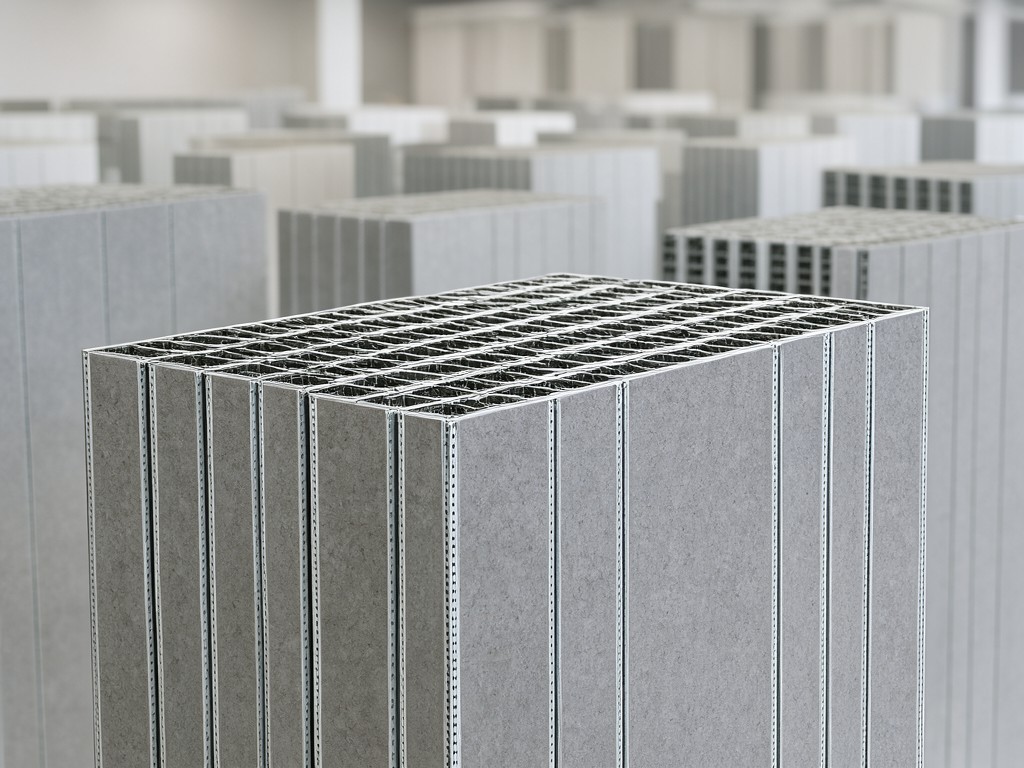
Specifying ce certified eps core insulated partition wall panels factory for Wholesale and Orders
Structural integrity in modular partitioning depends on the density of the EPS core and the mechanical bond strength of the facing skins. In high-traffic industrial environments, panel failure typically originates at the seam joints where thermal expansion coefficients differ between materials. Our manufacturing process focuses on high-pressure thermal bonding to ensure the EPS core maintains dimensional stability across varying humidity levels.
What Actually Determines Performance
Thermal resistance and R-values are directly linked to the cell structure and density of the expanded polystyrene within the core. Lower-density cores offer better insulation but increase the risk of surface deformation under mechanical impact or point-load fastening. We calibrate the foam-to-skin ratio to prevent the internal structural bowing often seen in long-span ceiling installations.
- Core bond strength: High-shear resistance prevents delamination during rapid-fire assembly cycles.
- Fire retardant additives: Compliance with Euroclass standards ensures minimal smoke production in thermal-stress events.
- Surface tensile strength: Galvanized steel or reinforced faces prevent cracking and scratching during transport.
Construction Method and Its Effect
The vacuum extrusion process for the EPS core determines the uniformity of the wall thickness. If the temperature fluctuates during the molding phase, the internal air pockets distribute unevenly, leading to warping once the panel is installed. We utilize automated temperature monitoring to ensure that every batch meets the +/- 1mm tolerance required for large-scale commercial projects.
| Parameter |
Standard Range |
Industrial Impact |
| Core Density |
15 - 30 kg/m³ |
Higher density increases acoustic damping |
| Panel Thickness |
50mm - 200mm |
Affects total U-value performance |
| Face Gauge |
0.4mm - 0.7mm |
Determines corrosion and impact resistance |
Where This Product Beats Alternatives
Traditional gypsum-based partitions suffer from moisture absorption and significant weight penalties, increasing labor costs. Our EPS-core panels provide a high strength-to-weight ratio, allowing for rapid modular installation without heavy-duty machinery. This reduces the overall project timeline by up to 40% in commercial fits.
Thermal Efficiency
The closed-cell structure of the EPS prevents condensation, making these ideal for cold storage environments where temperature control is critical.
Logistics Savings
Lightweight construction allows for higher units per container, significantly lowering the shipping cost per square for international importers.
Buying Mistakes That Lead to Returns
Procurement officers often overlook the compatibility of the joint profile system. If the tongue-and-groove is not machined with high precision, the panels will shift, leading to visible gaps that compromise thermal integrity. We utilize CNC-cut interlocking profiles to ensure a flush seal across the entire wall surface.
Using low-grade steel coatings in coastal environments leads to rapid oxidation at the cut edges. We specify specific zinc-rich or galvanized finishes to ensure the lifecycle of the partition matches the lifespan of the building.
What Checked Before Shipment
Our quality control protocol involves multi-stage testing to verify mechanical compliance. We perform perpendicular load tests on random samples to ensure the core does not shear under maximum design pressure.
- Ultrasonic thickness testing to verify internal core consistency.
- Pull-off tests for skin-to-core adhesive strength.
- Visual inspection for surface defects or coating delamination.
Frequently Asked Questions
Can these panels be customized for specific R-values?
Yes, we offer various core thicknesses and densities, though custom foam densities require a specific tooling setup for the production run.
What is the lead time for bulk CE-certified orders?
Standard sizes typically ship within 14-21 days, while custom configurations may require 35 days depending on material availability.
Do the panels meet European fire safety standards?
All panels are manufactured to meet CE marking requirements, including fire-retardant testing documentation provided for your project compliance.