custom insulated exterior wall panels suppliers: What Buyers Should Check Before Ordering
What This Product Is and Where It Fits
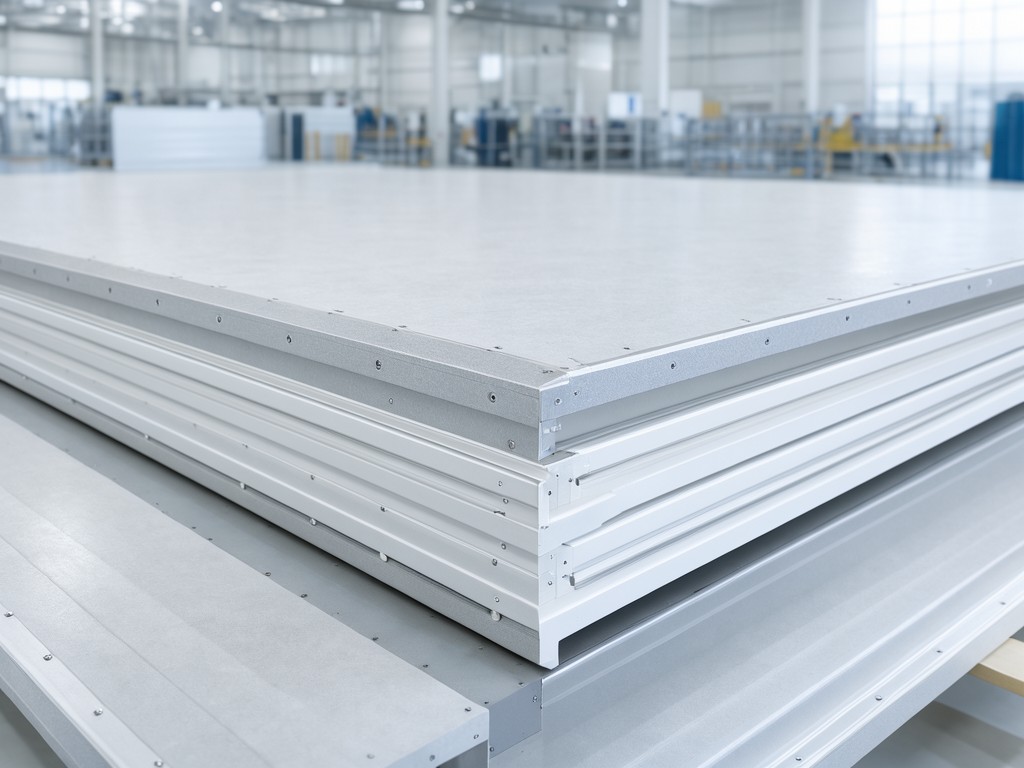
Insulated metal panels (IMPs) combine structural skin, thermal core, and weather barrier in a single factory-finished unit. They arrive on site as large modules — typically 2 ft to 4 ft wide by 8 ft to 53 ft long — reducing field labor to joint sealing and fastener installation. The product family spans commercial warehouses, cold-storage facilities, data centers, and architectural façades where continuous insulation and air-barrier continuity are non-negotiable.
Total cost of ownership shifts once returns are counted. A panel that passes the submittal but delaminates at the roof transition after two freeze-thaw cycles costs far more than the per-square-foot delta between a commodity line and a project-specific spec. Buyers qualifying a second source need to verify that the supplier controls the full lamination line — skin profiling, core injection, and cure — rather than outsourcing the foam pour to a third party.
The critical interfaces are the joint profile (single lock, double lock, or pressure-equalized rain screen), the reveal depth, and the fastener pattern. These determine whether the assembly meets ASTM E283 air leakage (<0.06 cfm/ft² at 1.57 psf) and ASTM E331 water penetration (no leakage at 12 psf for 15 min) without relying on field-applied sealant as the primary barrier.
Materials and Construction Trade-offs
| Core Type | Aged R-value/in (hr·ft²·°F/Btu) | Fire Rating (ASTM E84) | Max Span (ft) at 20 psf | Typical Cost Index |
|---|---|---|---|---|
| PIR (polyisocyanurate) | 6.5–7.0 | Class A (flame spread ≤25) | 12–16 (24 ga skins) | 1.0× baseline |
| Mineral Wool (4.5–6.0 pcf) | 3.7–4.2 | Non-combustible, 1–3 hr assembly | 8–12 (22 ga skins) | 1.3–1.5× |
| EPS (1.5–2.0 pcf) | 3.6–4.0 | Class A with thermal barrier | 6–10 (24 ga skins) | 0.7–0.85× |
Skin gauge and coating drive the other half of the durability equation. 24 ga G90 galvanized with SMP (silicone-modified polyester) is the commodity baseline for distribution centers. Architectural projects specify 22 ga AZ50 or AZ55 Galvalume® with 70% PVDF (Kynar 500®/Hylar 5000®) to hold ΔE < 5 after 20 years UV exposure. The coating decision locks in before the first coil hits the roll former — changing it mid-run scraps the entire coil inventory.
Core-to-skin adhesion is where field failures originate. Continuous-line lamination with in-line infrared cure produces a more uniform bond line than batch press systems, but only if the line speed matches the foam gel time. Ask the supplier for their pull-off test frequency (ASTM D4541) and the minimum acceptable value — typically ≥25 psi for PIR, ≥15 psi for mineral wool. If they quote a single number without a standard deviation, the process isn't controlled.
Matching the Product to the Buyer's Need
Cheaper stock options fail at the worst point in the season. A cold-storage operator needing -20°F interior with 95°F exterior summer temps requires a 6 in PIR panel (R-40 aged) with a thermal-break joint and stainless fasteners. The same panel on a 40 ft warehouse wall in Climate Zone 4 creates condensation risk at the purlin line because the steel skin bridges the insulation. The fix is a 4 in PIR with a 1 in exterior continuous insulation layer — different product, different supplier capability.
Distribution / Warehouse
- 24 ga SMP, 4–6 in PIR, single-lock joint
- Span 10–12 ft on 16 ga purlins
- Truckload quantities, standard colors
- Lead time: 3–4 weeks from order
Architectural / Cold Storage
- 22 ga PVDF, 5–8 in PIR or mineral wool
- Pressure-equalized joint, concealed fastener
- Custom colors, reveal depths, radius panels
- Lead time: 8–12 weeks + shop drawings
The selection guide is not a menu — it's a constraint matrix. Write the performance requirement (R-value, fire rating, wind load, seismic drift) first, then let the supplier confirm which core/skin/joint combination satisfies it. Reverse-engineering from a catalog page guarantees a change order.
Assumptions Buyers Should Stop Making
"All Class A panels meet the same fire code." The assembly rating (ASTM E119/UL 263) depends on joint detail, fastener spacing, and through-penetration protection. A mineral wool core panel with a single-lock joint may only achieve 1 hr; the same core with a double-lock, mineral-wool-stuffed joint achieves 3 hr. The supplier must provide the tested assembly number, not just the core material rating.
"Dimensional tolerances are standard." IMP length tolerance is typically ±¼ in, but squareness and flatness (oil canning) vary by line. A 53 ft panel with ⅜ in bow across the width reflects sunlight differently on each module — visible from 100 ft. Specify maximum allowable bow (e.g., L/360) and require the supplier's in-line laser measurement report for each bundle.
"Freight is included." Panels ship on flatbeds or step-decks at 45,000–48,000 lb per load. A 200,000 sq ft project needs 5–6 trucks. If the supplier quotes FOB factory, the buyer owns permits, tarps, and job-site crane time. If the supplier quotes delivered, verify the truck count matches the panel layout — partial loads incur the same freight cost per mile.
Segment-Specific Requirements
Cold storage: Vapor drive is inward. The interior skin must be the vapor retarder (perm <0.1). Joint sealant must remain flexible at -40°F — specify butyl or hybrid polymer, not silicone. Floor-to-panel transition requires a thermal-break detail; otherwise the slab edge creates a 2 ft wide thermal bridge that ices up.
Data centers: Air leakage directly impacts PUE (Power Usage Effectiveness). Specify ≤0.04 cfm/ft² at 1.57 psf — tighter than code. Panel joints must accommodate ½ in seismic drift without losing seal. Coordinate with raised-floor pedestals and overhead cable tray penetrations before panel fabrication.
Architectural façades: Color consistency across 50,000 sq ft requires single-coil batches. Request coil numbers on the submittal and hold a 2% attic stock from the same coil for future repairs. Reveal depth tolerance ±⅛ in; misaligned reveals read as a construction defect even when structurally sound.
Volume Planning and Lead Time
Tooling amortisation decides whether a custom profile pencils out. A dedicated roll-form die set for a unique reveal depth costs $18,000–$35,000 and takes 6–8 weeks to cut and prove. At 50,000 sq ft the tooling adds $0.40–$0.70/sq ft; at 10,000 sq ft it adds $2.00–$3.50/sq ft. Most suppliers waive tooling above 75,000 sq ft if the profile runs on their standard line.
Production slots are the real constraint. A continuous PIR line runs 1,200–1,500 linear ft per hour at 4 ft width. That's 4,800–6,000 sq ft per shift. Two shifts, five days = 48,000–60,000 sq ft/week theoretical. Real throughput after changeovers, quality holds, and coil end-welds is 70–80%. A 200,000 sq ft order consumes 4–6 production weeks. Add 2 weeks for coil procurement (PVDF colors are mill-run, 3–4 week lead) and 1 week for crating and staging.
Schedule the shop-drawing review cycle before the coil order. The supplier submits panel layout, joint details, and fastener patterns; the design team returns markups. Two rounds is typical. Three rounds pushes fabrication by 10 business days. Lock the drawings, then release the coil.
Ordering, Tooling and Lead-Time Questions
What to confirm before issuing a PO
- Does the quoted price include engineered shop drawings stamped by a licensed structural engineer in the project state?
- What is the pull-off adhesion test frequency and acceptance criterion for this core/skin combination?
- Which coil lots are allocated to this order, and can we reserve attic stock from the same lots?
- What is the maximum panel length the line can produce without a field splice, and how does that affect the layout?
- How many production weeks are currently open, and what is the penalty clause if the ship date slips beyond the contracted week?
- Does the supplier carry product liability insurance covering delamination and water infiltration for the warranty period (typically 20 yr finish, 25 yr thermal)?
- What is the process for field-reported defects — who pays for the forensic investigation if the root cause is manufacturing vs. installation?
Sample approval protocol
Request a 4 ft × 8 ft full-profile sample with the actual coil, core, and joint detail. Test it: cut a 6 in strip for pull-off adhesion, run a hose test at the joint (ASTM E331), measure flatness with a straightedge. The sample is the only physical benchmark before 50,000 sq ft ships. If the supplier ships a generic sample from a different coil run, reject it.
FAQ
Can we mix core types on the same project?
Yes, but each core type needs its own joint detail and fastener schedule. Mineral wool at the fire-rated stair tower, PIR at the warehouse wall. The transition joint requires a thermal break and a fire safing detail — coordinate with the fire protection engineer before panel fabrication.
What causes oil canning, and can it be eliminated?
Oil canning is inherent to thin-gauge flat metal under residual stress. It cannot be eliminated, only minimized: specify 22 ga over 24 ga, add stiffening ribs in the roll-form profile, tension-level the coil, and limit panel width to 36 in for architectural grades. Acceptance criteria should reference MBMA or MCA visual standards, not "no visible waviness."
How do we handle panel damage discovered at the job site?
Document with photos and written notice within 48 hr of delivery. Minor skin scratches (no base metal exposure) can be touched up with the supplier's matched air-dry paint pen. Dented cores, delaminated edges, or coating cracks require a supplier field rep visit before installation. Do not install damaged panels — the warranty voids.
What is the typical warranty structure?
Two parallel warranties: (1) Weather-tightness — 10–20 yr, covers water infiltration at joints and fasteners. (2) Finish — 20–30 yr, covers chalking (ΔE ≤5), fading (Hunter units ≤5), and film integrity (no cracking, peeling). Thermal performance warranty (R-value retention) is rare; most suppliers warrant core density and thickness only. Read the exclusions — ponding water, mechanical damage, and incompatible sealants void coverage.
Ready to Review Tooling and Lead Times?
Send us the project specification section, structural loads, and target ship date. We'll return a capacity confirmation, tooling cost (if any), and a sample approval timeline within two business days.
Start the tooling review


