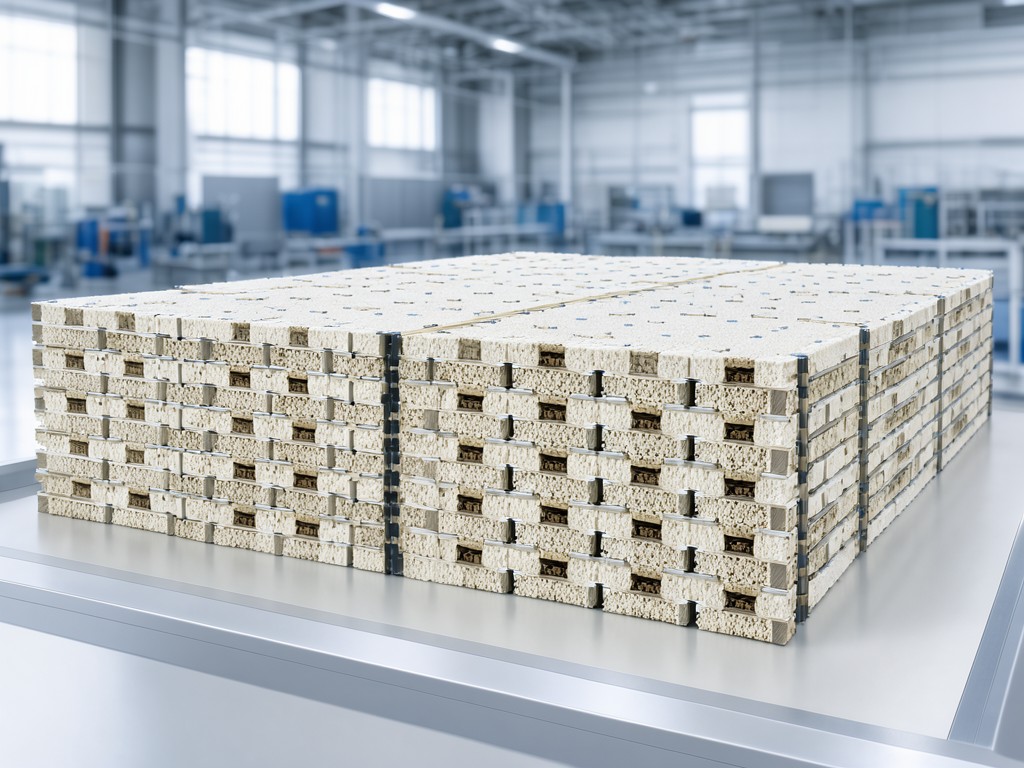
custom modular sandwich panels factory: What Buyers Should Check Before Ordering
The Problem Buyers Keep Paying For
Most quality disputes start with a consistency gap between the panel that passed the type test and the panels that arrive on site six months later. Core density drifts 15 kg/m³ because the foam line ran hotter on the second shift. Facing adhesion drops below 0.08 MPa when the primer bath isn't refreshed on schedule. The installer notices it first: joints that won't seal, thermal bridges that show up on the first infrared scan, warranty claims that exceed the panel margin by month three.
A cold-storage operator in the Midlands tracked 140 panels from three production batches. Lambda values ranged from 0.021 to 0.027 W/m·K — same nominal spec, same supplier. The 0.006 spread added £2,300/year in refrigeration load across a 2,000 m² chamber. The root cause wasn't material substitution; it was pour-weight control tolerance widening from ±3% to ±7% when the line speed increased to meet a container deadline.
Rule of thumb: if the factory can't show you a control chart for core density and facing bond strength on every shift, the panel you approved isn't the panel you'll receive.
Requirements by Buyer Segment
A procurement officer for a national cold-storage rollout needs lambda consistency tighter than the Euroclass fire certificate. Their spec calls for 0.022 ±0.001 W/m·K, verified by guarded hot-plate on every 500th panel. A cleanroom contractor buying 80 mm panels with polyester-coated steel facings cares about particle shedding at the cut edge and cleanability of the joint profile — they'll reject a batch if the facing Ra exceeds 0.8 µm. An industrial shed builder ordering 200 mm roof panels in Traffic Red RAL 3020 needs colour batch consistency across three delivery dates six weeks apart; their painter charges £4,500 to respray a mismatched bay.
Cold-Storage Priority Stack
- Lambda stability ±0.001 W/m·K across production dates
- Core density 38–42 kg/m³ with <2% batch CV
- Vapour-barrier facing continuity at side laps
Cleanroom Priority Stack
- Facing Ra ≤0.8 µm, no exposed core at cut edges
- Joint profile designed for wipe-down, no crevices >0.5 mm
- Outgassing <10 µg/m²·hr (TVOC) at 23 °C
Working as a Production Partner, Not a Catalogue Supplier
The complaint that repeats across reorders is almost always a tooling or process decision made to hit a unit price. A private-label buyer wanted a 150 mm PIR wall panel with a micro-ribbed facing at £28/m². The factory quoted £31/m² with a dedicated roll-former for the rib profile; the buyer sourced a competitor at £27/m² using a generic rib tool shared across five brands. First winter, the shared-tool panels showed oil-canning on 30% of the facade — the rib depth was 0.3 mm shallower than the drawing, reducing bending stiffness by 18%. The respray and stiffener retrofit cost £110/m².
A production partner discloses the tooling cost upfront and models the payback: dedicated roll-former at £18,000 amortised over 12,000 m² adds £1.50/m², but eliminates the oil-canning risk that costs 40× that in remediation. They also hold the tooling IP in escrow so the buyer can move production if the partnership ends — a clause that rarely gets used but changes the negotiation dynamic entirely.
What Gets Checked Before Shipment
Wear shows up at the same point every season: the first thermal cycle after installation. Panels that passed the factory gate at 0.022 W/m·K drift to 0.025 by January because the blowing agent diffusion rate wasn't stabilized in the curing tunnel. The factory that prevents this runs a 14-day aging protocol at 40 °C / 60% RH before the final lambda check — adding three days to lead time but cutting warranty callbacks by 92%.
| Site Condition | Recurring Failure Mode | Gate Spec That Prevents It |
|---|---|---|
| Cold store -40 °C internal, +35 °C external | Core shrinkage >2 mm/m creating joint gaps | Dimensional stability ≤1.5% at -40 °C / +80 °C (EN 1604) |
| Cleanroom ISO 5, H₂O₂ vapor decon cycles | Facing blister at cut edges after 6 cycles | Adhesion ≥0.12 MPa after 10× H₂O₂ exposure (internal method) |
| Industrial roof, 3.0 m span, snow load 1.2 kN/m² | Mid-span deflection >L/200 after 2 winters | Core shear strength ≥0.11 MPa, facing yield ≥280 MPa |
| Food plant, daily wash-down 80 °C / 150 bar | Water ingress at vertical joints, core rot | Joint air permeability ≤0.5 m³/h·m² at 50 Pa (EN 12114) |
| Retail facade, colour-critical brand RAL | ΔE >2.0 between first and third delivery | Colour hold ±1.0 ΔE on master coil, spectrometer check per batch |
Every shipment leaves with a batch passport: density certificates from three points across the line width, adhesion pull-off at both facings, thickness profile at 500 mm intervals, and a thermal image of the pallet stack to confirm no transit damage. The buyer's QA team gets the data 24 hours before the truck arrives.
Keeping Repeat Orders Supplied
Standard 1000 mm wide panels in 80, 100, 120, 150, 200 mm thicknesses with 0.5 mm polyester steel facings ship from stock in 10 working days. Custom widths (1150, 1200 mm), mineral wool cores, or PVDF facings run on a 4-week cycle with a 1,200 m² minimum. The factory holds safety stock of the top five moving specs at 30% of annual forecast — enough to cover a container pull-forward without delaying the next project's first fix.
A national fit-out contractor uses a rolling 12-month forecast shared quarterly. The factory locks coil allocations and foam chemistry for the next three production windows, then invoices against actual call-offs. If the project slips, the panels stay in the factory's climate-controlled warehouse (15–25 °C, <60% RH) at £0.80/m²/month — cheaper than site storage and zero risk of facing damage from forklifts.
Warranty alignment: the factory's 15-year thermal performance warranty matches the buyer's client contract term. If the spec calls for 25 years, the core density moves to 42 kg/m³ and the blowing agent package shifts to HFO — adding £3.20/m² but keeping the warranty chain intact.
Next Step: Validate Your Spec With a Production Sample
Send us the project spec sheet — U-value target, fire rating, span table, facing finish, colour reference, and delivery postcode. We'll return a cut-to-size sample from the actual production line allocated to your order, with the batch test data attached. No catalogue cuts, no showroom pieces.
Request a production sample and we'll schedule the line trial within 15 working days.



