Specifying custom modular walk in cold room panel system manufacturer for Wholesale and OEM Orders
Returns usually trace back to the same weak point: the panel joint. A 0.5 mm gap at the cam-lock lets warm, humid air infiltrate the envelope. Within weeks the foam face skins delaminate, frost bridges the thermal break, and the evaporator runs 18–22 % longer to hold set-point. That energy penalty compounds across every pallet position in a 500 m³ room.
The complaint that repeats across reorders is not foam density or skin gauge — it is dimensional repeatability. When the second truckload arrives 15 mm wider than the first, installers shim, tape, and caulk. The fix holds until the first defrost cycle. Then the tape lets go, the gap breathes, and the cycle restarts.
Where Cheaper Alternatives Fall Short
Joint Integrity Threshold
A cam-lock system rated to 1.2 kN/m² holding force maintains seal integrity through 200+ freeze-thaw cycles. Below 0.8 kN/m², joint movement exceeds 0.3 mm per cycle — enough to pump moist air into the core.
Specify the lock rating on the purchase order. If the datasheet quotes only "positive engagement" without a kN value, the joint has not been tested to a structural standard.
Budget panels substitute a 0.4 mm galvanised skin for 0.6 mm pre-painted steel. The thinner skin oil-cans under forklift impact, creating micro-creases that become corrosion highways once the paint film is breached. In a −25 °C freezer, that corrosion reaches the foam interface in 14–18 months.
Foam blow-agent retention is the silent spec. Cyclopentane-blown PIR holds λ ≤ 0.022 W/m·K for ten years only if the skin permeability stays below 0.5 g/m²·day. Cheaper skins exceed 1.2 g/m²·day. The panel ships at spec; by year three the U-value has drifted 35 %. The evaporator never catches up.
What the Design Has to Balance
Thickness vs. Footprint
100 mm panels deliver R-4.5 (IP) at 12.5 kg/m². 150 mm panels reach R-6.8 at 16.8 kg/m². The 50 mm upgrade costs 22 % more panel but saves 1.8 kWh/m²·yr in a −18 °C room — payback in 3.2 years at $0.11/kWh.
If the building slab cannot carry the extra dead load, 100 mm with a 50 mm insulated floor overlay often outperforms 150 mm walls on a bare slab.
Fire Rating vs. Insurance
FM 4880 Class 1 panels add 18 % to panel cost but reduce annual premium 12–15 % for cold storage occupancies. The break-even is typically year two.
Specify the exact FM or LPCB listing number on the PO. "Fire rated" without a listing number is not a specification — it is a marketing claim.
Serviceability drives the third trade-off. A panel system that requires a proprietary hex tool for every cam-lock adds 45 minutes per panel during a coil replacement. Standard 13 mm hex or 8 mm Allen heads let the site maintenance crew work with stock tools. That difference decides whether the room is back on line in four hours or two shifts.
Size, Weight and Specification Range
| Parameter | Standard Range | Customisation Window | Tolerance |
|---|---|---|---|
| Panel thickness | 80, 100, 120, 150, 175, 200 mm | 50–250 mm in 5 mm steps | ±1.5 mm |
| Width (effective cover) | 1,150 mm | 900–1,200 mm | ±2 mm |
| Length | 2,400–12,000 mm | 1,800–13,500 mm | ±3 mm |
| Skin gauge (pre-painted steel) | 0.5 / 0.6 / 0.7 mm | 0.4–1.0 mm | ±0.02 mm |
| Core density | 40 ± 2 kg/m³ | 38–45 kg/m³ | ±1.5 kg/m³ |
| Declared λ (aged, 10 yr) | 0.022 W/m·K | 0.020–0.024 W/m·K | ±0.001 W/m·K |
| Cam-lock holding force | 1.2 kN/m² | 0.9–1.5 kN/m² | ±0.1 kN/m² |
| Fire classification | FM 4880 Class 1 / LPCB LPS 1181 | Class 1 or Class A2-s1,d0 | Listing-specific |
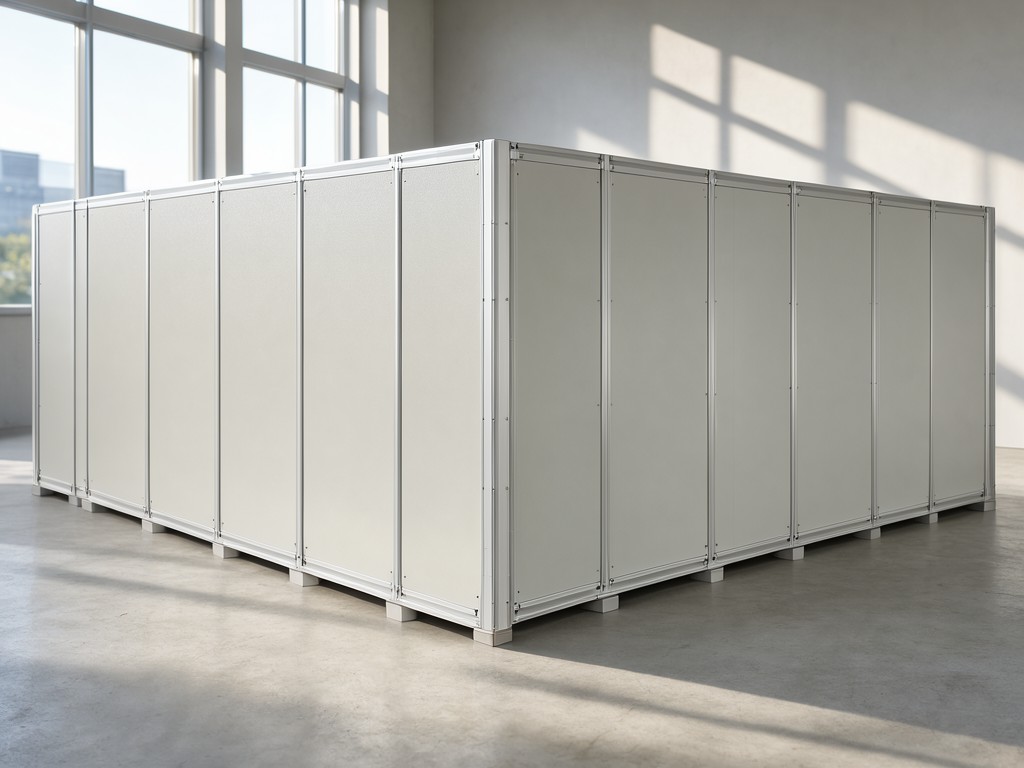
Lengths over 9,000 mm ship on extendable trailers; the 2.4 m width limit for container loading means panels over 2,400 mm wide require break-bulk or flat-rack. Confirm freight mode before locking the cut list.
Quality Control and Batch Consistency
Most quality disputes start with a consistency gap between the approval sample and the production run. The sample is hand-laid in a climate-controlled cell; production runs on a continuous line at 4 m/min. Foam rise profile, skin adhesion, and cam-lock alignment all shift with line speed.
| Check Point | Method | Acceptance | Frequency |
|---|---|---|---|
| Dimensional audit | CMM scan of 5 panels per batch | All dims within tolerance table | Every production lot |
| Skin adhesion | ASTM D1002 lap-shear, 25 mm/min | ≥ 0.45 MPa, cohesive foam failure | Every 200 panels |
| Core density | ISO 845, 50 mm cube from centre | 40 ± 2 kg/m³ | Every 100 panels |
| Thermal conductivity (aged) | Guarded hot plate, 28-day conditioned | ≤ declared λ + 0.001 W/m·K | Quarterly per formulation |
| Cam-lock torque | Digital torque wrench, 5 locks/panel | 1.2 kN/m² ± 0.1 | Every panel |
| Colour / gloss match | Spectrophotometer D65/10°, ΔE*ab | ΔE ≤ 0.8 vs. master | Every coil change |
The cam-lock torque check is 100 % — every panel, every lock. A single under-torqued cam becomes the leak path for the entire wall. We record the value per panel and ship the dataset with the packing list so the receiving QA can spot-check without unpacking.
Capacity, Tooling and Scheduling
Tooling Lead-Time Reality
A new profile (width, thickness, or cam-lock geometry) requires a dedicated roll-form die set: 6–8 weeks for tooling, 2 weeks for first-article validation. If the project schedule cannot absorb 10 weeks, select from the standard 1,150 mm width and the six stock thicknesses.
Colour matching to a RAL or custom swatch adds 3 weeks for coil procurement and paint-line trial. Standard RAL 9010, 9002, 7035, 7016 ship from stock coil.
Continuous line capacity is 1,200 m²/day per shift. Two shifts run standard; a third shift adds 35 % throughput for 18 % overtime premium. Large orders (> 5,000 m²) are split across two lines to de-risk a single-line breakdown. The split plan is agreed at PO — panel sequence numbers stay sequential so the installer sees no visual break.
Packing: panels stack flat, 22 per bundle, PET-strapped, corner-protected, wrapped in 150 µm UV-stabilised film. Each bundle weighs 1.1–1.4 t depending on thickness. A 40 ft HC takes 22 bundles (≈ 500 m²). Container loading diagrams are issued with the shipping notice so the receiver can stage by wall elevation.
Keeping Repeat Orders Supplied
A cold storage operator adds 15 % floor area every 18–24 months. The panel specification must be repeatable without re-engineering. We hold the approved BOM — coil heat number, foam formulation batch, cam-lock supplier lot — in a locked revision record. Reorders pull from that record; only a written change request with a new first-article approval can alter it.
Stocking Programme
Standard 100 mm and 150 mm panels in RAL 9010, 0.6 mm skin, FM Class 1 are held in 2,000 m² safety stock. Release window: 5 business days from PO for quantities ≤ 500 m².
Custom colours or thicknesses move to the production queue — 3–4 week lead from PO acknowledgment.
Spare Parts Kit
Every project ships with a 2 % spare panel allowance (minimum 2 panels) plus a dedicated hardware kit: cam-locks, gaskets, cap trims, and 13 mm hex drivers. The kit part number is logged to the project BOM.
Replacement panels from the original production lot are traceable for 7 years. After that, a new first-article is required to confirm dimensional and thermal parity.
Serviceability is not a feature — it is a contractual obligation. The cam-lock design allows single-panel removal without disturbing adjacent panels. The gasket is a replaceable EPDM profile, not a bonded foam strip. When the door heater fails at −25 °C, the maintenance tech swaps the panel in 20 minutes with the spare kit. That is the standard we build to.
Tooling Review and Next Steps
Every project starts with a tooling review. We walk the drawing set, confirm the joint detail against the structural calculation, lock the coil specification, and issue the first-article inspection plan. No production order is cut until the buyer signs the FAI report.
If the schedule demands stock panels, we confirm availability against the current allocation board and reserve the quantity on the PO date. No verbal holds.
Submit the project specification for a tooling review and lead-time confirmation


