Custom Perforated Rock Wool Acoustic Wall Panels Factory: Bulk Supply Specification Guide
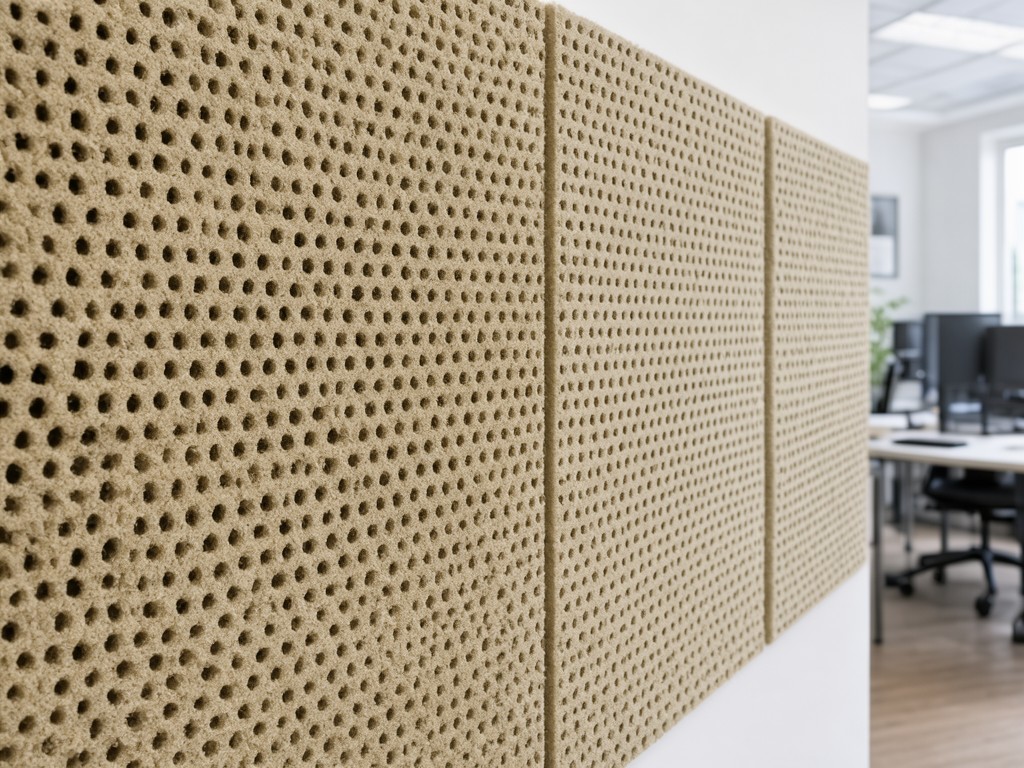
Engineering acoustic absorption requires precise control over the core density and perforation geometry to meet specific noise reduction coefficients. When sourcing perforated rock wool panels, the relationship between the mineral wool density—typically ranging from 40kg/m³ to 80kg/m³—and the perforation pattern determines the frequency-specific performance. Our factory manufacturing process focuses on maintaining dimensional stability across large-batch orders to prevent the warping or sagging often seen in large-scale architectural installations.
Technical Note: Perforation Consistency
We utilize CNC-driven punching to ensure that hole diameter and spacing remain within a ±0.5mm tolerance. This precision ensures the acoustic impedance remains uniform across the entire surface area, preventing hot spots in sound reflection.
Material Options and Performance Trade-offs
| Configuration | Technical Specification | Primary Benefit |
|---|---|---|
| High-Density Core | 80kg/m³ - 50mm thickness | Low-frequency absorption |
| Micro-Perforation | 1mm - 3mm diameter | High-frequency diffusion |
| Fabric-Faced Face | Non-woven or acoustic mesh | Dust containment & fire rating |
Large-scale projects often face issues with delamination of the face material from the rock wool substrate under fluctuating humidity. We mitigate this by using heat-activated adhesives that create a mechanical bond with the mineral fibers. This ensures that the panel maintains its structural integrity over a 20-year service life, even in commercial environments.
OEM and ODM Programme Structure
Custom Perforation Geometry
We provide custom patterns including hexagonal, slotted, or randomized distributions based on your CAD files. The ratio of open area to solid area is calculated to tune the absorption coefficient to your specific NRC requirements.
Surface Finishes
Options include vinyl-wrapped edges, decorative wood veneers, or perforated metal membranes. Each finish is tested for adhesion strength to ensure it does not peel during high-volume transport or installation.
Inspection Items and Methods
To guarantee batch-to-batch consistency, every production run undergoes a rigorous series of verification checks. This prevents the drift in acoustic performance that occurs when mineral wool density varies between shipments.
- Dimensional Tolerance: Thickness and width are measured to ensure a ±2mm variance for seamless grid fitting.
- Density Verification: Random sampling of the rock wool core to confirm the specified kg/m³ rating.
- Acoustic Testing: Impedance tube testing to verify the Noise Reduction Coefficient (NRC).
- Adhesion Shear: Pull-off testing of the face-to-substrate bond to prevent delamination.
Packing and Marking
Bulk logistics for fragile acoustic panels require protection against moisture ingress and mechanical damage to the edges. We utilize moisture-barrier-wrapped pallets secured within reinforced corrugated crates. Each crate is marked with batch lot numbers, production dates, and technical specifications to ensure full traceability from the factory to the site.
Frequently Asked Questions
What is the minimum order quantity for custom perforation patterns?
Typically, we require a minimum of 500 square meters for custom designs, depending on the complexity of the CNC tooling setup required.
Can the panels meet specific fire-safety standards?
Yes, rock wool is inherently non-combustible. We can provide fire-test data sheets for Class Class A ratings, depending on the face material selected.
What is the lead time for international wholesale orders?
Standard custom orders usually range from 4 to 6 weeks following technical sample approval and deposit confirmation, based on raw material availability.



