custom sandwich panel polyurethane wall factory - Bulk Supply and Specification Guide
How It Performs in Use
The interface between parts determines whether a panel system holds its thermal rating after five winters or starts leaking heat at every joint. Polyurethane cores deliver the lowest lambda values of any mainstream insulation — typically 0.022–0.026 W/m·K — but only when the foam stays intact and the facings remain bonded. Delamination at the metal-to-foam interface is the single most reported failure mode on site, usually traced to inadequate surface preparation or a foam formulation that shrinks post-cure.
Structural performance hinges on the composite action between skins and core. A 100 mm panel with 0.5 mm steel facings spans 3–4 m under typical wind loads; drop the skin to 0.4 mm and the allowable span drops 15–20% without changing the foam. Fire behaviour is governed by the blowing agent and any added flame retardants: pentane-blown PU chars predictably, while older HCFC formulations can produce dense smoke. Specify the reaction-to-fire class (B-s1,d0 or better for most European façades) and verify the certificate covers the exact thickness and facing combination you will order.
Specification rule: Thermal bridging at panel joints adds 0.05–0.15 W/m²·K to the assembly U-value. Tongue-and-groove profiles with factory-applied butyl sealant keep the penalty below 0.07 W/m²·K; simple butt joints with field-applied tape rarely do.
Material Options and Their Trade-offs
Balance and load analysis shows that facing material drives both cost and service life more than core density. Pre-painted galvanized steel (PPGI) remains the default for industrial walls: 25 µm polyester topcoat gives 10–15 years before first maintenance in C3 environments; 50 µm PVDF pushes that to 25+ years but adds €2.5–3.5/m². Aluminium facings save 1.8 kg/m² versus 0.5 mm steel — critical for retrofit over existing structures — yet dent under 50 J impact where steel survives 80 J.
Core density is a lever, not a spec to maximise. Standard 40 kg/m³ PU meets most thermal and structural targets; 45 kg/m³ improves screw pull-out by ~12% and reduces foam shrinkage risk, but raises material cost 8–10% and increases freight weight. For cold-store walls held at –25 °C, specify 42–45 kg/m³ with a closed-cell content ≥95% to limit long-term moisture ingress. The table below maps the buyer's service condition to the failure mode most often reported and the specification that prevents it.
| Service Condition | Typical Complaint / Failure | Preventive Specification |
|---|---|---|
| Coastal / C4–C5 corrosivity | Red rust at cut edges within 2 years; coating blister at fasteners | ZM310 metallic coating + 50 µm PVDF; factory-sealed cut edges; stainless fasteners with EPDM washers |
| Cold store –25 °C / high humidity differential | Foam shrinkage gaps at joints; ice formation in core | 42–45 kg/m³ pentane-blown PU; ≥95% closed cells; double tongue-and-groove with butyl sealant |
| High wind / seismic zone | Panel bowing; fastener pull-through; joint leakage | 0.5–0.6 mm steel; 45 kg/m³ core; structural adhesive bond line ≥3 mm; engineered fastener pattern per EN 14509 |
| Retrofit over lightweight substrate | Deflection of existing structure; panel oil-canning | 0.4 mm aluminium facings; 80–100 mm core; stiffening hat profiles at 600 mm centres |
| Fire-rated compartment wall | Failure to meet EI 30/60; excessive smoke | Mineral wool hybrid core (PU + 50 mm MW); intumescent joint tape; certified system per EN 13501-2 |
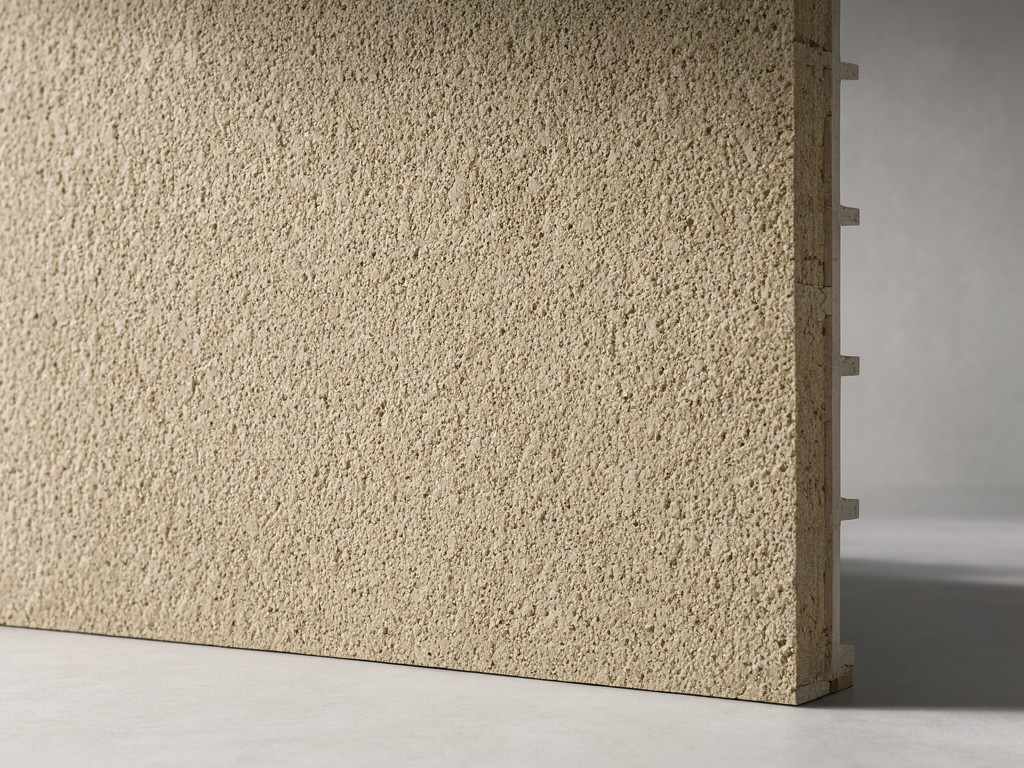
How to Choose Before Requesting a Quote
Consistency depends on locking three variables before the first coil hits the line: panel thickness (dictated by U-value target and span), facing gauge and coating (driven by environment and warranty), and joint profile (determines airtightness and installation speed). A private-label buyer typically fixes the first two and leaves the joint profile to the factory — but the profile choice changes the tooling cost by €8k–15k and the line speed by 15–25%.
Send the following with your RFQ to avoid back-and-forth revisions: target U-value and local code reference, design wind load and span table, corrosivity category (ISO 12944), fire classification required, preferred facing brand and colour RAL, and whether the order will ship in standard 11.8 m lengths or cut-to-length. If you need cut-to-length, state the tolerance (±2 mm is standard; ±1 mm adds a secondary saw station and 3% to unit cost).
Tooling amortisation and volume thresholds
A dedicated tongue-and-groove roller set costs €12k–18k. At 5,000 m² the tooling surcharge is ~€3/m²; at 20,000 m² it drops below €1/m². Most factories will absorb the tooling cost entirely above 30,000 m² annual volume if the profile matches an existing standard. Custom colours add a one-time paint setup of €1,200–2,500 per RAL plus a minimum coil run of 3–5 tonnes (≈1,500–2,500 m² at 0.5 mm). Plan colour changes to coincide with coil changes to avoid scrap.
Who Uses It and Where It Matters
Cold-storage operators specify 150–200 mm panels with 45 kg/m³ cores because every 0.01 W/m²·K reduction saves €0.80–1.20/m²/year in refrigeration load at current energy prices. Logistics developers building 12 m clear-height warehouses choose 100 mm panels with 0.5 mm PPGI facings to hit EI 30 fire rating without mineral wool, keeping wall weight under 12 kg/m² for lighter foundations. Food-processing plants need wash-down resistant surfaces: they select 0.5 mm stainless steel (1.4301) facings with 2B finish and specify silicone sealant in joints instead of butyl to withstand 80 °C steam cleaning.
Modular builders assembling pods off-site order panels cut to exact module dimensions (±1 mm) with pre-punched service penetrations. This shifts 40% of site labour to the factory but requires the panel supplier to hold a digital twin of each module for clash detection. Data centres specify FM-approved panels with 150 mm PU core and 0.6 mm steel to meet both thermal and fire insurance requirements in a single product.
Working as a Production Partner, Not a Catalogue Supplier
A catalogue supplier hands you a datasheet and asks for a PO. A production partner runs a pre-production trial on your exact coil batch, measures peel strength at 0 °C and 60 °C, and shares the force-displacement curves before full-line commitment. We allocate a dedicated line slot for your profile — typically 4–6 hours changeover — and hold the roller set in temperature-controlled storage between runs to maintain dimensional stability.
Quality hold points: first-article dimensional check (length ±2 mm, width ±1 mm, thickness ±1 mm, squareness ≤1 mm/m), peel test every 500 m (minimum 0.08 MPa per EN 14509), foam density check every 1,000 m, and coating adhesion cross-hatch per ISO 2409 every coil change. Non-conformance triggers immediate line stop; root cause and corrective action are documented in the shared quality portal within 24 hours.
Process capability note: Our continuous line holds ±1.5 mm thickness tolerance at 8 m/min. For ±1 mm tolerance we reduce to 5 m/min, adding ~7% to conversion cost. Communicate your tolerance requirement at RFQ stage so we schedule the correct line speed.
Stock Availability and Reorder Planning
Standard 100 mm / 0.5 mm PPGI / RAL 9010 panels in 11.8 m lengths are held at 3,000–5,000 m² in the European hub; lead time ex-stock is 3–5 working days. Custom colours, gauges, or lengths move to made-to-order: 10–12 working days for coil procurement + 3–5 days conversion. Blanket orders with monthly call-offs lock coil pricing for 6 months and guarantee line allocation; spot orders float at market coil price plus conversion.
Reorder point planning: allow 4 weeks for coil procurement on non-standard colours, 2 weeks for standard colours. If your project has a hard commissioning date, place the blanket order 8 weeks ahead and schedule the first call-off 4 weeks before site delivery. We stage finished goods in our warehouse at no charge for up to 14 days; beyond that, storage is €0.15/m²/week.
Packing, Marking and Freight Configuration
Panels are stacked horizontally on timber bearers at 600 mm centres, max stack height 2.4 m (≈30 panels at 100 mm). Each stack is wrapped in 150 µm UV-stabilised PE film with corner protectors at bearing points. A 13.6 m tautliner takes 22–24 stacks (≈1,100 m² at 100 mm); a 40 ft HC container takes 18 stacks (≈900 m²). Weight per stack: 1,100–1,350 kg depending on facing gauge.
Every panel carries a laser-etched label on the hidden face: project code, panel ID, thickness, facing spec, production date, and QR link to the coil certificate and peel-test record. Packing lists are EDI-compatible (EDIFACT DESADV) and include stack weights for load planning. For sea freight to humid climates, we add VCI emitter sachets (one per 50 m²) and double-wrap with aluminium-barrier film — adds €0.40/m² but prevents white rust on zinc edges during 30+ day transits.
Setup, Use and Replacement Parts
Installation tolerances: panel bow ≤L/200 (max 15 mm on 3 m span), joint gap ≤3 mm before sealant compression, fastener flush ±0.5 mm. Use self-drilling screws with 19 mm EPDM washer; torque to 4–5 Nm — over-torquing crushes the foam and creates thermal bridges. For horizontal layouts, start at the bottom and shim the first panel level; each subsequent panel locks into the previous tongue-and-groove. Vertical layouts require temporary props at 1.2 m centres until the structure is braced.
Replacement panels: provide the original project code and panel ID from the label. We retain the roller set for 5 years after last order; beyond that, a re-tool fee applies. Colour match on aged panels: expect ΔE 1.5–2.5 versus new due to UV exposure; we can accelerate weathering on a sample if exact match is critical. Touch-up paint pens (RAL-matched, 12 ml) are available for cut-edge repair — order with the main shipment to avoid separate freight.
Next Step: Tooling Review and Trial Run
Send your project specification — U-value target, wind load table, corrosivity class, fire rating, facing preference, and annual volume forecast — to /contactus. We will return a tooling layout drawing, coil procurement timeline, and a per-square-metre cost model at three volume tiers within two working days. If the profile is new, we schedule a 500 m² trial run at cost; you receive full test reports and first-article panels for site mock-up before committing to the full order.



