custom slotted rock wool sound insulation panels factory: Specification, Ordering and Quality Notes
Deflection under load governs long-term acoustic performance in high-traffic architectural environments. When sourcing custom-labeled solutions, the interface between the rock wool density and the slotted face membrane determines whether the panel maintains its structural integrity over time. If the slot frequency is not calibrated to the material tension, the edges are prone to mechanical sagging, leading to a loss in sound absorption coefficient across the installation.
Technical Constraint: Slot Geometry
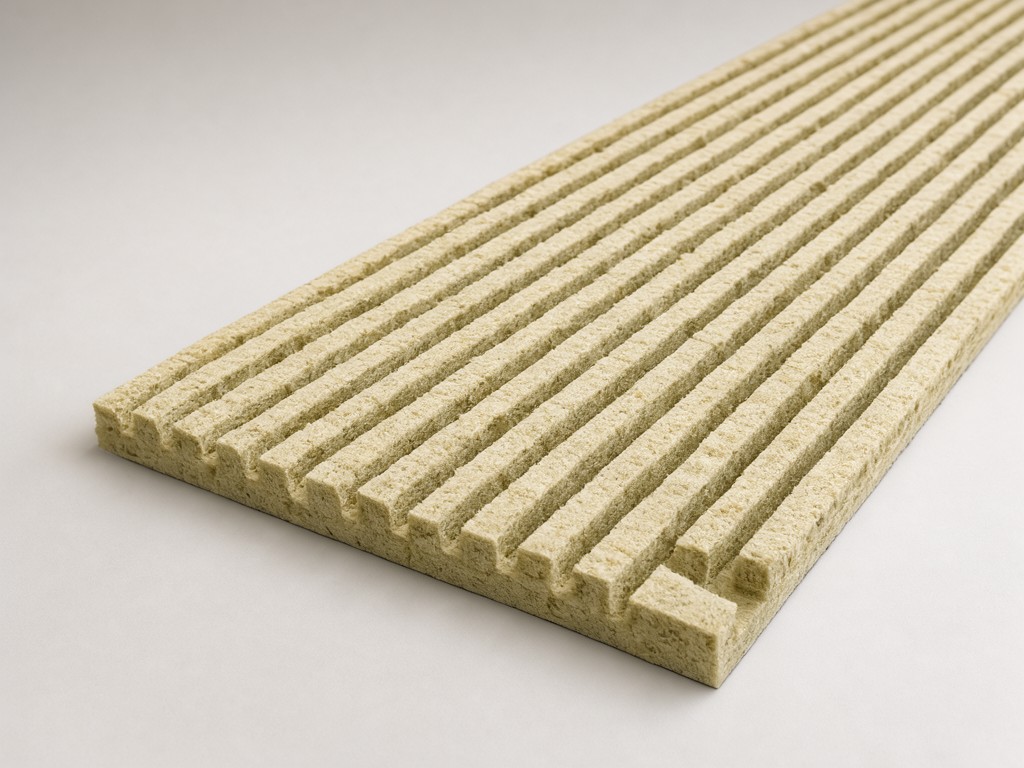
Slot width and spacing must be synchronized with the rock wool's air resistance. Narrower slots increase high-frequency absorption but can compromise the stability of the wool core, resulting in uneven fiber migration during the installation phase.
What the Design Has to Balance
Acoustic engineering requires balancing the mass of the core against the permeability of the surface. High-density rock wool provides superior transmission loss but increases the dead load on ceiling suspension systems, necessitating more robust mounting hardware. For procurement managers, the trade-off is often between the cost of high-density material and the structural reinforcement required for the building's frame.
The stability of the slotted pattern also depends on the adhesive bond between the face material and the mineral fiber. If the bond is too rigid, thermal expansion can cause the face layer to delaminate at the slot edges. We evaluate these based on shear strength tests to ensure the panel remains flat across a 20-year service life.
Construction Method and Its Effect on Consistency
Precision CNC-cutting is the standard for maintaining the dimensional tolerance of slotted panels. Traditional manual cutting methods often result in fraying at the rock wool edges, which creates dust and degrades the aesthetic profile. By utilizing automated cutting systems, we ensure that every slot is identical in geometry, which is critical for maintaining acoustic uniformity in large-scale commercial projects.
Core Density Options
Standard densities range from 40kg/m³ to 100kg/m³. Higher density cores offer better impact resistance but require specialized cutting tools during production.
Face Membrane Types
Available in non-woven fabrics, perforated metal, or vinyl. The choice directly affects the NRC (Noise Reduction Coefficient) rating.
Assumptions Buyers Should Stop Making
Many distributors assume that thicker panels always equate to better sound absorption. In reality, the slot configuration and the air gap behind the panel are more influential for specific frequency control. A thinner panel with an optimized slotted pattern can often outperform a thick, solid-surface panel in mid-range frequencies.
- Rock wool is not inherently moisture-resistant without a hydrophobic coating.
- Slot patterns are not purely aesthetic they alter the structural rigidity of the panel.
- Standard off-the-shelf sizes rarely match the structural requirements of custom architectural grids.
Segment-Specific Requirements
Different environments demand different material priorities. In healthcare facilities, fire-rated membranes with antimicrobial properties are non-negotiable. In industrial mechanical rooms, the focus shifts to vibration damping and the ability to withstand high-velocity air movement.
| Segment | Priority Metric | Material Focus |
|---|---|---|
| Office Spaces | Acoustic NRC | Lightweight fabric face |
| Industrial Labs | Impact Resistance | High-density rock wool |
| Education/Public | Fire Safety (Class-A) | Flame-retardant coatings |
Capacity, Tooling and Scheduling
Production timelines are dictated by the complexity of the slot pattern. Custom geometric layouts require specific programming for CNC machinery, which adds to the initial lead time. For bulk orders, we utilize modular production runs to minimize waste, but bespoke private-labeling requires dedicated batch processing to ensure color consistency across shipments.
Setup, Use and Replacement Parts
Installation requires specialized edge-trimming tools to prevent rock wool fibers from shedding. Because these panels are often custom, replacement parts must be matched to the original batch's density. We recommend maintaining a 5% buffer of stock on-site for visual and acoustic matching during future maintenance.
Ordering, Tooling and Lead-Time Questions
Before finalizing an order, we require technical drawings specifying the slot depth and face material tension. Lead times typically vary from 4 to 8 weeks depending on the volume and the availability of specialized mineral-wool coatings or membranes. You can discuss your project specifications to receive a detailed production schedule.
Frequently Asked Questions
Can the slots be customized for specific acoustic frequencies?
Yes, provided the slot width does not exceed the limits required to maintain the structural integrity of the rock wool core.
>What is the minimum thickness for custom slotted panels?
Typically 25mm is required to ensure the rock wool core does not collapse during the CNC cutting process.
Yes, provided the slot width does not exceed the limits required to maintain the structural integrity of the rock wool core.
Typically 25mm is required to ensure the rock wool core does not collapse during the CNC cutting process.



