Custom Standing Seam PIR Roof Sandwich Panels Factory: Technical Specification Standards
Material choice for thermal envelopes starts with the bond between the polyisocyanurate (PIR) core and the galvanized steel skins. In large-scale industrial projects, the primary failure mode is often delamination caused by thermal expansion cycles where the metal exceeds the rigid foam. Our manufacturing process utilizes continuous-pressure laminating to ensure the adhesive layer remains chemically uniform, preventing the buckling seen in spans under high solar gain.
Structural Integrity Note
The load-bearing capacity of the standing seam profile is directly tied to the skin thickness (typically 0.50mm to 0.70mm) and the specific compressive strength of the internal PIR foam.
Scope of Supply and Physical Form
The profile is engineered for mechanical water tightness without the need for penetrative fasteners. Unlike fastened systems, the interlocking lock allows the roof skin to expand and contract without compromising the primary vapor barrier. We provide various profile depths to accommodate specific wind load requirements in high-exposure zones.
- PIR core thickness ranging from 40mm to 200mm for varying R-value requirements.
- Steel skin options with PVDF, Polyester, or Plastisol-S finish coatings for corrosion resistance.
- Standing seam locking geometries: snap-lock or mechanical-fold-lock profiles.
- Custom lengths up to 12 meters to minimize site-joints and potential leakage points.
How It Performs in Use
Thermal performance is measured by the lambda conductivity of the PIR core, which typically stays between 0.022 and 0.028 W/mK. This efficiency allows for thinner panel profiles compared to mineral wool alternatives, reducing the overall dead load on the steel structure. Fire behavior is also critical; PIR foam is formulated to form a char layer that maintains structural integrity during high-temperature exposure.
| Parameter | Technical Range |
|---|---|
| Core Density | 35 - 45 kg/m³ |
| Compressive Strength | ≥ 150 kPa (10% deformation) |
| Thermal Conductivity | ≤ 0.023 W/m·K |
| Dimensional Tolerance | ± 1.5mm per length |
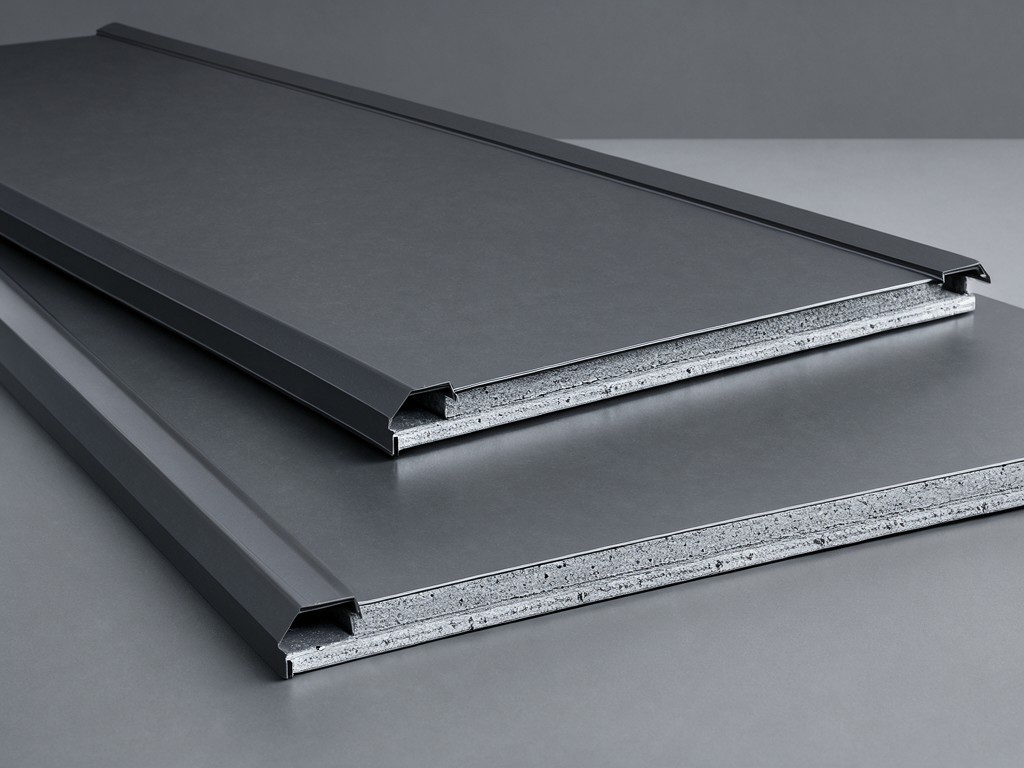
Standard Industrial Grade
Ideal for large-span logistics warehouses where cost-to-performance ratio is the priority. Focuses on standard rib geometry for maximum stiffness and rapid installation.
High-Performance Grade
Designed for cold storage or pharmaceutical facilities. Features higher-density PIR cores and specialized coatings for extreme coastal salt-spray environments.
Matching the Product to the Buyer's Need
Procurement must weigh the total cost of ownership against the initial material price. While PIR panels carry a higher upfront cost than mineral wool, the reduction in structural steel weight and faster installation cycles often results in net savings. We provide detailed technical drawings to ensure the standing seam profile aligns with your structural framing plan before production begins.
Stock Availability and Reorder Planning
Lead times are dictated by coil specification and the specific profile tooling required. Standard widths are typically maintained for rapid dispatch, while custom architectural profiles or specific PIR core thicknesses require a 4-6 week production window for manufacturing setup and quality testing.
Packing, Marking and Freight Configuration
Panels are bundled on treated timber or metal frames to prevent edge damage during transit. Each bundle is marked with batch numbers, core thickness, and coating specifications to ensure traceability during the construction phase.
Technical FAQs
Can the PIR core be moisture-resistant?
Yes, the PIR foam structure is closed-cell, but the primary resistance comes from the integrity of the steel skin and seam joints.
What is the maximum span for a 100mm panel?
Spans vary based on profile depth and local snow loads, typically ranging from 3.0m to 5.0m in industrial configurations.
Request a technical data sheet or custom quote for your project specifications.
Contact our engineering team for custom specifications


