durable aluminium foil faced insulation board panels factory in china: What Buyers Should Check Before Ordering
How It Performs in Use
| Parameter | Typical Range | Test Method | Acceptance Window |
|---|---|---|---|
| Thermal conductivity (λ) | 0.021–0.024 W/m·K | ASTM C518 / EN 12667 | ±0.001 W/m·K lot-to-lot |
| Compressive strength (10% deformation) | 120–250 kPa | ASTM D1621 / EN 826 | ≥ rated value, no single board below 90% |
| Foil peel adhesion | ≥ 1.5 N/mm | ASTM D903 (180° peel) | Zero delamination after 28-day 70°C/90% RH |
| Water vapor permeance (foil facing) | ≤ 0.01 perm (NG) | ASTM E96 Procedure A | Consistent across width, no pinholes > 0.1 mm |
| Dimensional stability (48 h, 70°C) | ≤ 1.0% linear change | ASTM D2126 / EN 1604 | Length, width, thickness all within spec |
| Surface burning characteristics | Flame spread ≤ 25, Smoke developed ≤ 450 | ASTM E84 / UL 723 | Class A / Class 1 rating maintained |
The foil facing does more than reflect radiant heat. It acts as the primary vapor barrier, the abuse-resistant skin during handling, and the surface that tapes and sealants must bond to. When the adhesive layer between foil and core is under-specified — typically a cost-driven decision — the board passes initial QC but fails after six months of thermal cycling. Buyers who qualify a second source should demand the 28-day accelerated aging peel data, not just the day-zero number.
Measured Performance in Real Use
PIR Core with Pure Aluminium Foil (7–12 µm)
Lowest λ per inch of thickness. Foil thickness at 12 µm resists puncture during installation and maintains vapor seal after incidental impact. Adhesive formulation must be polyurethane-reactive, not hot-melt, to survive 80°C surface temperatures behind metal cladding.
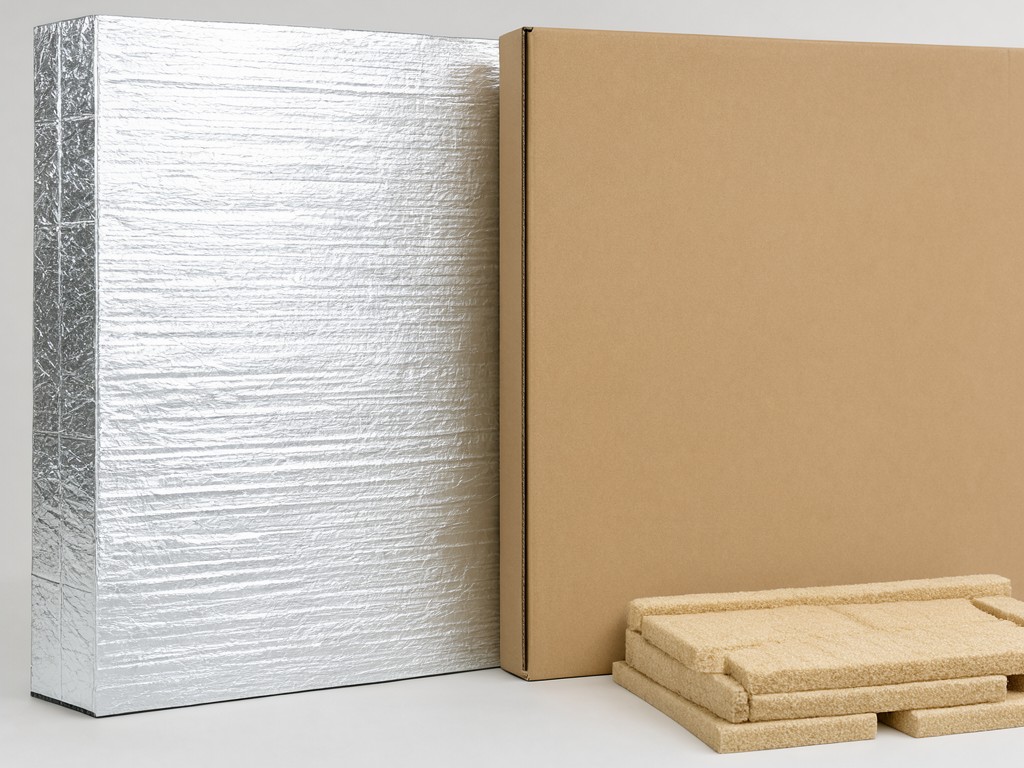
Best for: commercial roofing, cold-store envelopes, high-rise curtain wall backup insulation where long-term R-value retention is contractually guaranteed.
XPS Core with Reinforced Foil-Scrim-Kraft (FSK) Facing
Higher compressive strength (250–400 kPa) tolerates foot traffic and ballasted roof systems. The scrim layer prevents tear propagation if the foil is nicked. Trade-off: λ runs 0.029–0.033 W/m·K, so thickness increases 30–40% for equivalent R-value.
Best for: plaza decks, inverted roof assemblies, below-grade exterior foundation insulation where load-bearing and moisture tolerance outweigh thermal efficiency.
First-article tooling determines whether the foil-to-core bond survives the thermal shock of a -30°C to +80°C cycle. The lamination nip pressure, adhesive coat weight, and dwell time are locked in during trial runs. A factory that cannot produce dated, signed first-article reports for each facing/core combination has not validated the process — they have only sampled it.
Consistency is set at the forming stage. Continuous lamination lines with infrared zone control hold the adhesive cure within ±3°C. Batch lamination — still common in lower-cost shops — introduces ±8°C variation across the panel width. That spread shows up as edge delamination first, then center-line blisters after the first heating season. Ask for the lamination line specification and the last six months of in-line temperature logs.
Assumptions Buyers Should Stop Making
- "All foil-faced boards meet the same fire rating." The core chemistry dictates flame spread; the foil only delays ignition. A 25/450 rating on 50 mm PIR does not transfer to 100 mm EPS with the same facing.
- "Thicker foil means better durability." Foil above 15 µm without a reinforced scrim actually increases telegraphing of core surface irregularities, creating micro-channels for vapor ingress. The adhesive keying mechanism changes with foil gauge.
- "Factory certifications cover lot consistency." ISO 9001 certifies the management system, not the panel-to-panel variance. Request the statistical process control charts for peel strength and thickness — at least 30 consecutive lots.
- "Edge damage is a freight issue." Boards shipped loose-stacked on pallets without corner protection and stretch-hood wrapping arrive with crushed edges that become thermal bridges. Specify packaging in the purchase order: double-wall corrugated edge guards, 4-way forklift entry pallets, max stack height 1.8 m.
What Can Be Customised and What Cannot
Customisation lives in the facing and the edge profile. The core chemistry — PIR, PUR, XPS, EPS, mineral wool — is a line commitment. Switching core types requires a different foam line, different blowing agents, different aging profiles. A factory that claims "any core, any thickness" on one line is either tolling cores from multiple sources (introducing lot traceability gaps) or running a batch foam process with wider property scatter.
What can be specified per order:
- Foil alloy and temper: 1100-O (soft, best adhesion), 3003-H18 (stiffer, better handling), 8011-O (common in Asia, verify purity)
- Foil thickness: 7, 9, 12, 15 µm — each step changes roll cost ~18% and peel behavior
- Reinforcement: none, fiberglass scrim (tri-directional 3×3 mm), kraft paper lamination (FSK), polypropylene mesh
- Edge profile: square, shiplap, tongue-and-groove, rabbeted — shiplap adds 3 mm to installed width, factor into takeoffs
- Panel dimensions: standard 1200×2400 mm, 1200×3000 mm; custom lengths up to 6000 mm on continuous lines, 3000 mm on batch presses
- Printed facing: brand logos, installation guidelines, vapor barrier warnings — requires engraved rollers, 5,000 m² MOQ per design
What cannot change without re-qualification: blowing agent package (affects λ aging curve), polyol/isocyanate ratio (changes cell structure and compressive creep), adhesive chemistry family (polyurethane vs. acrylic vs. hot-melt). If a supplier offers to "adjust the formula" for price, the aged R-value and peel durability are no longer the tested values.
Keeping Repeat Orders Supplied
Supply reliability for foil-faced board comes down to three upstream dependencies: polyol allocation (especially for PIR/PUR), foil roll availability (aluminium mills run 8-week campaigns), and adhesive resin lead time (often 6–10 weeks for specialty polyurethane systems). A factory with only one qualified polyol supplier and no safety stock on foil rolls will extend lead times from 3 weeks to 10 weeks the moment any link tightens.
Ask for the bill of materials with approved alternate sources listed per line item. Verify that the alternates have run trial lots and passed the same inspection standards tabled above. Request the last 12 months of on-time shipping performance by SKU — not the factory average. A 92% OTIF average hides a 65% rate on custom-width 12 µm foil PIR that your project depends on.
Batch traceability must link: foam production date and batch number → lamination shift and operator → foil roll certificate → adhesive lot → pallet ID. When a distributor receives a claim for foil delamination on a single pallet, the factory should isolate the exact 2-hour lamination window and the corresponding foil/adhesive lots within 24 hours. If they cannot, the quality system is documentation-only.
Weather Resistance Reality Check
Foil-faced boards are not exterior cladding. UV exposure degrades the adhesive at the foil edge within 60–90 days, even with UV-stabilized formulations. The facing protects the core during the "dry-in" window — typically 30–60 days on commercial projects. Specify the maximum allowable exposure in the submittal, and require the installer to document cover-up dates. Boards stored outdoors on site before installation should be rejected if the foil shows chalking or the edges show adhesive bleed.
Request a Quotation Review
Send us your specification — core type, thickness, facing construction, edge profile, panel sizes, annual volume, and delivery schedule. We will return a marked-up spec with process capabilities, lead-time commitments, and the first-article validation plan for your sign-off.
Start the technical review →


