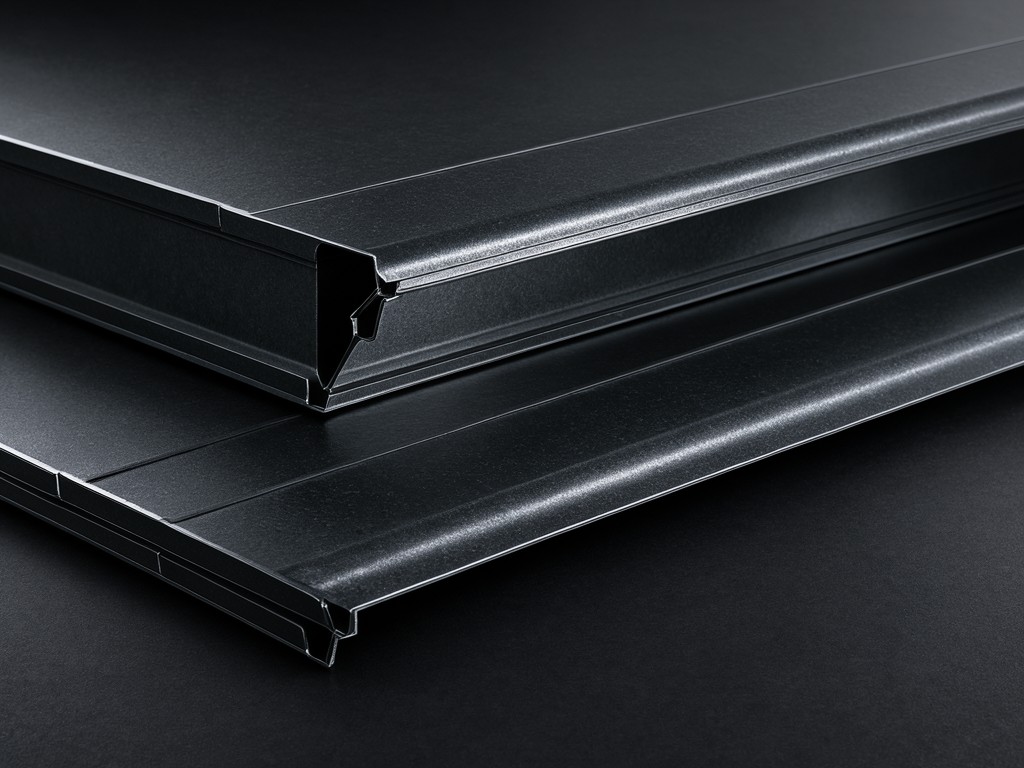
Specifying durable exterior insulated metal wall cladding panels company for Wholesale and OEM Orders
Where Cheaper Alternatives Fall Short
| Failure Mode | Typical Low-Cost Cause | Result on Site |
|---|---|---|
| Core delamination at 18-24 months | Reduced adhesive coat weight; line speed pushed past gel window | Panels bow 15-25 mm under solar load; façade grid misaligns |
| Coating chalk and fade at 3-4 years | Polyester 15 µm instead of PVDF 25 µm; no primer on backskin | Colour drift > ΔE 5 across elevation; owner demands reclad |
| Joint leakage at parapet and sill | Tolerance stack-up: ±3 mm cut length, ±2 mm fold radius | Water tracks to interior; mould claims within first heating season |
| Oil-canning visible at 600 mm centers | 0.5 mm skin on 150 mm core; no stretcher levelling | Aesthetic rejection by architect; full replacement at contractor cost |
When a brand extends an existing range into insulated cladding, the temptation is to spec the thinnest skin and the cheapest core that still meets the U-value on paper. The table above shows what actually happens when those panels hit a south-facing elevation in July. Delamination starts at the adhesive interface because the line ran 12 m/min instead of 8 m/min to hit a price point. Coating fails because the backskin primer was deleted to save $0.40/m². Joint leakage traces back to a cutting tolerance that looked acceptable on the drawing but stacks up across a 12 m run.
The fix is not a better brochure. It is a spec that locks line speed, adhesive gram weight, primer presence, and cut tolerance before the PO is cut.
Measured Performance in Real Use
During a private-label launch with a fixed ship date, the buyer needs data that survives the first warranty cycle. Laboratory U-values at 23 °C mean little when the panel sees 65 °C surface temperature and -15 °C on the interior face. What matters is the in-service thermal drift, the fastener pull-through after 500 freeze-thaw cycles, and the colour hold after 2,000 MJ/m² UV exposure.
PIR Core — 40 kg/m³ Density
Lambda 0.022 W/m·K declared. In-service drift to 0.024 after 10 years per EN 13165 aging protocol. Keeps wall U-value ≤ 0.18 W/m²·K at 100 mm thickness.
Fire: Euroclass B-s1,d0 at 100 mm. Chars but does not propagate flame vertically. Required for Type A construction above 18 m.
Mineral Wool Core — 110 kg/m³ Density
Lambda 0.036 W/m·K. Zero thermal drift — inorganic. U-value 0.25 W/m²·K at 150 mm. Heavier: 16.5 kg/m² vs 11.2 kg/m² for PIR.
Fire: Euroclass A2-s1,d0. Non-combustible core. Mandatory for residential towers > 18 m in UK and EU jurisdictions.
Skin options drive the next tier of performance. 0.6 mm G550 AZ150 steel with 25 µm PVDF topcoat and 7 µm backer primer delivers 25-year colour warranty in C3-C4 corrosion zones. 0.7 mm aluminum 3105 H44 with 30 µm PVDF cuts weight 30% but reduces span by 200 mm at same wind load. Choose steel for industrial and retail boxes; aluminum for reclad projects where dead load is capped.
Fastener pull-through on 0.6 mm steel with 19 mm washer: 1.8 kN characteristic. On 0.7 mm aluminum: 1.2 kN. Design to 0.6 kN service load with 3.0 safety factor. That gives 600 mm centers on steel, 450 mm on aluminum for typical 1.2 kPa suction.
Buying Mistakes That Lead to Returns
Moving from sample orders to container loads changes the risk profile. A 3 m sample panel ships flat, protected, and inspected. A 40 ft container holds 180 panels stacked 12 high. The bottom panel sees 1,200 kg compressive load for six weeks at sea. If the core compressive strength is 80 kPa instead of 120 kPa, the bottom row crushes 3-4 mm. That panel will never sit flat on the sub-girt.
- Specifying U-value only at center-of-panel. Thermal bridging at joints adds 0.02-0.04 W/m²·K. Whole-wall calculation must include girt penetration and joint tape.
- Ordering standard 1150 mm width for a 7.2 m bay. Leaves 200 mm infill strips every run. Custom 1200 mm width eliminates waste and cuts install hours 18%.
- Accepting "equivalent" coating without naming the pigment system. Chromatic yellows and reds fade 3× faster than mica-based metallics. Lock the RAL code and the pigment chemistry in the spec.
- Skipping the factory witness hold point for adhesive cure. Infrared scan at line exit confirms 120 °C core temp for 45 seconds. No scan, no ship.
The most expensive mistake is approving a first-article panel that passes dimensional check but fails the 28-day aging test. We run accelerated aging (70 °C / 95% RH / 28 days) on every new SKU before release. Panels that delaminate in that chamber never reach your dock.
Quality Control and Batch Consistency
| Check Point | Method | Acceptance | Frequency |
|---|---|---|---|
| Skin thickness | Micrometer at 4 corners + center | ±0.02 mm of nominal | Every coil change |
| Coating DFT | Eddy current gauge, 5 readings/panel | Topcoat 25±3 µm, Primer 7±2 µm | Every 50th panel |
| Adhesion peel | 180° peel at 50 mm/min, 25 mm width | ≥ 4.5 N/mm, cohesive failure in foam | Every batch (max 500 m²) |
| Dimensional | Laser track: length, width, squareness, thickness | L ±2 mm, W ±1 mm, squareness ≤1 mm/m | Every panel |
| Core density | 100×100×50 mm coupon, gravimetric | PIR 40±2 kg/m³, MW 110±5 kg/m³ | Every foam pour / bale |
| Thermal lambda | Heat flow meter per EN 12667 | Within 3% of declared | Quarterly per formulation |
Batch traceability links every panel to the coil heat number, the foam pour record, and the line operator shift. QR code on the protective film returns the full birth certificate when scanned on site. That traceability is what lets a contractor isolate a single suspect batch instead of recladding an entire elevation.
We hold 1 m² retention samples from every production run for 24 months. If a field complaint arrives, we pull the retention, run the peel test, and have root cause in 48 hours.
Questions Buyers Ask Before Ordering
What is the realistic lead time for a custom width and colour?
Standard widths (1150, 1200 mm) in stock RAL colours: 10 working days ex-works. Custom width requires new slitter knives — add 5 days. Custom colour requires coil coating run minimum 5,000 m² — add 15 days plus MOQ. If your launch date is fixed, lock the colour and width at sample approval, not at PO.
Can you ship panels pre-cut to our floor-to-floor heights?
Yes. Provide the cutting schedule (length per panel, quantity per length) with the PO. We nest the cut list to minimize offcut waste. Tolerance ±2 mm. Label each bundle with level and grid line. Adds 2 days to lead time. Eliminates site cutting and the dust/fire risk that comes with it.
How do you handle the protective film — and how long can it stay on?
Co-extruded 50 µm PE film, UV-stabilized for 12 months outdoor exposure. Printed with panel ID, spec, and handling arrows. Must be removed within 30 days of installation. Beyond 30 days, adhesive transfer risk rises sharply above 35 °C surface temp. We supply film removal tools with every container.
What is the minimum order quantity for a private-label run?
2,000 m² for standard core/skin combinations. 5,000 m² if the run requires a dedicated foam formulation or a non-stock coil colour. Below MOQ, we can allocate from scheduled stock runs with your label — lead time 3 weeks, no tooling charge.
Do you provide the installation accessories — flashings, fixings, sealants?
We supply the panel. Flashings are roll-formed to your profile drawings — 5 day lead, same coil as panel for colour match. Fixings: we specify the fastener (carbon steel Class 3 or bi-metal) and supply at cost. Sealant: we qualify two neutral-cure silicones (Dow 791, Sika Weatherproof N) and include the technical data sheet. Single-source warranty only applies when our specified accessories are used.
Ready to Lock the Spec?
Send the elevation drawings, the U-value target, and the fire classification requirement. We return a marked-up specification sheet with core, skin, coating, and accessory callouts — plus a container loading plan that hits your ship date.
Start the project discussion


