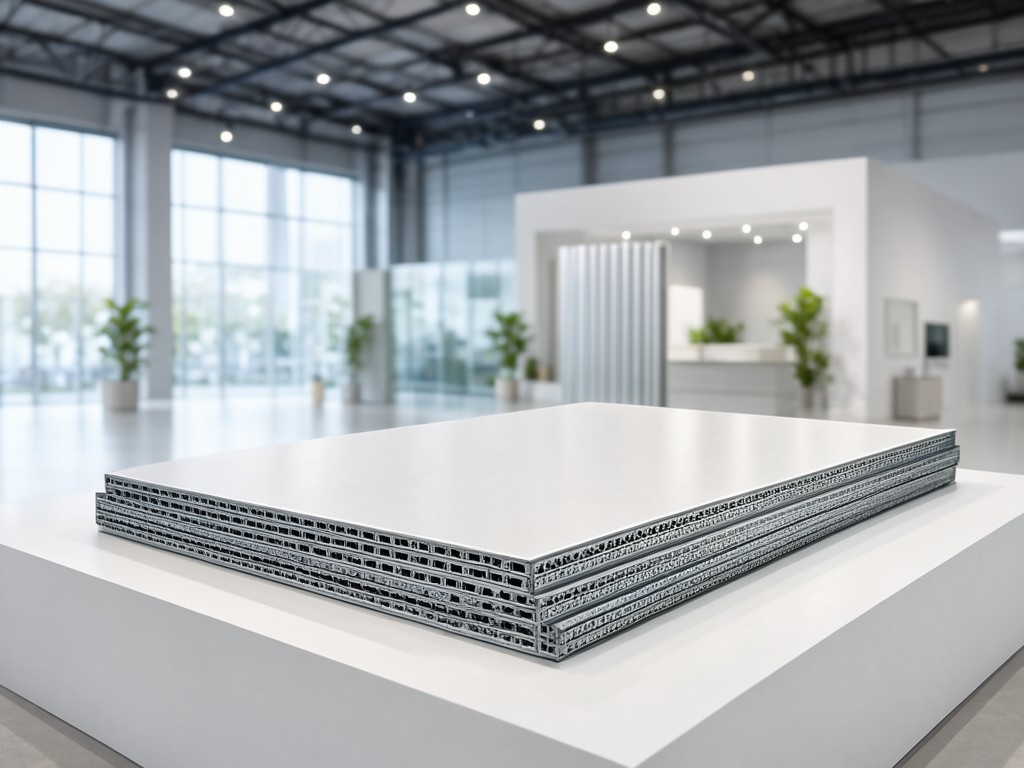
Durable Outdoor Insulated Wall Panels Factory: What Buyers Should Check Before Ordering
During a private-label launch with a fixed ship date, the first container of panels arrived with a consistent 0.8 mm oil-canning wave across every 1,000 mm module. The specifier had approved the 0.5 mm pre-painted steel skin on a PIR core, but the roll-former's tension settings had drifted between shifts. That single deviation turned a 2,500 m² warehouse facade into a punch-list nightmare — re-rolling, re-coating, and a three-week delay the client could not absorb.
The lesson repeats across projects: outdoor insulated wall panels are judged on thermal stability, joint integrity, and surface durability under UV, wind-driven rain, and thermal cycling. A factory that controls skin thickness tolerance, core density uniformity, and lamination cure cycles delivers panels that hold their R-value and flatness for 20+ years. One that treats those parameters as loose ranges ships liability.
Material Options and Their Trade-offs
Skin material drives both first cost and the maintenance budget ten years out. The decision tree below maps the typical selection path for export-grade projects.
- Define the exposure zone — coastal (chloride > 300 mg/m²/day), industrial (SO₂ > 50 µg/m³), or inland — because it sets the minimum coating system.
- Coastal → PVDF 25 µm minimum over 275 g/m² zinc-aluminum (AZ150) or HDG Z275.
- Industrial → SMP 25 µm over Z275 with a corrosion-inhibitive primer.
- Inland → Polyester 20 µm over Z200 acceptable for non-critical façades.
- Choose core type based on fire strategy and thermal target.
- PIR (polyisocyanurate) — λ 0.022–0.024 W/m·K, B-s1,d0 achievable at 40–60 kg/m³; best R-value per mm.
- Mineral wool — λ 0.035–0.040 W/m·K, A1 non-combustible; 100–150 kg/m³ for structural spans.
- EPS (expanded polystyrene) — λ 0.032–0.038 W/m·K, E-class; lowest cost but melts at 100 °C.
- Lock skin thickness to span and wind load — 0.5 mm steel spans 3.0 m at 1.2 kPa; 0.7 mm reaches 4.5 m. Aluminum 0.7 mm matches 0.5 mm steel stiffness but doubles material cost.
- Specify joint sealant compatibility — butyl tape for PIR, intumescent strip for mineral wool, polyethylene foam for EPS. Mismatched sealant causes delamination within 18 months.
Specification callout: every 0.05 mm reduction in steel skin thickness saves ~$1.20/m² but cuts dent resistance by 30% and increases oil-canning risk exponentially. For panels > 6 m long, 0.6 mm is the practical floor.
Construction Method and Its Effect on Consistency
Continuous lamination lines — where steel coil, foam injection, and top skin move through a 40 m heated press at 0.8–1.2 m/min — produce the most uniform bond line. Discontinuous (batch) presses cure 12 m panels individually; they allow faster changeover for custom lengths but introduce ±1.5 kg/m³ core density variation between batches. That variation translates to ±0.002 W/m·K thermal drift and visible panel-to-panel flatness differences on a long elevation.
Roll-forming the skin profile before lamination (pre-profiling) yields sharper ribs and consistent joint geometry. Post-lamination profiling distorts the foam cell structure at the ribs, creating thermal bridges that show up as cold spots on infrared surveys. A factory running both methods should quote pre-profiled as standard for façades; batch-press/post-profile only for non-visible soffits or partition walls.
Specification Range and Customisation Limits
| Parameter | Standard Range | Custom Window | Lead-time Adder |
|---|---|---|---|
| Overall thickness | 50–200 mm (PIR), 60–250 mm (MW) | 30–300 mm in 10 mm steps | +5 days |
| Module width | 1,000 / 1,150 / 1,200 mm | 900–1,250 mm | +3 days (roll change) |
| Length | 2.0–13.5 m (container limited) | Up to 16 m (break-bulk) | +7 days + freight surcharge |
| External skin | 0.5 / 0.6 / 0.7 mm steel; 0.7 / 0.9 mm Al | 0.4–1.0 mm steel; 0.6–1.2 mm Al | +10 days (coil procurement) |
| Internal skin | 0.4–0.5 mm steel, liner profile | 0.35–0.7 mm, flat or micro-rib | +3 days |
Colour and finish options sit in a separate matrix because they interact with coating warranty tiers.
| Finish System | Gloss Range | Warranty (Film Integrity / Fade ΔE) | Typical MOQ |
|---|---|---|---|
| PVDF 70/30 (25 µm) | 20–35 GU | 25 yr / 5 ΔE | 1,000 m² per colour |
| SMP (25 µm) | 30–80 GU | 15 yr / 8 ΔE | 500 m² per colour |
| Polyester (20 µm) | 40–90 GU | 10 yr / 12 ΔE | 300 m² per colour |
| Textured / Granular | 5–15 GU | Matches base system | +15% MOQ |
Who Uses It and Where It Matters
Cold-storage operators specify 150–200 mm PIR panels with vapor-sealed joints because a 0.5 °C drift in a -25 °C freezer adds 8–12% to compressor runtime. They audit factories for core density certificates and joint air-leakage test reports (ASTM E283) before approving a supplier.
Logistics developers building 12 m clear-height warehouses need 1,200 mm module PIR panels spanning 6 m between columns. The critical parameter is deflection under 1.5 kPa suction — L/180 max — which demands 0.7 mm external skin and 45 kg/m³ core minimum. They reject panels with > 2 mm bow over 6 m.
Modular housing fabricators run mineral wool cores for fire separation walls (EI 60–120). They require panel-to-panel intumescent seals pre-installed in the factory groove; site-applied sealant adds 4 hours per joint and fails inspection 30% of the time.
Segment-Specific Requirements
Cold Chain / Food Processing
- USDA/FDA wash-down cycles: 80 °C water, 200 bar, daily — skin must resist chalking and coating lift.
- Vapor drive: interior -30 °C to exterior +35 °C → 65 °C ΔT; joint perm rating < 0.1 ng/Pa·s·m².
- Ammonia refrigeration leak detection: panels must not absorb refrigerant; closed-cell PIR only.
Industrial / Chemical Plant
- Chemical splash resistance: PVDF topcoat tested to ASTM D1308 reagent list.
- Explosion venting: panels rated for 0.5–1.0 bar burst pressure with frangible joint clips.
- Cyclic thermal shock: 200 cycles -40 °C to +80 °C without delamination (FM 4880 protocol).
What Gets Checked Before Shipment
A shipment release package from a disciplined line includes:
- Dimensional report: length ±2 mm, width ±1 mm, thickness ±1 mm, squareness ≤ 1 mm/m — measured on 100% of panels > 6 m, 10% statistical sample below.
- Adhesion peel test: 50 mm strip, 90° pull, ≥ 0.45 N/mm (PIR) or ≥ 0.35 N/mm (MW) — one test per 500 m² per shift.
- Thermal conductivity spot check: guarded hot plate on 300 × 300 mm core sample, λ within ±3% of declared value.
- Colour verification: spectrophotometer ΔE ≤ 1.0 vs. approved master on L*a*b* scale — recorded per coil batch.
- Container loading plan: panels stacked flat on timber bearers at 600 mm centers, corner protectors, desiccant bags (2 kg per 40' HC), and vapor-barrier wrap. No vertical stacking — it bows the bottom panels permanently.
Questions Buyers Ask Before Ordering
What is the realistic container load factor for 1,200 mm wide, 150 mm thick panels?
A 40' high-cube takes 540 m² laid flat (two stacks of 13 panels, 13.5 m max length). Break-bulk flat-rack loads 720 m² but adds 35% freight cost. Always confirm the factory's pack height — some lines stack three-high to hit 810 m² but risk bottom-panel compression marks.
Can you supply fire-test certificates for the exact panel assembly, not just the core?
Many factories show a core-only EN 13501-1 report. The full assembly — skins, adhesive, joint — must be tested per EN 14509 or FM 4880. Ask for the test report number, lab name, and whether the joint detail matches your project's flashing design.
How do you handle colour matching across multiple production runs spaced months apart?
Reputable mills retain a physical master coil and run a pilot strip before each campaign. Spectrophotometer data is archived; ΔE ≤ 0.5 run-to-run is achievable on PVDF. If the factory cannot produce the master coil reference, expect visible batch banding on a long façade.
What is the minimum order quantity for a custom RAL colour in PVDF?
Typically 1,000 m² (one coil slit). Below that, the coater charges a $1,200–$1,800 setup fee plus 15% surcharge. Some factories hold stock coils in RAL 9010, 7016, 9006, 3009 — those ship with no MOQ penalty.
Do you pre-install flashings, corners, and base tracks?
Pre-fabricated flashing kits (press-braked to panel profile) cut site labor 40% but require the factory to have a dedicated brake press and CAD nesting. Verify the factory's flashing tolerance: ±0.5 mm on bend angle, ±1 mm on leg length. Loose flashings leak.
Final check: Request the factory's in-process control plan — frequency of peel tests, density checks, dimensional audits, and coating thickness mapping. A one-page document tells you more than any brochure.
Request a Quotation Review
Send your panel schedule, project location, and fire/thermal specs. We return a marked-up specification with line-item pricing, lead-time by configuration, and the exact container load plan — no generic catalogues.
Submit project details for technical quotation


