durable pir insulated roof panels china supplier: Specification, Ordering and Quality Notes
Tooling amortisation decides the long-term viability of large-scale construction projects. While the initial cost per square meter often draws the focus of procurement, the structural integrity of the polyisocyanurate core and the bond to the steel skins determine the failure rate in the field. High-density PIR cores provide thermal resistance that standard EPS foam cannot match, preventing thermal degradation under prolonged UV exposure.
The Problem Buyers Keep Paying For
| Parameter | Standard Grade | High-Performance |
|---|---|---|
| PIR Core Density | 38-42 kg/m³ | 45-50 kg/m³ |
| Steel Skin Thickness | 0.4mm - 0.5mm | 0.6mm - 0.8mm |
| Thermal Conductivity (K-value) | 0.023 W/m·K | 0.021 W/m·K |
| Load Bearing Capacity | 1.5 kN/m | 2.5 kN/m |
Cheaper stock options fail at the worst point in the season when temperature fluctuations cause internal stress. Low-density PIR cores often lack the structural rigidity to resist the deformation of the metal skins, which results in water ingress at the jointed edges. Procurement officers often find that the cost of replacing warped sections exceeds the initial savings of lower-grade material.
Comparing Two Standard Configurations
Profile: Trapezoidal
Designed for long-span industrial roofing where structural weight is a priority. The trapezoidal profile increases the moment of inertia of the panel, allowing for thinner steel gauges without sacrificing load capacity.
- Fast-track installation
- High span-to ratio
- Ideal for warehouse structures
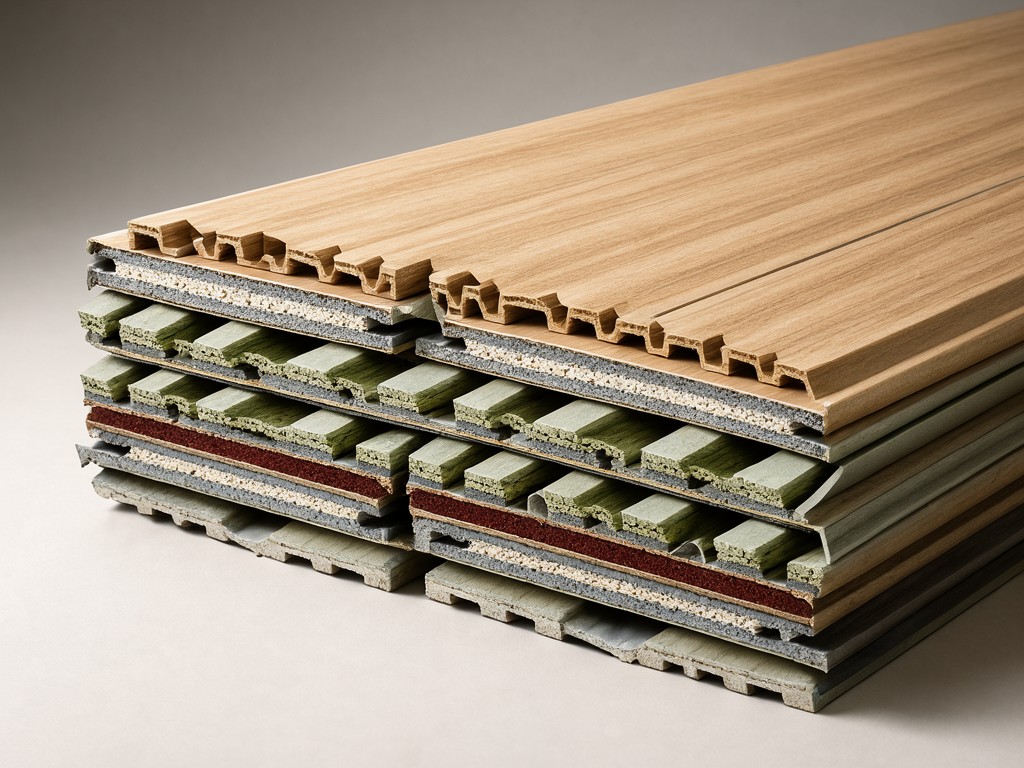
Profile: Flat Top/Ribbed
Utilized in commercial buildings where aesthetic finish and internal insulation are critical. These panels offer a flatter surface for internal ceiling mounting and easier integration with HVAC duct systems.
- Clean internal surface finish
- Easier mechanical ducting
- Suitable for retail and offices
Assumptions Buyers Should Stop Making
Replacement rate, not unit price, is the metric that defines project profit margins. Many buyers assume that all PIR panels are identical if they share the same R-value rating. In reality, the chemical stability of the foam blowing agent varies between suppliers; if the gas migration rate is not properly balanced, the core loses its thermal efficiency over five years.
Another common misconception is that the coating thickness is purely for color. In coastal or industrial environments, the micron level of the PVDF coating is the only barrier against corrosion. Using substandard coatings leads to premature oxidation, which eventually reaches the PIR substrate.
OEM and ODM Programme Structure
Our manufacturing process allows for the customization of core density and skin tension to meet specific regional climatic requirements. For private-label distributors, we provide batch-specific traceability, ensuring that color consistency is maintained across different production runs.
- Custom profile extrusion for unique architectural designs
- Specific mineral wool inserts for fire-rated wall systems
- Variable skin thickness to optimize localized thermal-bridge calculations
Quality Control and Batch Consistency
Batch consistency is maintained through real-time monitoring of the foam injection reaction temperature. If the temperature fluctuates by more than 2 degrees, the cell structure of the PIR changes, leading to inconsistent tensile strength. We utilize ultrasonic testing on every batch to ensure the core density is uniform across the entire width of the panel.
- Pull-off tests to verify skin-to-foam bond strength
- Dimensional stability checks to prevent joint-fit issues
- Salt spray testing on galvanized steel layers
Volume Planning and Lead Time
Capacity is dictated by the throughput of the continuous production line. Large orders exceeding 5,000 square meters require dedicated production slots to ensure that the material batch remains consistent throughout the entire project. Planning orders six weeks in advance allows for the amortization of the tooling costs associated with custom profile extrusionsions.
Setup, Use and Replacement Parts
The installation of PIR panels depends heavily on the precision of the overlap joints. Using the wrong fasteners can create thermal bridges that negate the benefits of the insulated insulated core. For replacement parts, we provide matching profile-specific flashing and gaskets to maintain the integrity of the thermal envelope during localized repairs.
Ordering, Tooling and Lead-Time Questions
What is the minimum order for custom profile tooling?
Typically, a minimum of one full container load is required to offset the cost of the specialized rolling dies and production line setup.
How does panel thickness affect lead time?
Thicker panels (above 100mm) require slower cooling cycles to prevent warping, which can add 3-5 days to the standard production timeline.
Ready to review technical specifications and branding requirements?
Contact our Engineering Team for Artwork and Branding Review


