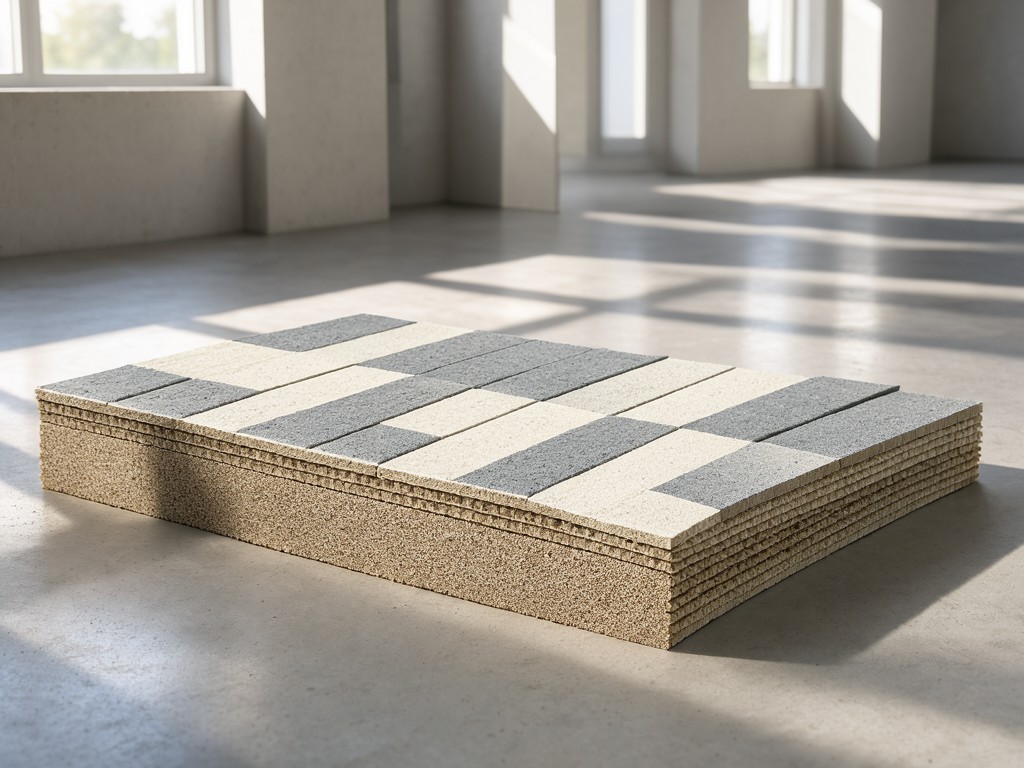
factory direct engineering building roof insulation board solution: What Buyers Should Check Before Ordering
Unit price and service life diverge the moment a board leaves the press. Two suppliers quoting the same lambda value and compressive strength can deliver panels that behave differently after six months on a warm deck — one holds its R-value and flatness, the other shrinks at the joints and forces a re-roof before the warranty expires. The difference is not in the data sheet; it is in the foam cell structure, the facing adhesion, and the ageing protocol the factory actually runs.
Buyers qualifying a second source for PIR or PUR roof insulation boards need to ask for the ageing curve, not just the declared lambda. A 0.022 W/m·K claim at day 28 means little if the 10-year aged value drifts to 0.028. That drift adds up fast across 10,000 m² of warm roof — higher U-value, thicker board to compensate, more dead load, more freight cost. The factory that publishes its own ageing data, tied to batch records, is the one that survives a second-source audit.
Where Cheaper Alternatives Fall Short
Low-cost boards often cut corners on three fronts that do not show up in a first-article inspection. First, the blowing agent package: cheaper pentane blends or incomplete CO₂ conversion leave larger cells and thinner walls, accelerating gas diffusion and lambda drift. Second, the facing bond — aluminum foil or glass tissue applied with insufficient adhesive weight or inadequate cure time — delaminates under thermal cycling, especially at roof perimeters where temperature swings are sharpest. Third, dimensional tolerances: boards sold as 1200 × 600 mm that actually run +3/−2 mm create gaps at every joint, and those gaps become thermal bridges the specifier never modelled.
A procurement team that switches on price alone typically sees the first complaint at month 18: condensation staining at board joints on a cold-store roof, or wind uplift failure on a mechanically fixed system because the board edges crumbled during installation. The rework cost — strip, dispose, reinstall — runs 4–6× the board price difference they thought they saved.
Design Constraints Behind the Specification
Specification rule: declare the aged lambda at 10 years per EN 13165 Annex C, not the initial value. If the datasheet only shows λD at 28 days, ask for the ageing coefficient and the test report number. A factory that cannot produce the report is not controlling the blowing agent retention.
The board specification is a compromise between thermal performance, compressive strength, and fire behaviour — each driven by the foam formulation and the facing choice. Higher compressive grades (≥ 150 kPa) use denser foam or reinforced facers, which raises lambda slightly but prevents deflection under foot traffic or ballast. Fire-rated facers (Euroclass B-s1,d0 or better) add intumescent layers that increase thickness by 2–3 mm per side; the buyer must confirm the finished board still fits the purlin spacing and flashing details.
Moisture resistance is not a single number. Short-term water absorption (EN 12087) matters for site exposure; long-term diffusion resistance (μ-value) matters for the roof's service life. A glass-tissue facer gives better μ than uncoated aluminum, but aluminum reflects radiant heat better on a warm deck. The decision tree below maps the typical selection logic.
- Roof build-up type
- Warm deck (insulation above structure) → prioritize aged lambda, dimensional stability, facer reflectivity
- Inverted roof (insulation above membrane) → prioritize compressive strength ≥ 200 kPa, water absorption < 0.7 % vol, XPS preferred over PIR
- Hybrid / tapered schemes → confirm board availability in 5 mm increments across the taper range
- Fixing method
- Mechanical fasteners → board must pass pull-through test ≥ 1.2 kN per fastener (ETAG 031)
- Adhesive bond → facer must be compatible with PU adhesive; foil facers often need priming
- Ballasted → compressive strength drives board grade; check point-load resistance at 25 mm deformation
- Fire requirement
- Unrestricted (typical commercial) → Euroclass E or F acceptable with mineral wool barrier strips
- Restricted (escape routes, high-rise) → Euroclass B-s1,d0 minimum; verify facer intumescent thickness does not exceed joint tolerance
- Service environment
- Standard occupancy → standard PIR, λaged ≤ 0.027 W/m·K
- Cold store / freezer → λaged ≤ 0.024 W/m·K, closed-cell content > 95 %, facing vapour barrier mandatory
- Coastal / chemical exposure → coated aluminum facer or stainless-steel fastener specification
Quality Control and Batch Consistency
Lot-to-lot consistency is what separates a reliable second source from a headache. The critical control points are foam density (± 2 kg/m³), lambda ageing coefficient (within ± 0.001 W/m·K of declared), board thickness (± 1 mm), and squareness (≤ 2 mm per metre). A factory that runs statistical process control on the continuous laminator — recording density every 50 boards, lambda every 500 boards, dimensional checks every shift — can produce a capability report (Cpk ≥ 1.33) for each parameter. Ask to see the last 12 months of Cpk trends.
Facing adhesion is the silent killer. Peel strength (EN 1607) should be tested on every jumbo roll before slitting, not just on the first board of the day. A drop from 80 kPa to 40 kPa peel strength means the adhesive coat weight drifted or the cure oven temperature slipped. That drift shows up as facer delamination at roof corners after the first winter. The factory that logs adhesive coat weight, oven profile, and peel test per roll — and ties it to the board batch number — is the one you can audit remotely.
Colour consistency on coated aluminum facers matters for visible roof edges and parapet flashings. ΔE ≤ 1.5 between batches is achievable with inline spectrophotometry; ΔE > 3.0 is visible from ground level and triggers aesthetic complaints. If the project specifies a RAL colour, the factory must hold a master panel and run a colour check at start-up and every colour change.
Inspection Items and Test Methods
| Property | Test Standard | Acceptance Criteria (Typical) | Frequency |
|---|---|---|---|
| Aged thermal conductivity (λaged) | EN 13165 Annex C / EN 12667 | ≤ declared value + 0.001 W/m·K | Every 500 boards / per batch |
| Compressive strength (10 % deformation) | EN 826 | ≥ declared grade (e.g., 150 kPa) | Every 200 boards / per batch |
| Dimensional stability (70 °C, 90 % RH, 48 h) | EN 1604 | Length/width ≤ 1 %, thickness ≤ 5 % | Per formulation change |
| Facer peel strength | EN 1607 | ≥ 60 kPa (foil), ≥ 40 kPa (glass tissue) | Every jumbo roll |
| Water absorption (short term) | EN 12087 | ≤ 1.0 % vol (PIR), ≤ 0.7 % vol (XPS) | Per batch |
| Reaction to fire | EN 13501-1 | Per project spec (Euroclass) | Per product line / facer type |
| Board thickness | EN 823 | ± 1 mm (≤ 100 mm), ± 2 mm (> 100 mm) | Every shift / inline gauge |
| Squareness | EN 824 | ≤ 2 mm/m | Every shift / inline gauge |
| Facer colour (coated aluminum) | ISO 7724 / ASTM D2244 | ΔE ≤ 1.5 vs master panel | Start-up + every colour change |
Setup, Use and Replacement Parts
Boards arrive on timber bearers, shrink-wrapped in packs of 8–12 depending on thickness. Store flat, dry, and off ground — UV exposure degrades unprotected facers in 4–6 weeks. Cut with a fine-tooth handsaw or hot-wire cutter; power saws generate static-charged dust that coats the facer and reduces adhesive bond. For tapered schemes, number the boards on the facer before cutting to maintain the fall sequence.
Mechanical fixing: use telescopic tube fasteners with polyamide sleeves to eliminate thermal bridging. Fastener density per wind-load calculation (EN 1991-1-4), minimum 2 per board for 1200 × 600 mm. Adhesive bonding: apply PU adhesive in continuous beads 150 mm centres; board must be weighted for 15 minutes at 15–25 °C ambient. Do not install below 5 °C substrate temperature — adhesive cure fails and boards lift.
Replacement parts are not stocked as discrete SKUs. A damaged board is replaced by cutting a new board from the same batch (hence the importance of batch traceability). Keep one full pack per 5,000 m² on site for the first 12 months. After that, the aged lambda of replacement boards will not match the in-situ boards — the U-value calculation must account for the mismatch if a large area is replaced.
Questions Buyers Ask Before Ordering
What is the minimum order quantity for a custom thickness or facer?
Standard thicknesses (20–200 mm in 10 mm steps) run from 500 m². Custom thicknesses or non-standard facers (e.g., stainless-steel foil, coloured aluminum) require a jumbo roll commitment — typically 3,000 m² — because the laminator set-up and facer changeover take 4 hours. If you need 1,200 m² of a custom grade, ask if the factory can piggyback on another order's facer run; sometimes they hold a facer roll for a week between compatible jobs.
How do you prove batch-to-batch lambda consistency without destructive testing every pallet?
Inline density gauges (gamma backscatter) correlate to lambda within ± 0.0005 W/m·K for a stable formulation. The factory should show you the density–lambda correlation chart from their last 20 ageing tests. If they only test lambda on the first board of a batch, you have no visibility on drift across the run. Ask for the SPC chart of density at the slitter — that is your proxy.
Can you supply a Declaration of Performance (DoP) and CE mark for each delivery?
Yes, mandatory under CPR 305/2011 for EN 13165 products. The DoP must reference the specific AVCP system (usually System 3 for thermal insulation) and the notified body number. If the factory sends a generic DoP without the batch-specific test report numbers, it is not compliant. Verify the DoP matches the board label on the shrink-wrap.
What is the lead time for a repeat order once the first batch is approved?
Standard grades ex-stock: 5–7 working days. Custom grades or facers: 15–20 working days from confirmed order, assuming the facer is in stock. If the facer must be sourced (special colour, thickness), add 3–4 weeks. Build a 4-week buffer into your procurement schedule for the first repeat order; the second repeat can be forecast-driven once the factory has your consumption history.
How do you handle a claim for dimensional drift discovered after installation?
The factory requires photographs of the board label (batch number, production date), joint gap measurements at 3 locations per board, and ambient/site conditions at time of discovery. If the drift exceeds EN 824 tolerance and the boards were stored and installed per the datasheet, the factory replaces the affected packs from the same batch or issues a credit note based on the board cost — not the installed cost. Consequential loss (re-roofing, programme delay) is excluded unless a project-specific quality agreement was signed upfront.
Request a Sample Pack with Batch Data
We ship a 6-board sample pack (your choice of thickness and facer) with the corresponding batch test report, density SPC extract, and aged lambda certificate. No charge for the boards; freight collect on your courier account. Use the form below to specify the grade, facing, and project reference so we match the correct production run.
Open sample request form


