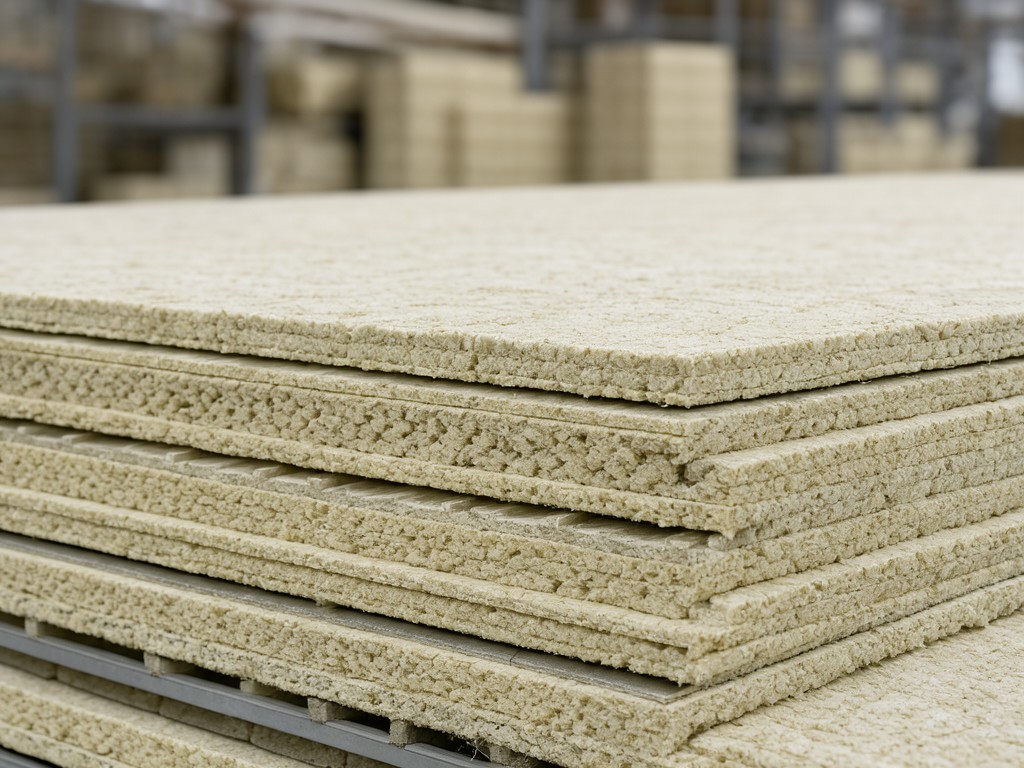
Specifying factory direct high density rockwool roof sandwich panels exporter for Wholesale and OEM Orders
Selection trade-off: core density drives both fire rating and panel weight. At 120–160 kg/m³ you gain 60–120 minute fire resistance and stiffen the span table, but dead load rises 15–25 % versus standard 100 kg/m³ boards. Specify the minimum density that satisfies the local code, then lock facing gauge and adhesive cure cycle to keep flatness within ±3 mm over 6 m.
Scope of Supply and Physical Form
Panels ship as finished roof elements: mineral-wool core bonded to pre-painted galvanized or Galvalume facings on a continuous double-belt press. Standard widths are 1000 mm and 1150 mm (effective cover), thicknesses 50–200 mm in 10 mm steps. Lengths cut to project schedule, typically 2.5–13.5 m to suit container loading. Facings run 0.45–0.80 mm; standard polyester 25 µm top coat, optional PVDF 27 µm for coastal exposure. Male-female joint with integrated capillary break and factory-applied butyl sealant strip.
Every order includes edge-protective film, timber bearers at 1.2 m centres, corner guards, and strap-friendly packaging rated for double-stacking in 40 ft HC containers. Private-label packaging — printed wrap, branded strapping, custom crate marks — added at no tooling cost when MOQ exceeds 5,000 m².
Where This Product Beats Standard Alternatives
Fatigue appears at the stress concentration where the facing meets the core adhesive line. Standard 100 kg/m³ panels develop micro-cracks after 3–5 years of daily thermal cycling; the 140 kg/m³ grade we run holds adhesion above 0.12 MPa after 2,000 accelerated cycles (ΔT 60 °C). That translates to a 15-year warranty on delamination versus the typical 10-year offer.
Weight and stiffness trade off against each other. A 150 mm panel at 140 kg/m³ weighs 21.5 kg/m² but spans 3.2 m at 1.0 kN/m² snow load; the same thickness at 100 kg/m³ drops to 18.5 kg/m² yet max span falls to 2.6 m. For purlin spacings above 2.4 m the density premium pays back in fewer secondary members.
Water absorption stays below 1.0 % by volume after 28-day immersion because the hydrophobic treatment is injected into the fibre stream before curing, not sprayed post-production. Cut edges on site still need sealant, but capillary rise in the core is negligible — critical for low-slope roofs where ponding occurs.
Working as a Production Partner, Not a Catalogue Supplier
We do not stock finished panels. Each order triggers a dedicated press schedule: facing coil allocation, adhesive batch reservation, core density set-point, and cut-to-length program. This lets us match your project specification — facing colour, profile pitch, core density, facing gauge — without redesign. Tooling amortisation is zero; the press changes profile rollers in 45 minutes and adhesive formulation in 20 minutes.
For private-label buyers we run a pre-production lot of 200 m², ship samples with full test report (density, thermal conductivity, pull-off, dimensional), and hold the press parameters once you sign off. Repeat orders pull the same recipe from the MES; drift is tracked batch-to-batch and reported quarterly.
Artwork for branded wrap and crate marks is due 10 days before press start. We supply a print-ready template (AI, 300 dpi, CMYK) and proof digitally; physical proof on request adds two days.
How Consistency Is Held Across Batches
Repeat loading drives the failure mode we monitor most: adhesive bond fatigue. In-line ultrasound scans every 50 m of panel length, mapping bond amplitude; any drop >15 % from the batch baseline flags the section for destructive pull-off. Density is verified by gamma backscatter at 1 m intervals — target ±5 kg/m³. Thermal conductivity sampled every 500 m² per ASTM C518; result must stay within 0.038–0.042 W/m·K for 140 kg/m³ grade.
Facing flatness measured by laser profilometer after cooling: peak-to-valley ≤2 mm over 1 m, ≤5 mm over 6 m. Panels outside tolerance are reworked or downgraded to non-structural wall grade. All data logged to batch QR code on each pack; buyers receive CSV export at shipment.
Volume Planning and Lead Time
Press capacity: 12,000 m²/day on a single line, 22 days/month net of maintenance. Typical lead time from signed drawing approval: 15 days for ≤5,000 m², 22 days for 5,000–15,000 m², 30 days above 15,000 m² (second shift added). Container loading plan issued 48 h before dispatch; we optimise pack heights to hit 26–27 t per 40 ft HC.
Unit cost drops sharply at volume breaks: 5,000 m² (baseline), 10,000 m² (-4 %), 20,000 m² (-7 %), 50,000 m² (-10 %). The step at 10,000 m² covers facing coil minimum run; the 50,000 m² step absorbs a full adhesive tote changeover. Share your project phasing and we will stage production to keep each shipment at the best price tier.
| Thickness (mm) | Core Density (kg/m³) | Weight (kg/m²) | Max Span at 1.0 kN/m² (m) | Thermal Resistance R (m²·K/W) | Fire Rating (EN 13501-2) |
|---|---|---|---|---|---|
| 50 | 120–160 | 11.5–13.5 | 1.8–2.0 | 1.25–1.35 | EI 30–EI 60 |
| 80 | 120–160 | 15.0–17.5 | 2.4–2.7 | 2.00–2.15 | EI 60–EI 90 |
| 100 | 120–160 | 17.5–20.5 | 2.8–3.1 | 2.50–2.70 | EI 90–EI 120 |
| 150 | 120–160 | 24.0–28.0 | 3.2–3.6 | 3.75–4.05 | EI 120 |
| 200 | 120–160 | 30.5–35.5 | 3.8–4.2 | 5.00–5.40 | EI 120 |
Next Step: Project Discussion
Send the panel schedule — thicknesses, areas, purlin centres, snow/wind loads, facing colour codes, and target fire rating. We return a marked-up drawing with press recipe, pack plan, and landed cost per m² within two business days.
Start the technical review — no catalogue part numbers required.



