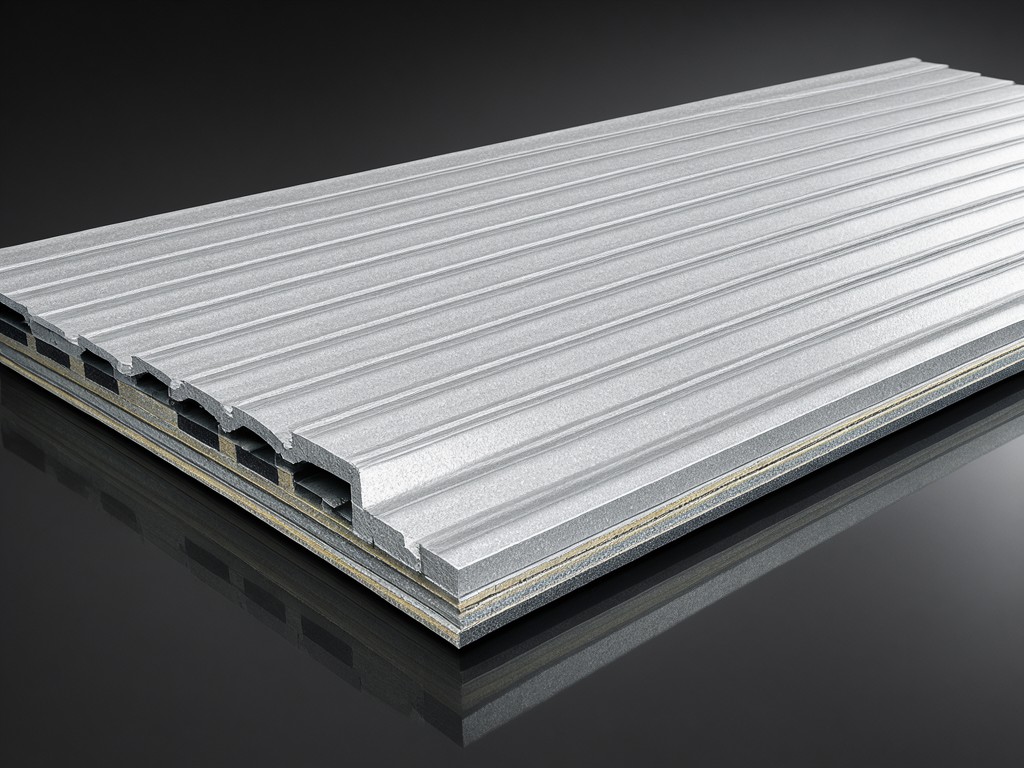
Factory Direct Insulated EPS Siding Panels for Steel Buildings for Wholesale and OEM Orders
Structural integrity in steel-frame construction depends on the bond strength between the metal skin and the foam core. While standard-grade panels often suffer from delamination under thermal cycling, high-pressure l aligns the expansion coefficients of the expanded polystyrene with the steel substrate. Our manufacturing line utilizes a continuous-forming foam process that ensures the EPS core remains bonded to the galvanized steel, preventing the air gaps that lead to localized corrosion and moisture ingress in industrial envelopes.
Technical Note: The 50mm to 150mm core thickness range provides the balance between R-value performance and mechanical impact resistance required for wide-span steel applications.
Scope of Supply
Procurement officers often face a trade-off between panel weight and the dead load on the primary structure. We provide varying EPS densities, ranging from 15kg/m³ to 30kg/m³, to meet the compressive strength requirements of specific load zones. Lower-density cores reduce freight costs and structural demand, but higher-density cores offer the necessary resistance to puncture during installation in high-traffic warehouse environments.
- Galvanized steel skins from 0.4mm to 1.0mm thickness based on tensile requirements.
- Interlocking profile profiles including trapezoidal and flat-rib configurations for thermal break continuity.
- PVDF or polyester coated finishes for UV-exposure resistance to prevent chalking on exposed facades.
- Custom-profileed locking systems for rapid on-site assembly.
Where Cheaper Alternatives Fall Short
Budget-tier EPS panels frequently fail at the joint line because the adhesive application is inconsistent or the foam density fluctuates across batches. When the steel skin expands under solar gain, a weak bond shears the foam, resulting in visible buckling and thermal bridging. Our process utilizes a thermal-bonding system that creates a permanent chemical bond across the entire surface area, ensuring the panel remains a monolithic unit even under extreme temperature gradients.
What the Design Has to Balance
The total cost of the building envelope is not just the price per square meter but the labor speed and thermal efficiency. A thicker EPS panel reduces the HVAC capacity requirements but increases the material volume and requires specialized handling for transport. We help buyers calculate the specific thickness-to-density ratio that minimizes material waste while staying within the structural limits of the steel frame design.
| Parameter | Standard Grade | Industrial Grade |
|---|---|---|
| EPS Density | 15-20 kg/m³ | 25-35 kg/m³ |
| Skin Tensile | 250 MPa | 350 MPa+ |
| Compressive Strength | 80 kPa | 150 kPa+ |
| Thermal Conductivity | 0.038 W/m·K | 0.032 W/m·K |
Matching the Product to the Need
- If the project requires high-wind load resistance, select a minimum 0.5mm skin with a deep-profile rib to prevent skin deflection.
- For cold storage facilities, prioritize a 100mm+ EPS core to maintain internal temperature stability and prevent frost point formation.
- For lightweight industrial sheds, utilize lower-density foam to reduce the total dead load on the steel purlins.
Working as a Production Partner, Not a Supplier
Our production schedule integrates with project-specific timelines to ensure that panels arrive just before the framing is completed. We manage dimensional tolerances to a ±2mm deviation in length, which ensures that the interlocking joints align perfectly without requiring excessive field-trimming. This precision reduces on-site labor hours and minimizes material waste during large-scale deployments.
Quality Control
Batch consistency is verified through destructive shear testing of the foam-to-steel interface. We monitor adhesive application temperature to ensure the bond fails before the material does, indicating a successful structural integration. Additionally, moisture content in the raw EPS is controlled to prevent shrinkage or warping during the curing process of the steel skins.
Ordering, Tooling and Lead-Time Questions
What is the MOQ for custom profile tooling?
Custom steel profiles require a minimum of 2,000 square meters to amortize the cost of the rolling die adjustments.
How does thickness affect lead times?
Standard thicknesses are typically available within 14 days; custom cores exceeding 150mm may require an additional 7 days for specialized foam extrusion and curing cycles.
Are shipping crates included?
Panels are bundled and shrink-wrapped with protective strapping to prevent edge damage to the EPS core during maritime transit.
Request a technical data sheet or volume quote for your project.
Contact our engineering team for specification review


