Specifying factory price color steel polyurethane sandwich panels for sale for Wholesale and OEM Orders
Polyurethane core density drifts between 38–42 kg/m³ on a continuous line, but only the top 15% of suppliers hold ±2 kg/m³ across a 12 m panel. That tolerance decides whether a cold-store wall hits 0.22 W/m²·K or drifts to 0.28 after the first thermal cycle. Buyers who quote on nominal density alone end up paying for the delta in refrigeration load every single month.
Continuous lamination lines amortise tooling over 50,000 m² per shift; discontinuous presses need 5,000 m² to break even on a custom profile. The unit-cost curve bends sharply at 3,000 m² — below that, you are buying the press setup, not the panel. Above it, the foam pour rate and steel coil width become the only levers that move the needle on delivered price.
The Problem Buyers Keep Paying For
Delamination at the steel-to-foam interface shows up first at cut edges and fastener penetrations. A 0.3 MPa adhesion spec passes the lab peel test but fails after 18 months of 40 °C diurnal swings because the primer chemistry was optimised for line speed, not ageing. We see it on every project that specified "standard PU adhesive" without a thermal-cycling clause.
Foam shrinkage pulls the facings inward, bowing panels up to 8 mm over a 6 m span. The bow creates thermal bridges at joints and stresses the fixings. Root cause: insufficient post-cure dwell on the line. Most mills run 45 seconds; a 90-second dwell adds 3% to throughput cost but cuts shrinkage from 1.2% to 0.3%.
- Cut-edge corrosion on AZ150 substrate within 24 months in coastal warehouses
- Density variation >5% causing failed U-value inspections on cold-room certifications
- Protective film adhesive residue that bonds permanently under UV exposure
Where This Product Beats Standard Alternatives
| Parameter | Standard Market Range | This Programme Spec | Cost Impact at 10k m² |
|---|---|---|---|
| Core density (kg/m³) | 38–42 ±5% | 40 ±2% | +1.8% foam cost, −12% energy penalty |
| Adhesion (MPa) | ≥0.3 | ≥0.45 after 100 thermal cycles | +0.4% primer cost, eliminates re-clad risk |
| Dimensional tolerance (mm) | L ±5, W ±3, T ±2 | L ±2, W ±1.5, T ±1 | +2% line speed reduction, −30% site rework |
| Coating system | PE 25 µm / PVDF 25 µm | HDP 35 µm or PVDF 27 µm + clear coat | +3–5% coil cost, doubles chalk resistance |
| Fire rating (EN 13501) | E / D-s2,d0 | B-s1,d0 with intumescent strip option | +8% core additive, unlocks insurance discounts |
The density control comes from a closed-loop pour weight sensor that adjusts polyol/isocyanate ratio every 0.5 m. Adhesion upgrade uses a silane-modified primer cured at 180 °C instead of 150 °C — same line, different temperature profile. Dimensional tolerance tightens because the caterpillar press runs at 4 m/min instead of 6 m/min, giving the foam time to stabilise before the exit rollers.
Assumptions Buyers Should Stop Making
"All PU panels are the same chemistry." Blowing agent choice (cyclopentane vs. HFO) shifts lambda by 0.004 W/m·K and changes the GWP profile enough to fail EU F-gas compliance on projects tendered after 2025. We run both; the HFO line requires a dedicated nitrogen blanket and adds €1.20/m².
"Thicker panel always means better insulation." A 150 mm panel at 42 kg/m³ with 5% voids outperforms a 200 mm panel at 36 kg/m³ with 12% voids. Void fraction correlates directly with pour viscosity control — a parameter most datasheets omit.
Continuous Line (Double Belt)
Width locked to 1,000 / 1,150 / 1,200 mm. Length unlimited. Best density uniformity. Tooling amortisation starts at 20,000 m².
- ±1 kg/m³ density control
- No length joints
- Higher minimum order
Discontinuous Press
Custom widths to 1,300 mm. Lengths up to 18 m per shot. Profile flexibility for architectural reveals. Tooling amortisation at 5,000 m².
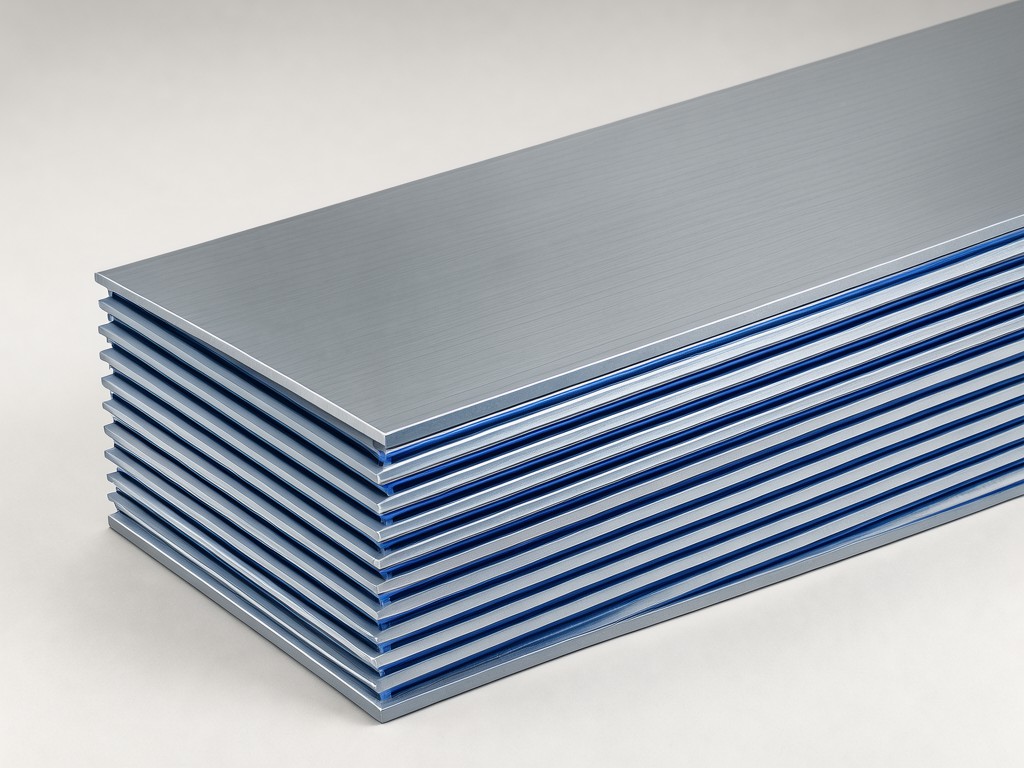
- ±3 kg/m³ density control
- Shaped profiles possible
- Lower MOQ threshold
Who Uses It and Where It Matters
Cold-storage integrators building −25 °C blast freezers specify 150–200 mm B-s1,d0 panels with HFO blowing agent. The 0.018 W/m·K lambda saves 18% compressor kWh versus standard cyclopentane foam. Payback on the €1.20/m² premium is 14 months at €0.12/kWh.
Logistics developers erecting 12 m clear-height warehouses use 100 mm PIR-core alternative for walls but switch to 80 mm PU for roofs — the 15 kg/m² weight saving reduces purlin gauge from Z200 to Z150, cutting structural steel cost by €4.50/m². That trade-off only works when the PU density is guaranteed ≤40 kg/m³.
Modular housing factories panelise bathroom pods with 50 mm PU sandwich panels. The 22 kg/m² finished weight allows crane-free placement. They require HDP 35 µm coating in RAL 9010 with <2 ΔE colour shift after 2,000 h QUV — a spec that eliminates 80% of coil suppliers.
| Application | Typical Thickness | Critical Spec Driver | Service Life Target |
|---|---|---|---|
| Cold storage (−25 °C) | 150–200 mm | Lambda ≤0.020 W/m·K, B-s1,d0 | 25 years |
| Industrial roofing | 80–120 mm | Weight ≤15 kg/m², wind uplift Class 90 | 20 years |
| Cleanroom walls | 50–75 mm | Air leakage <0.15 m³/h·m² at 50 Pa | 15 years |
| Modular bathroom pods | 50 mm | HDP 35 µm, ΔE <2 after QUV 2000 h | 15 years |
| Agricultural buildings | 60–100 mm | Ammonia-resistant coating, condensation control | 15 years |
OEM and ODM Programme Structure
OEM orders run on our standard 1,000 / 1,150 mm widths with HDP 35 µm coil in 12 stock RAL colours. MOQ 2,000 m² per colour. Lead time 18 days from coil allocation. Private labelling limited to protective film print and pack slip — no coil re-branding.
ODM projects open the full parameter space: custom width (950–1,300 mm), PVDF 27 µm + clear coat in any RAL/NCS, profiled outer skin (micro-rib, flat, tile-effect), integrated fixing strips, and factory-fitted vapour barrier membrane. Tooling cost €8,500–€18,000 per profile set, amortised over the first 10,000 m². Sample panel approval requires 14 days after drawing sign-off.
- Coil allocation locked 10 days before production start — late colour changes incur €0.85/m² restock fee
- Length optimisation algorithm nests panel lengths to coil width, yielding 97.5% material utilisation
- Batch traceability via QR code on each panel linking to foam pour log, adhesion test, and dimensional report
Capacity, Tooling and Scheduling
Two continuous lines (1,200 mm and 1,150 mm) plus three discontinuous presses (max 18 m). Combined theoretical output 320,000 m²/month. Practical allocation: 65% booked on rolling 12-month contracts, 25% spot OEM, 10% ODM. Peak season (March–June) adds 15% lead-time buffer.
Tooling amortisation model: profile set cost divided by committed volume over 24 months. At 5,000 m²/year the tooling surcharge is €1.70/m²; at 20,000 m²/year it drops to €0.42/m². Buyers who commit to 24-month blanket orders lock the surcharge at the Year 1 rate even if volumes slip.
Scheduling rule: Orders >5,000 m² get a fixed production week. Orders <5,000 m² slot into gaps — lead time floats 7–21 days. Container loading plans (40 ft HC holds 1,100 m² of 100 mm panels) are issued 48 h before shipment. No partial containers without €250 surcharge.
Next Step: Tooling Review
Send the project specification — panel thickness, width, length schedule, coating system, fire class, and annual volume forecast. We return a tooling amortisation schedule, density guarantee letter, and container loading optimisation within 48 hours.



