odm corten steel appearance insulated panels manufacturer - Bulk Supply and Specification Guide
Critical Specification Trade-off: Thermal Mass vs. Structural Weight
Selecting a corten-appearance panel requires balancing the aesthetic depth of the weathered oxide layer against the load-bearing requirements of the core. Higher-density cores improve thermal resistance but increase the dead load per square meter, potentially requiring reinforced support framing in long-span installations.
What This Product Is and Where It Fits
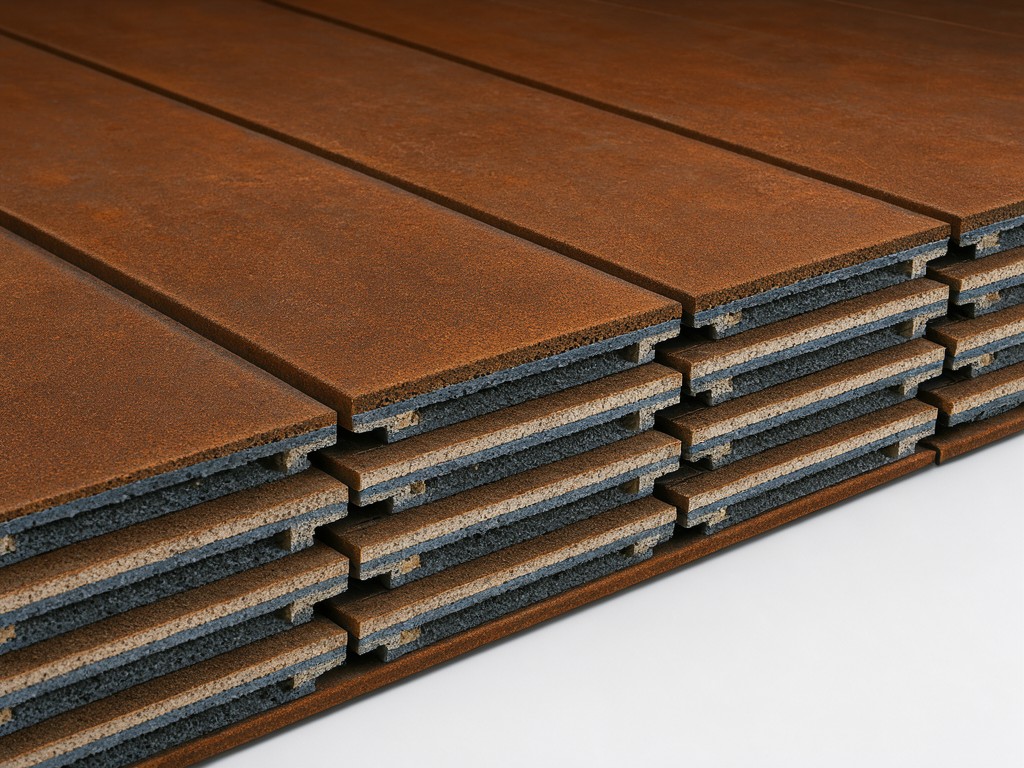
These insulated panels are engineered to replicate the specific aesthetic profile of weathering steel while maintaining the dimensional stability of modern composite construction. The manufacturing process is designed for architectural envelopes where the visual texture of oxidized iron is required without the maintenance- or structural runoff associated with actual weathering steel. Unlike standard galvanized steel, the corten-appearance finish utilizes a specialized coating or pre-treated surface that remains chemically stable across the panel's lifecycle.
In commercial construction, these units are frequently utilized for facade systems, industrial cladding, and high-end residential partitions. The core—typically PIR, mineral wool, or EPS—dictates the R-value, while the outer steel skins provide the mechanical resistance against impact and environmental shear. For procurement, the value lies in the consistency of the weathered pattern across thousands of square meters, ensuring visual uniformity across large surfaces.
Where Cheaper Alternatives Fall Short
Low-cost alternatives often rely on thin digital prints that lack the UV stability required for long-term exposure. This results in rapid chalking or fading where the "weathered" look loses its saturation within two to three solar cycles. Furthermore, inferior adhesive grades often fail between the steel skin and the insulation core, leading to delamination when thermal cycling causes the materials to expand and contract.
The most common failure point in budget panels is the seam integrity. If the interlocking profile is not manufactured to high precision tolerances, the joints will gap, allowing moisture ingress that compromises the insulation core. This leads to internal corrosion and a loss of thermal efficiency that costs far more in remediation than the initial material savings.
Material Options and Their Trade-offs
| Component Type | Primary Benefit | Technical Trade-off |
|---|---|---|
| PIR Foam Core | High thermal rating & low weight | Higher cost per m² |
| Mineral Wool | Acoustic insulation & fire rating | Significant weight increase |
| 0.5mm Steel Skin | Cost-effective | Susceptible to denting |
| 0.7mm Steel Skin | High structural rigidity | Increased freight costs |
Size, Weight and Specification Range
Dimensional consistency is governed by the rolling mill's production line. Standard widths range from 1000mm to 1200mm, optimized for standard structural spans. Lengths are typically custom-cut up to 6000mm to meet transport constraints, though larger lengths require specialized flatbed logistics.
Core Thickness
- 50mm - 100mm (Internal partitions)
- 120mm - 150mm (Standard cladding)
- 200mm+ (Cold storage / Industrial)
Finish Profiles
- Flat face (Aural focus)
- Micro-ribbed (30mm-50mm pitch)
- Trapezoidal (High-span load bearing)
What Can Be Customised and What Cannot
Customization focuses on the surface treatment and the core density. We can adjust the specific hue of the corten effect—ranging from light ochre to deep burnt umber—to match specific architectural palettes. However, the mechanical properties of the steel skin and the thermal conductivity of the insulation core cannot be altered without changing the performance rating of the panel.
The profile geometry is also fixed by the existing tooling. While custom profiles can be engineered for high-volume OEM orders, they require significant upfront investment in die sets, impacting the minimum order quantity for any non-standard project.
Keeping Repeat Orders Supplied
For large-scale developments, lot-to-lot consistency is the primary metric. A shift in the color-pattern between two batches can result in visible seams on a finished facade. Our facility utilizes strict batch-control protocols for the coating process to ensure that a reorder placed six months later matches the original installation within acceptable Delta E tolerances.
Ordering, Tooling and Lead-Time Questions
What is the lead time for standard thickness corten-appearance panels?
Standard stock configurations typically ship within 3-4 weeks, depending on current raw material inventory availability and production scheduling.
Can you provide custom samples for architectural approval?
Yes, we provide full-scale samples showing the specific finish profile and core type to verify aesthetic and thermal properties before bulk production begins.
Need a specific technical specification for your next project?
Start a project discussion and request a quote


