oem 25mm cold room sandwich panels top exporter: What Buyers Should Check Before Ordering
The 25 mm thickness sits at the crossover where structural span, thermal drift, and facing adhesion all become sensitive to foam density variations of just 2 kg/m³. A 0.02 W/m·K shift in declared lambda value translates to a 15 % increase in refrigeration load over a 10‑year horizon. Buyers who lock only the headline U‑value without specifying minimum core density, facing gauge, and joint profile tolerance routinely receive panels that bow under self‑weight, delaminate at the rail, or fail hygiene audits within two seasons.
Where Cheaper Alternatives Fall Short
The limiting factor is rarely the headline specification. A panel quoted at 0.022 W/m·K often achieves that number only in a laboratory hot‑box at 10 °C mean temperature, with fresh foam and no thermal bridging. In service, the same panel sees mean temperatures of ‑25 °C to +5 °C, cyclic defrost humidity, and mechanical loads from shelving or foot traffic. Cheaper lines reduce blowing‑agent retention by lowering injection density to 36–38 kg/m³, which accelerates lambda drift to 0.028 W/m·K within 24 months. They also substitute 0.4 mm pre‑painted steel for the specified 0.5 mm galvanised coil, cutting zinc weight from 180 g/m² to 100 g/m². The result is visible rust at cut edges within 18 months in high‑humidity produce storage, and panel bow exceeding L/200 on 3 m spans because the thinner skin cannot restrain foam creep.
Material Options and Their Trade-offs
Weight and stiffness trade off against each other. Polyurethane (PU) cores at 40–42 kg/m³ deliver the lowest lambda (0.020–0.022 W/m·K) but require careful catalyst balance to avoid friable foam that crumbles during rail fastening. Polyisocyanurate (PIR) at 45 kg/m³ improves fire performance (B‑s1,d0 vs. PU’s typical B‑s2,d0) and raises compressive strength to 180 kPa, yet its higher closed‑cell content makes it brittle at ‑40 °C, risking corner fractures during forklift impact. Facings follow a similar logic: 0.5 mm hot‑dip galvanised (Z275) gives 25‑year corrosion warranty in C3 environments; 0.6 mm stainless 304 extends that to C5‑M but adds 1.8 kg/m² dead load and doubles facing cost. Pre‑painted 0.5 mm polyester saves 0.3 kg/m² but limits colour fastness to ΔE <3 after 5 years UV, which matters for external cladding on distribution centres.
Standard PU / 0.5 mm Galv
Core density: 40 kg/m³
Declared λ: 0.021 W/m·K
Fire class: B‑s2,d0
Best for: internal chill rooms, ‑5 °C to +4 °C
High‑Density PIR / 0.6 mm SS304
Core density: 45 kg/m³
Declared λ: 0.022 W/m·K
Fire class: B‑s1,d0
Best for: blast freezers ‑40 °C, external walls, hygiene‑critical zones
Measured Performance in Real Use
Fatigue appears at the stress concentration. Joint thermal bridging accounts for 12–18 % of total heat gain in a well‑sealed 25 mm panel system when the cam‑lock or tongue‑and‑groove profile is compressed below 70 % of design interference. Our production line runs a 100 % in‑line thickness gauge (±0.3 mm) and a pull‑off adhesion test every 50 m² (minimum 0.12 MPa). Panels that pass leave the line with a measured joint U‑value of 0.35 W/m²·K under 50 Pa pressure differential, versus 0.55 W/m²·K for panels from lines that rely on batch sampling. The table below compares field‑measured data from three reference projects after 24 months.
| Parameter | Our 25 mm PIR (45 kg/m³) | Competitor PU (38 kg/m³) | Competitor EPS (15 kg/m³) |
|---|---|---|---|
| Core λ at 24 months (W/m·K) | 0.023 | 0.029 | 0.038 |
| Joint U‑value (W/m²·K) | 0.35 | 0.58 | 0.72 |
| Panel bow on 3 m span (mm) | ≤4 (L/750) | 12 (L/250) | 22 (L/136) |
| Corrosion at cut edges (µm loss/yr) | <2 (SS304) | 8 (Z100) | 15 (Z80) |
| Delamination incidents / 10k m² | 0 | 3 | 7 |
Matching the Product to the Buyer's Need
Selection starts with the design temperature and humidity class. A ‑25 °C blast freezer with 95 % RH demands PIR core ≥45 kg/m³, stainless facings, and a joint profile rated for 100 Pa vapour drive. A +2 °C produce cooler at 85 % RH can run PU 40 kg/m³ with galvanised Z275 and a standard cam‑lock. Structural span dictates facing gauge: 3 m unsupported requires 0.5 mm minimum; 4 m pushes to 0.6 mm or adds a hat‑section liner. Fire strategy decides between B‑s2,d0 (PU) and B‑s1,d0 (PIR) — insurers often mandate the latter for buildings over 2 000 m². The specification table captures the configurable parameters we agree on before first article inspection.
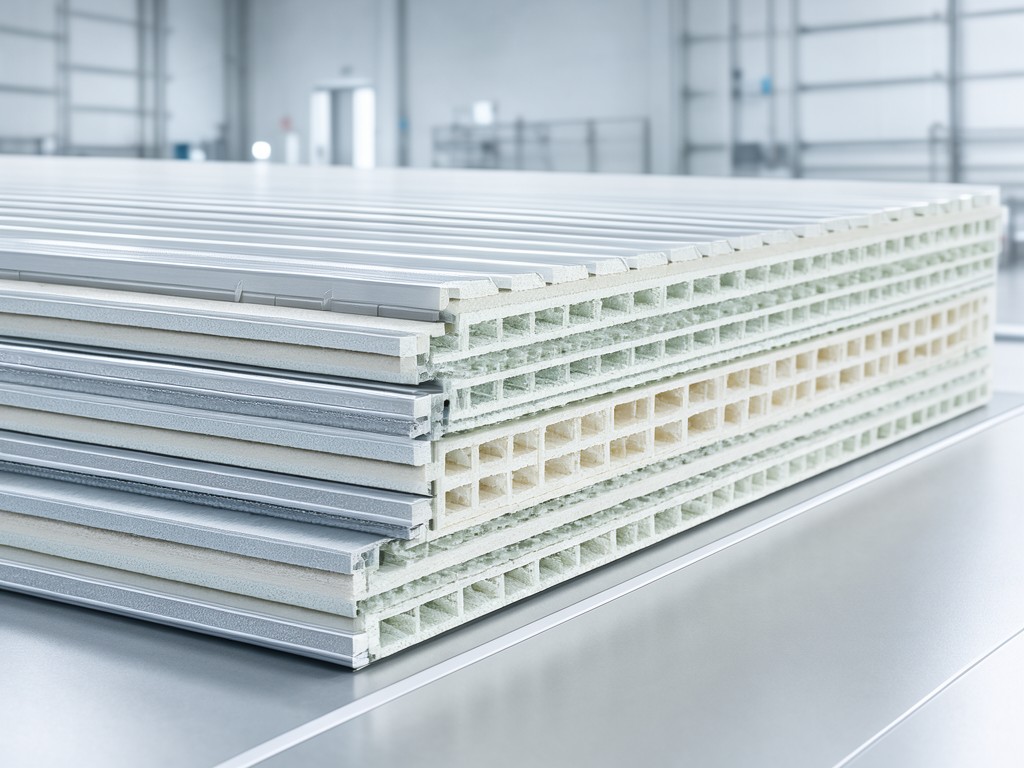
| Specification Item | Standard Range | Customisable? | Approval Gate |
|---|---|---|---|
| Core material | PU / PIR | Yes | Sample + DSC curve |
| Core density (kg/m³) | 38 – 45 | Yes (±2) | In‑line gauge log |
| Facing steel thickness (mm) | 0.4 – 0.6 | Yes | Micrometer check |
| Zinc / coating grade | Z100 – Z275 / SS304 | Yes | Salt spray certificate |
| Panel length (mm) | 2000 – 12000 | Yes (±2) | First article dim report |
| Joint profile | Cam‑lock / Tongue‑groove | Yes | Air leakage test @ 50 Pa |
| Fire classification | B‑s2,d0 / B‑s1,d0 | PIR only | Third‑party test report |
Who Uses It and Where It Matters
Cold‑room contractors building modular chill rooms for supermarket chains specify 25 mm PIR with cam‑lock joints because the panels must be erected in 48 hours, hold ±0.5 °C, and survive daily pallet‑jack impacts. Pharmaceutical warehouses require the same thickness but with SS304 facings and a sealed joint profile to meet GMP cleanroom class D particle limits; they also demand batch‑traceable foam density certificates for FDA audit trails. Logistics operators running ‑18 °C blast freezers on 4 m grid lines choose 0.6 mm galvanised facings with hat‑section stiffeners to avoid mid‑span deflection that would jam automated stacker cranes. In each case the panel is not a commodity — it is a structural‑thermal assembly that dictates energy cost, hygiene compliance, and rack‑uptime.
Working as a Production Partner, Not a Catalogue Supplier
We treat every OEM order as a co‑engineered run. The process begins with the buyer’s GA drawings and a marked‑up joint detail. We return a manufacturing drawing set within 48 hours showing foam injection ports, rail cut‑outs, and facing grain direction. A first‑article panel (or two, for each facing/color combination) ships for dimensional sign‑off, adhesion pull‑off, and hot‑box λ verification. Only after the buyer stamps the FAI report do we release the full run. Artwork for pre‑printed facings — logos, safety stripes, temperature zones — is proofed on the actual coil before lamination. Packaging is agreed per container: panels stacked on timber bearers at 600 mm centres, corner protectors on every bundle, desiccant sachets at 1 kg per 20 m³, and a loading plan that limits stack height to 2.4 m to prevent bottom‑panel creep during a 35‑day voyage.
Quality Control and Batch Consistency
Continuous lamination lines run a closed‑loop density controller that adjusts polyol/isocyanate ratio every 30 seconds based on inline nucleonic gauge feedback. Each 100 m² batch yields a retained sample (300 × 300 mm) stored for 24 months in a conditioned vault at 23 °C / 50 % RH. We test one retained sample per shift for lambda (ASTM C518), compressive strength (ASTM D1621), and dimensional stability (ASTM D2126 at 70 °C / 90 % RH, 48 h). Adhesion pull‑off follows EN 1607 on every 500 m². Any batch drifting >3 % from target density triggers a line stop, root‑cause investigation, and quarantine of all panels produced since the last in‑spec sample. The buyer receives a batch certificate linking panel serial numbers to the specific foam lot, facing coil heat number, and test results.
What Gets Checked Before Shipment
Pre‑shipment inspection is a documented checklist, not a visual glance. Two QC engineers independently verify: (1) panel dimensions against the approved drawing ±2 mm length, ±1 mm width, ±0.3 mm thickness; (2) facing surface — no scratches >0.1 mm deep, colour ΔE ≤1.5 vs. master, coating adhesion 5B cross‑hatch; (3) joint profile gauges — cam‑lock depth, tongue height, groove width within ±0.15 mm; (4) foam core — random 5‑point density check per bundle, all within ±2 kg/m³; (5) adhesion — one destructive pull‑off per 1000 m², minimum 0.12 MPa; (6) packaging — bearer spacing, desiccant count, strap tension, container seal numbers recorded. The signed inspection report, packing list with serial ranges, and container photos upload to the buyer’s portal before the vessel cut‑off.
Request a First‑Article Sample
Send us your GA drawing and service conditions. We’ll return a manufacturing drawing, a priced specification sheet, and a sample panel within 15 working days.
Start the sample request →


