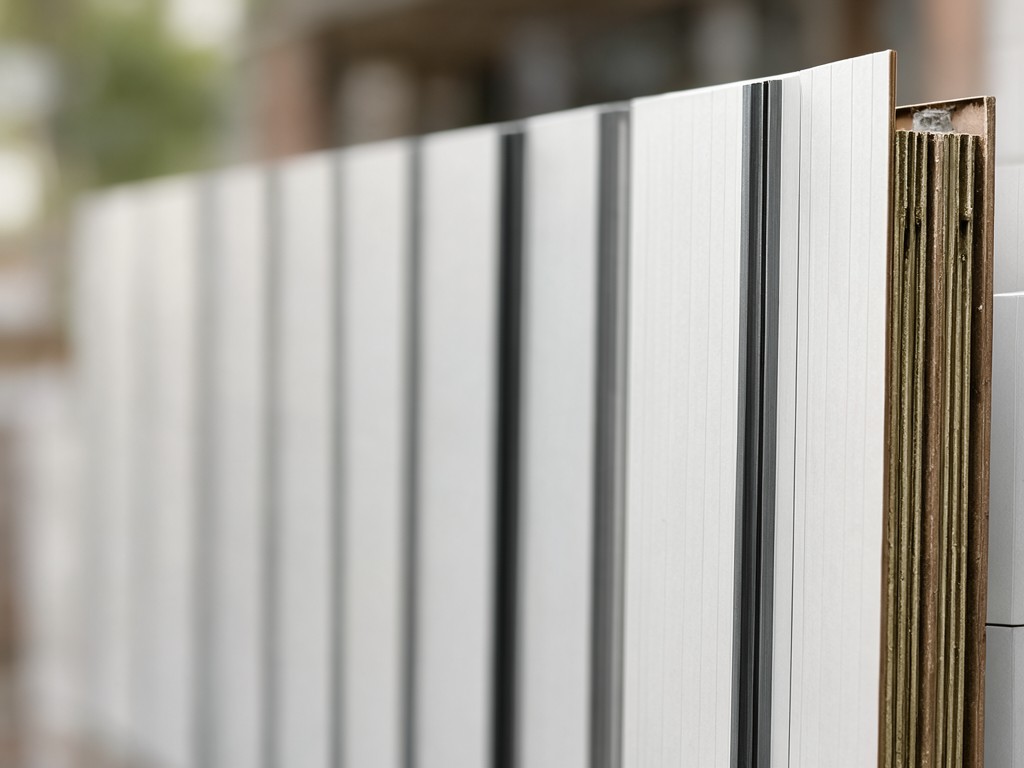
oem energy saving pir insulated exterior wall panels supplier - Bulk Supply and Specification Guide
The critical trade-off on every PIR panel line is foam density versus skin gauge. Thinner skins (0.4 mm) cut coil cost but increase oil-canning risk on long spans; heavier foam (40 kg/m³) improves lambda but raises exotherm during lamination, which can bow the panel if the press dwell isn't retuned. Lock the density-skin combination in the shop-drawing sign-off before the first coil ships.
Where Cheaper Alternatives Fall Short
During a private-label launch with a fixed ship date, a distributor switched to a lower-cost panel from a regional press that ran 32 kg/m³ foam on 0.5 mm G90 steel. The panels passed the factory lambda test at 0.022 W/m·K, but six months after installation the end-user documented thermal bowing on the south elevation — peak surface temperatures hit 78 °C, the foam softened, and the adhesive line crept. The fix required a full reclad because the joint profile couldn't accommodate the deflection. Cheaper foam formulations often use higher pentane residuals; they hit the datasheet R-value at 24 °C but drift 8-12 % by year three as blowing agent diffuses. That drift is what triggers warranty claims on energy-model compliance.
The other failure mode we see on budget lines is facer wrinkling at the panel ends. Continuous double-belt presses run 8-10 m/min; if the top belt tension isn't matched to the foam rise profile, the steel skins wrinkle before the foam sets. Those wrinkles become corrosion initiation sites once the building sees its first freeze-thaw cycle with road salt aerosol. A supplier that only shows center-cut lambda data and skips the ASTM C303 aged-R test is usually hiding that drift.
What the Design Has to Balance
Every project specification starts with three hard constraints: the required U-value for the climate zone, the maximum panel span between structural supports, and the fire rating the authority having jurisdiction demands. PIR gives you the best lambda of any commercial foam — typically 0.020-0.023 W/m·K at 10 °C mean temperature — so you hit code thickness with 50-100 mm less insulation than mineral wool. But that same chemistry chars differently; FM 4880 Class 1 requires a specific char formation that only certain catalyst packages deliver. If the foam supplier changes the polyol blend mid-year without re-testing, the panel that passed last quarter's factory burn may fail the next one.
Skin gauge drives both structural capacity and freight economics. A 0.7 mm exterior skin on 100 mm core spans 3.6 m at 2.4 kPa wind load; drop to 0.5 mm and the span falls to 2.7 m, adding a girt line that costs more than the coil upgrade. Interior liner gauge is often spec'd at 0.45 mm for abuse resistance, but if the project uses a suspended ceiling the 0.4 mm liner saves 1.2 kg/m² — three more panels per container. Those are the trade-offs we walk through on the submittal call before the shop drawings are frozen.
How It Performs in Use
The joint is where the system lives or dies. Our standard tongue-and-groove with a factory-applied butyl tape seal holds 0.1 L/s·m² at 75 Pa per ASTM E283 — that's the air-barrier benchmark for most North American energy codes. Water penetration under ASTM E331 at 300 Pa passes with zero leakage when the installation crew follows the 15 mm compression spec on the tape. The failure we see in the field isn't the panel; it's the installer stretching the tape or skipping the end-dam sealant at window heads. That's why we ship a one-page install card with every crate and offer a pre-install video call for the first 500 m².
Thermal cycling is the long-term test. PIR's closed-cell structure resists moisture uptake — 1.5 % volume after 28-day immersion per ASTM C209 — so the R-value stays stable even if the vapor drive reverses seasonally. The steel skins see the delta-T; a dark PVDF finish on a 100 mm panel in Phoenix can cycle 65 °C daily. That drives the bowing calculation. We provide the thermal bow deflection table (span/200 limit) in the submittal so the structural engineer can verify the girt spacing before the panels arrive.
Specification Range and Customisation Limits
| Parameter | Standard Range | Custom Window | Approval Gate |
|---|---|---|---|
| Core thickness | 50, 75, 100, 125, 150, 200 mm | 25 mm increments 50-250 mm | Shop drawing + lambda test per thickness |
| Foam density | 38-42 kg/m³ | 35-45 kg/m³ (affects lambda ±0.001) | Aged R-value report (ASTM C1303) |
| Exterior skin | 0.5-0.7 mm G90 / AZ50 steel | 0.4-1.0 mm; aluminum 0.7-1.2 mm | Span table + oil-canning waiver |
| Interior liner | 0.45 mm G60 steel | 0.4-0.7 mm; embossed option | Impact test (ASTM D5420) if <0.45 mm |
| Coating system | PVDF 70 % (25 µm), SMP (25 µm) | FEVE, polyester, custom color match | Delta-E ≤ 1.0 on master panel |
| Panel length | 2.4-12.2 m (8-40 ft) | Up to 16 m with splice joint | Container fit + splice detail sign-off |
| Joint profile | Double tongue-and-groove with butyl | Offset joint, reveal joint, concealed fastener | Air/water test mock-up (ASTM E283/E331) |
| Fire rating | FM 4880 Class 1 / UL 1715 | FM 4881, EN 13501 B-s1,d0 | Full-scale burn per project jurisdiction |
Any parameter outside the standard range triggers a first-article inspection: we run a 3-panel pilot on the production line, cut coupons for lambda, adhesion, and dimensional stability, and hold the container until the test report matches the submittal. That adds 7-10 days to lead time but eliminates the rework that kills margin on repeat orders.
Requirements by Buyer Segment
Procurement officers on multi-building programs need container-level traceability. We laser-etch each panel with heat number, production date, and line ID; the packing list links to the MTC for the coil and the foam batch certificate. That lets the owner's QA team close the material submittal without opening crates. Brand product managers launching a private-label line need the color master panel approved under D65 lighting before the first coil runs — we ship the master in a light-tight sleeve with a spectrophotometer report (ΔE ≤ 0.5 vs. target). Distributors carrying stock for retrofit crews prioritize the 100 mm / 0.5 mm / PVDF white SKU because it fits 90 % of climate zones and loads 42 panels per 40 ft HC container. We keep that SKU in safety stock at two ports so the 2-week lead time holds even in peak season.
Ordering, Tooling and Lead-Time Questions
What drawings do you need to lock the specification?
We require a PDF shop drawing showing panel layout, joint orientation, flashing details, and opening schedules. The drawing must note the design wind pressure, required U-value, and fire rating. We return a marked-up version with our standard joint details and any span reductions within 48 hours. Sign-off on that drawing freezes the BOM.
How does the color approval work for private label?
You send a physical chip or RAL number. We produce a 300 × 300 mm master panel on the actual coil and coating line, measure it with a calibrated spectrophotometer (D65/10°), and ship it overnight. You approve or request a reformulation. No coil is slit until the master is signed. Typical cycle: 5 business days from chip receipt.
What is the minimum order for a custom skin gauge or foam density?
One full coil — roughly 1,800 m² at 100 mm thickness. Below that, the press setup scrap and foam changeover waste make the unit cost uncompetitive. If you need a smaller volume, we can often nest your custom run into a scheduled production window for a standard gauge; ask about the current schedule.
How do you handle container loading for export?
Panels are stacked flat on 100 × 100 mm timber bearers at 1.2 m centers, interleaved with polyethylene slip sheets. Corner protectors on every bundle. A 40 ft HC takes 42 panels at 100 mm / 12 m length; we provide a load diagram showing center of gravity and tie-down points. Fumigation certificate and moisture barrier bag included on request.
What warranty documentation ships with the order?
Each crate includes a warranty certificate referencing the project-specific submittal: 20-year thermal performance (R-value drift ≤ 10 %), 25-year structural integrity, 30-year coating adhesion (PVDF) or 20-year (SMP). The certificate lists the foam batch, coil heat numbers, and the third-party test reports that back each claim. No blanket "lifetime" language — only the tested values.
Ready to lock the specification?
Send your shop drawing and target U-value. We'll return the marked-up submittal, the master panel schedule, and a container-loading plan within two business days.
Start the submittal review


