Specifying OEM Expandable Polystyrene Sandwich Board Exporter for Wholesale and OEM Orders
Build method determines the structural integrity of the sandwich panel under mechanical stress. For high-volume industrial or retail applications, the density of the expandable polystyrene (EPS) core directly dictates whether the board resists compression deformation or suffers permanent indentation. By utilizing a precision thermal-bonding process, our OEM production avoids the common failure mode seen in low-grade alternatives where the core delaminates from the outer skins during thermal expansion or physical impact.
What This Product Is and Where It Fits
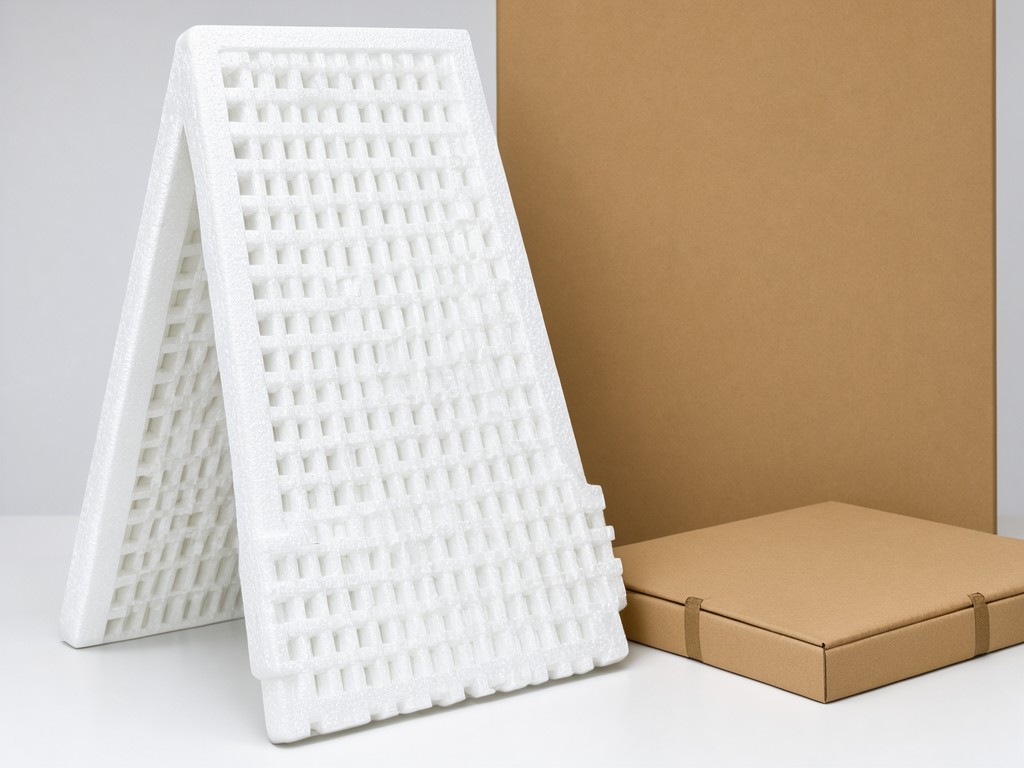
The product consists of a rigid EPS foam encapsulated between two protective face layers. This configuration is engineered for scenarios where high rigidity-to-weight ratios are required without the cost of solid foam cores. In industrial logistics, these boards serve as thermal barriers or structural packaging inserts, while in retail display, they provide a lightweight substrate for large-format graphics.
Consistency is set at the forming stage through controlled EPS bead expansion. If the bead size is inconsistent, the resulting board will exhibit surface irregularities and uneven load-bearing capacity. We calibrate the steam injection rate to ensure the dimensional stability remains within a +/- 0.5mm tolerance across the length of the production run.
- Core density ranging from 15kg/m³ to 45kg/m³ based on load requirements.
- Face material thickness from 0.2mm to 2.0mm for impact resistance.
- Moisture resistance properties suitable for cold-chain logistics applications.
- Custom-cut geometries via CNC routing for specific assembly needs.
Comparing Standard Configurations
Standard EPS Low-Density Core
Optimized for lightweight displays and short-term protection. The lower bead density reduces freight costs but limits the load-bearing capacity. Best for applications where weight outweighs structural support.
High-Density Rigid Core
Designed for structural spacers and heavy-duty insulation. The increased EPS density prevents core crushing under stacked loads. Ideal for industrial components requiring high dimensional precision over time.
Usage Scenarios and Buyer Segments
Procurement officers often balance the unit cost of the board against the failure rate during transit. A cheaper sandwich board may save 10% upfront, but if the adhesive bond fails during sea freight fluctuations, the total cost of replacement and replacement increases significantly. We mitigate this by offering reinforced facing options that increase the tensile strength required to separate the core-to-skin interface.
| Parameter | Specification Range |
|---|---|
| Core Thickness | 5mm to 200mm |
| EPS Density | 15 - 60 kg/m³ |
| Facing Material | Kraft, Aluminum Foil, PE Film, PVC |
| Standard Dimensions | 1200x2400mm (Custom available) |
Export Packaging and Handling
Exporting sandwich boards requires protection against moisture ingress and mechanical shear. While EPS is naturally hydrophobic, paper faces can warp if the shrink-wrap tension is uneven. We utilize pallet-stabilization techniques including edge protectors to ensure the boards do not shift, which is the primary cause of corner-cr during container loading.
Care and Service Life
The service life of an EPS board depends on UV exposure and temperature cycles. Prolonged exposure to direct sunlight can cause photo degradation of the polymer chains, leading to embrittleness. For indoor-controlled environments, we recommend storage in a dry area below 40°C to maintain the integrity of the adhesive bond lines.
Request Technical Specification Data Sheet
Discuss specific core requirements and facing material compatibility for your OEM project.
Contact our engineering team for sample approval


