oem insulated exterior wall panels factory: What Buyers Should Check Before Ordering
A contractor in Minnesota switched to a second source after their primary supplier pushed lead times from six weeks to fourteen. The replacement panels arrived with a 0.8 mm thickness variance across a 3,000 m² order — enough to throw off the clip spacing on a unitised curtain wall. The fix cost three times the per-panel savings. This page walks through the checkpoints that prevent that scenario.
The Problem Buyers Keep Paying For
Single-source dependency on insulated metal panels usually hides three cost drivers. First, core density drift — a 40 kg/m³ PIR spec that slips to 36 kg/m³ cuts R-value by roughly 0.15 per 25 mm and reduces screw pull-out by 12–15%. Second, face-sheet coil inconsistency: a 0.5 mm nominal steel that runs 0.46 mm on one coil and 0.53 mm on the next changes both flatness tolerance and the load span table the engineer stamped. Third, joint profile wear on the roll-former. A 0.15 mm radius increase on the male leg lets water track past the gasket at 40 Pa differential pressure — the exact condition ASTM E331 tests at.
Buyers who only compare FOB price per square metre miss these. The second-source qualification package should require a mill certificate for each coil lot, a core density certificate per foam batch, and a first-article joint profile scan against the approved CAD nominal.
How It Performs in Use
An insulated exterior wall panel is a composite beam: two metal skins carry bending, the foam core carries shear and provides thermal break. In a 100 mm thick panel with 0.6 mm outer / 0.5 mm inner skins and 42 kg/m³ PIR, the panel spans 3.6 m between girts at 2.4 kPa design wind load with L/180 deflection. Swap the core to 120 kg/m³ mineral wool and the same span drops to 2.8 m unless you increase skin gauge to 0.7 mm / 0.6 mm — adding 1.8 kg/m² dead load and $4–6/m² material cost.
Fire performance drives the core choice more than thermal. Mineral wool panels pass NFPA 285 at 150 mm thickness with standard joint details. PIR needs intumescent tape at every horizontal joint and a 50 mm mineral wool firestop at floor lines to pass the same assembly test. That tape adds $1.20/m linear and two labour hours per 100 m². On a 5,000 m² façade, the fire-detail delta is $60k–$80k before you price the panel.
Thermal cycling is the silent killer. A dark-coloured 0.6 mm steel skin hits 85°C in July sun; the inner liner sits at 22°C. That 63°C delta across 100 mm core drives 0.6 mm differential expansion per metre. If the joint detail doesn't accommodate 3 mm movement per 5 m panel, the gasket compresses, takes a set, and leaks by year three. We specify EPDM hollow-bulb gaskets with 40% compression allowance and verify recovery after 1,000 cycles at 70°C / -20°C.
Size, Weight and Specification Range
| Parameter | Standard Range | Tolerance | Notes |
|---|---|---|---|
| Overall thickness | 50–200 mm | ±2 mm | PIR/PUR: 50–150 mm; Mineral wool: 80–200 mm |
| Module width | 1,000 / 1,150 / 1,200 mm | ±1.5 mm | Custom widths require new roll-form tooling |
| Length | 2,000–16,000 mm | ±3 mm | Over 13.6 m needs permit freight |
| Outer skin gauge | 0.5–0.8 mm | ±0.02 mm | G90 galvanised or AZ150 aluminium-zinc |
| Inner skin gauge | 0.4–0.7 mm | ±0.02 mm | Usually lighter gauge; same coating class |
| Core density (PIR) | 38–45 kg/m³ | ±2 kg/m³ | Per EN 1602; each foam batch certified |
| Core density (mineral wool) | 100–140 kg/m³ | ±5 kg/m³ | Higher density = better fire, worse R-value |
| Panel weight (100 mm PIR) | 11.2–12.8 kg/m² | ±0.3 kg/m² | Depends on skin gauges |
| Panel weight (150 mm mineral wool) | 19.5–22.0 kg/m² | ±0.5 kg/m² | Requires 2-man lift or vacuum lifter |
Requirements by Buyer Segment
General Contractor / Erector
Needs panels that land on site square, labelled by elevation and sequence, with predrilled fastener holes matching the approved shop drawings. A 2 mm hole misalignment across 50 panels adds a day of field reaming. We ship on A-frames with orientation arrows and bundle tags that cross-reference the BIM model panel IDs.
Facade Consultant / Specifier
Requires full test reports: ASTM C518 thermal, ASTM E72 structural, ASTM E283/E331 air-water, NFPA 285 or equivalent assembly fire. Also demands the joint detail CAD in native format for thermal bridge modelling (THERM or WUFI). We maintain a library of 40+ pre-tested joint details; custom details need a 6-week mock-up cycle.
Distributor / Stockist
Stocks 100 mm and 150 mm PIR in 1,000 mm width, standard colours, 6 m and 12 m lengths. Needs consistent coil colour match across production runs — ΔE < 0.8 on CIELAB. We hold master colour chips and run spectrophotometer checks on every coil change. Minimum stock order: 500 m² per SKU.
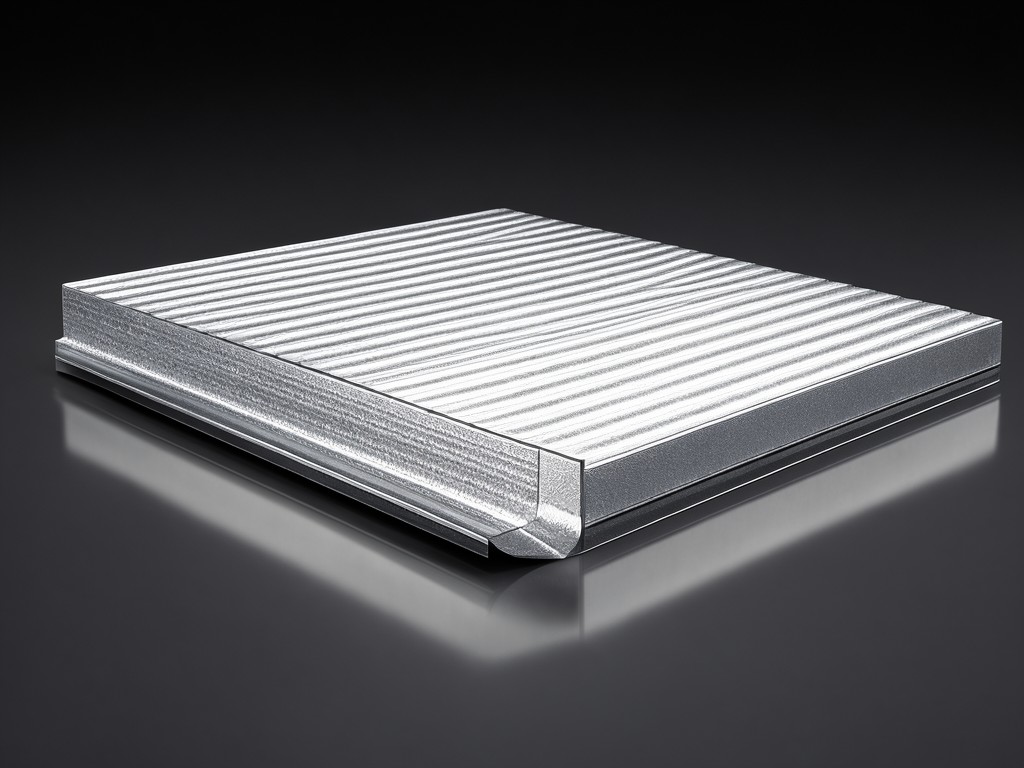
How Consistency Is Held Across Batches
The specification agreement starts with a three-document package: the panel schedule (thickness, width, length, core, skins, colour, coating), the joint detail drawings (horizontal, vertical, corner, base, head, jamb), and the quality annex (tolerances, test methods, acceptance criteria, hold points). All three are version-controlled in the project SharePoint; a change to any triggers a re-approval loop.
- Coil allocation: Each production order pulls from a single coil lot for outer skins and a single lot for inner skins. The mill certificate (EN 10204 3.1) is linked to the panel bundle label via QR code.
- Foam batch traceability: PIR batches are 2,000 kg; each batch gets a density certificate and a closed-cell content test (ASTM D6226). Mineral wool batches are traced to the fibreiser run; density and shot content are recorded.
- Roll-form first article: Before each width change, the line runs a 10 m first article. A laser profile scanner checks 12 cross-sections against the CAD nominal. Deviations > 0.15 mm on critical dimensions (joint leg height, gasket groove depth, stiffener rib position) stop the line until die adjustment.
- Continuous line monitoring: Infrared thermography tracks laminate temperature at the double-belt press. A 3°C differential across the width flags uneven foam rise — the operator adjusts chemical mix ratio in real time. Data logs are stored for 24 months.
- Artwork and branding approval: If the project requires printed logos or pattern coatings, the artwork proof is signed off on a 300 × 300 mm printed sample on the actual coil coating. Colour match is verified under D65, TL84, and A illuminants. Production does not start without the signed proof.
Any deviation found at final inspection — thickness, flatness, joint profile, colour, adhesion — is recorded against the bundle ID. The buyer receives a non-conformance report with photos and a disposition (accept-as-is, rework, reject) within 24 hours. No panel ships without a disposition code.
Inspection Items and Test Methods
| Inspection Item | Method / Standard | Frequency | Acceptance |
|---|---|---|---|
| Dimensional: thickness, width, length, squareness | Calibrated tape, digital caliper, laser square | Every panel (inline); 100% final | Per table tolerances |
| Flatness (oil-canning) | Straightedge + feeler gauge; max gap | Every panel | ≤ L/200 or 5 mm max, whichever less |
| Joint profile geometry | Laser profile scan (Keyence LJ-V) | First article + 1 per 500 m | ±0.15 mm on critical dims |
| Skin-to-core adhesion (peel) | ASTM D1781 climbing drum | 1 per foam batch | ≥ 50 N/25 mm (PIR); ≥ 30 N/25 mm (MW) |
| EN 1602 (core samples) | Every foam batch / fibreiser run | Within spec ± tolerance | |
| Thermal conductivity | ASTM C518 / ISO 8301 | 1 per foam batch; annual third-party | λ ≤ declared value + 0.002 W/m·K |
| Air / water penetration (assembly) | ASTM E283 / E331 on mock-up | Per project spec; min 1 per joint type | <0.3 L/s·m² @ 75 Pa; no leak @ 300 Pa |
| Coating adhesion / impact | ASTM D3359 cross-hatch; ASTM D2794 impact | Every coil lot | 5B adhesion; ≥ 10 J impact no cracking |
| Colour consistency | Spectrophotometer (X-Rite Ci7800) | Every coil; every 500 m² production | ΔE < 0.8 vs master chip |
Capacity, Tooling and Scheduling
The continuous line runs 18 m/min laminate speed. At 1,000 mm width, that's 1,080 m²/hour theoretical. Real-world throughput with coil changes, width changes, and first-article stops averages 750 m²/hour. Two shifts, five days gives 60,000 m²/week capacity. Current utilisation runs 70–85% depending on project mix.
Tooling lead times drive the critical path. A new module width requires roll-form die set: 6 weeks design, 4 weeks manufacture, 1 week commissioning. A new joint profile (male/female leg geometry) adds 3 weeks for the profile grinding. Custom colours on standard coatings need 2 weeks for coil coater scheduling. If the project needs a non-standard core density (e.g., 48 kg/m³ PIR for higher screw pull-out), the foam formulation trial adds 3 weeks and a minimum 5,000 m² run.
Scheduling works on a frozen spec date. The panel schedule, joint drawings, and quality annex must be signed off 4 weeks before the first coil slit date. After that, changes are change orders with 2-week minimum impact. We hold a 2-week buffer coil stock for standard colours (White, Light Grey, Dark Bronze) to absorb minor schedule pulls.
Care, Storage and Service Life
Panels ship on timber A-frames with 600 mm bearer spacing, wrapped in breathable polyethylene. Store on level ground, bearers aligned, maximum three bundles high. If site storage exceeds 4 weeks, cut the wrap corners to vent condensation — trapped moisture between panels causes white rust on galvanised edges within 10 days at 80% RH.
Install with vacuum lifters or suction cups on the outer skin; never hook the joint edges. Fastener pattern per the structural calc: typically #12-14 x 1-1/4" self-drilling at 300 mm o.c. on girts, 150 mm o.c. at edges and openings. Torque to 3.5 Nm — overdrive strips the thin skin, underdrive leaves the gasket uncompressed.
Service life modelling: 0.6 mm AZ150 steel with 25 µm polyester topcoat / 7 µm backer reaches 30 years in C3 environment (suburban/industrial) before first maintenance coat. In C4 (coastal) or C5-M (marine), specify 0.7 mm AZ185 with 35 µm PVDF — 40+ years to 10% red rust. Mineral wool cores do not degrade thermally; PIR loses 2–3% R-value in the first year (blowing gas diffusion), then stabilises. Joint gaskets: EPDM rated 20 years UV; replace at re-clad or major renovation.
Ready to lock in your panel spec? Send the panel schedule, joint details, and project timeline to /contactus. We'll return a first-article plan, coil allocation schedule, and a firm ship-date commitment within 3 business days.



