Specifying oem polyurethane cold room panels factory for Wholesale and OEM Orders
Cheaper stock options fail at the worst point in the season, leaving distributors with warped panels and lost refrigeration capacity. A factory‑direct specification locks in dimensional tolerance, core density, and skin adhesion before the first crate ships, turning a variable cost into a predictable line item.
Scope of Supply and Physical Form
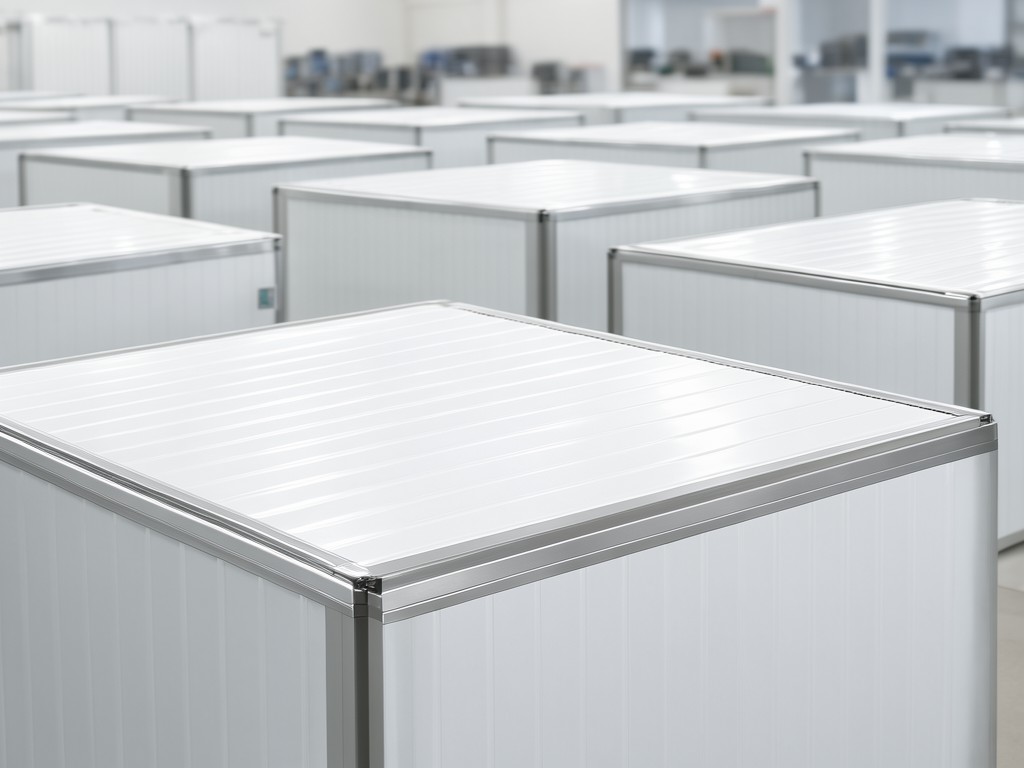
Panels leave the line as 1 200 mm × 2 400 mm sheets, 80 mm to 200 mm thick, with a 0.5 mm galvanized steel skin on each face. The polyurethane core is poured in a continuous‑flow press, giving a closed‑cell density of 40 kg/m³ ± 2 kg/m³. Edge profiles are CNC‑routed to a 30 mm tongue‑and‑groove that accepts standard cam‑lock fasteners, so the same panel fits walk‑in freezers, blast‑freeze tunnels, and modular cold‑storage rooms without re‑tooling.
- Length tolerance ± 2 mm, width tolerance ± 1.5 mm, thickness tolerance ± 1 mm.
- Skin adhesion tested to 1.2 MPa peel strength; delamination below 0.8 MPa triggers a re‑run.
- Each pallet carries 12 panels, wrapped in VCI film and strapped for 20‑ft container loading.
How It Performs in Use
| Test | Method | Acceptance Range |
|---|---|---|
| Thermal conductivity (λ) | ASTM C518 guarded hot plate | 0.020–0.023 W/m·K at 10 °C mean temp |
| Compressive strength | ISO 844 10 % strain | ≥ 150 kPa (core), ≥ 250 kPa (skin‑core composite) |
| Water vapour transmission | ASTM E96 desiccant method | ≤ 1.5 g/m²·day (80 mm), ≤ 1.0 g/m²·day (150 mm) |
| Fire rating (Euroclass) | EN 13501‑1 | B‑s2,d0 with intumescent coating; D‑s2,d0 uncoated |
| Dimensional stability (70 °C, 90 % RH, 168 h) | ISO 2796 | Length change ≤ 0.3 %, thickness change ≤ 0.5 % |
The table above is the inspection sheet the QA team signs off before a batch leaves the press. If any single value drifts, the whole pallet is held for root‑cause analysis — no “ship‑and‑hope”.
Materials and Construction Trade-offs
Core density vs. freight cost
Raising core density from 38 kg/m³ to 42 kg/m³ cuts λ by ~0.001 W/m·K but adds 4 kg per 80 mm panel. On a 40‑ft load that’s an extra 1.2 t, pushing freight from $2 800 to $3 100 per container. Most OEM buyers settle at 40 kg/m³ ± 2 kg/m³ — the sweet spot where thermal gain outweighs the shipping penalty.
Skin gauge is the other lever: 0.45 mm saves $0.12/m² but drops peel strength to 0.9 MPa, raising delamination claims in high‑humidity warehouses. We keep 0.5 mm as the default and offer 0.6 mm only for blast‑freeze corridors where impact loading exceeds 2 kN.
The polyurethane system uses a 2‑component MDI‑based polyol blend with a blowing agent that meets the current GWP‑150 ceiling. Switching to a lower‑GWP agent adds 3 % to raw‑material cost but future‑proofs the spec for EU F‑gas phase‑down schedules — a factor brand managers now price into 5‑year contracts.
Where This Product Beats Standard Alternatives
Standard EPS sandwich panel
λ ≈ 0.035 W/m·K — 60 % higher heat leak.
Water uptake 3 % after 28 days immersion; core crushes at 80 kPa.
Requires 150 mm thickness to match 80 mm PU R‑value, adding 30 % more steel and freight volume.
PU panel from a spot‑market supplier
Density drift ± 5 kg/m³ between lots; λ varies 0.022–0.028 W/m·K.
Skin adhesion spec only 0.7 MPa; delamination spikes after 12 months in 90 % RH.
No batch traceability; warranty limited to 12 months, no re‑work clause.
Our factory‑controlled line holds density within ± 2 kg/m³, skin peel at 1.2 MPa, and ships a full traceability packet (raw‑material lot, press parameters, QA sign‑off) with every container. That data cuts the buyer’s incoming inspection time from 4 h to 45 min per load.
Customisation Options and Their Limits
Tooling amortisation decides the viable envelope. A custom width (e.g., 1 100 mm) needs a new slit‑knife set — $4 500 one‑off, recovered after 1 200 panels. Colour‑coated skins (RAL 9010, 7016, 9005) add $1.8/m² and a 7‑day lead‑time for coil changeover. Embossed anti‑slip profiles on the interior face cost $0.9/m² but reduce peel strength by 0.15 MPa; we only approve them for walk‑in doors where foot traffic exceeds 200 cycles/day.
- Thickness steps: 80, 100, 120, 150, 180, 200 mm — each step a new press program, 2‑day setup.
- Fire‑retardant intumescent coating: +$3.2/m², adds 0.3 mm to skin, extends fire rating to B‑s2,d0.
- Pre‑cut service penetrations (pipe, cable) — CNC router time $0.45 per cut, minimum 20 cuts per order.
Beyond these, any geometry change (radius corners, integrated mounting brackets) moves the project into a full‑tooling quote with a 6‑week lead‑time and a 5 000‑panel MOQ.
Usage Scenarios and Buyer Segments
Regional cold‑store operators
Need 150 mm panels, 2 000 m² per site, re‑order every 18 months.
Value: consistent λ, fast‑track customs docs, palletised for forklift unload.
Modular blast‑freeze OEMs
Spec 100 mm with 0.6 mm skin, pre‑cut refrigerant ports.
Value: dimensional lock‑step with their frame jigs, zero field trimming.
Export distributors to MENA
Require 80 mm panels, RAL 9010, VCI wrap, 20‑ft container optimisation.
Value: freight‑density sweet spot, 5‑year warranty backed by factory audit trail.
Replacement rate, not unit price, drives the conversation. A 2 % panel‑swap rate over three years costs the operator $18 000 in labour and refrigerant loss — far more than the $0.35/m² premium for the tighter density spec.
Stock Availability and Reorder Planning
We hold a rolling buffer of 1 200 m² (80 mm, 100 mm, 150 mm) in the default galvanized finish. Standard colours turn in 10 working days from coil receipt; custom RAL adds 7 days. Lead‑time for a new thickness programme is 14 days after tooling sign‑off. A blanket PO covering 12 months locks the current density and skin gauge, shielding the buyer from raw‑material spikes — MDI rose 18 % in Q1 2024, but contracted buyers saw only a 3 % pass‑through.
- MOQ per line item: 300 m² (≈ 125 panels).
- Safety stock agreement: 10 % of forecast, invoiced quarterly.
- Traceability pack (mill cert, press log, QA sign‑off) shipped with every delivery.
If a buyer needs a faster turnaround, we can allocate a dedicated press shift — 48 h from order to load — at a 12 % surcharge that covers overtime and expedited VCI film.
Ready to lock in a spec that survives the season?
Request a quotation review


