Oem Prefabricated Steel Structure Sandwich Panel B2b Supplier - Bulk Supply and Specification Guide
Consistency depends on the tolerance stack between the steel skin, the insulating core, and the joint system; a 0.1 mm shift in skin thickness can change panel weight by 2 % and alter the thermal bridge factor enough to fail a cold‑storage U‑value test.
Scope of Supply and Physical Form
The standard delivery package includes factory‑cut sandwich panels, cold‑formed steel purlins and girts, self‑drilling fasteners with sealing washers, and a two‑component polyurethane sealant for the panel‑to‑panel joints. Panels are produced in 1000 mm nominal width, lengths up to 12 m, core thicknesses from 50 mm to 200 mm, and skin gauges of 0.5 mm to 1.0 mm hot‑dip galvanized steel (Z275 minimum). Dimensional tolerance on length is ±3 mm, on width ±2 mm, and on core thickness ±1 mm.
Critical Spec Rule
Core thickness drives both thermal resistance and structural stiffness; select 150 mm for cold storage, 100 mm for general warehousing.
| Option | Range / Detail | Cost / Lead‑time Impact |
|---|---|---|
| Core Material | PU, PIR, Mineral Wool | PIR adds ~5 % cost, 1 week lead; Mineral Wool adds ~12 % cost, 2 weeks |
| Core Thickness | 50 mm – 200 mm (25 mm steps) | Each 25 mm step ≈ 3 % price increase, no lead change |
| Skin Thickness | 0.5 mm, 0.7 mm, 1.0 mm | 1.0 mm adds ~8 % cost, 1 week extra for rolling |
| Coating System | Polyester 25 µm, PVDF 25 µm, Hot‑dip Galvanized Z275 | PVDF +15 % cost, 1 week; Galvanized standard |
| Panel Length | Up to 12 m (custom cut) | Lengths >10 m require special crating, +1 week |
| Fastener Package | Self‑drilling #12‑14, concealed clip system | Clip system +10 % cost, 3 days extra |
Where Cheaper Alternatives Fall Short
Panels sourced from low‑cost mills often show delamination at the skin‑core interface after 18 months of cyclic temperature swing, and cut‑edge corrosion appears within a single winter in coastal depots. The root cause is usually a reduced adhesive bead width (≤3 mm vs. the 6 mm spec) and a thinner zinc coating (Z140 vs. Z275).
- Delamination under freeze‑thaw cycles leads to core moisture ingress and loss of R‑value.
- Edge rust propagates into the core, creating thermal bridges that exceed design U‑values.
- Dimensional drift of ±5 mm on length forces on‑site re‑cutting, adding labor and waste.
- Inconsistent fastener pull‑out values cause joint leakage during high‑wind events.
Design Constraints Behind the Specification
Deflection under load governs the maximum span for a given core density; a 150 mm PIR core with 0.8 mm skins limits mid‑span deflection to 12 mm under 1.5 kN/m², meeting L/250 for most warehouse roofs. Shear modulus of the core, skin‑to‑core bond strength, and purlin spacing are the three variables that must be balanced before a drawing is released.
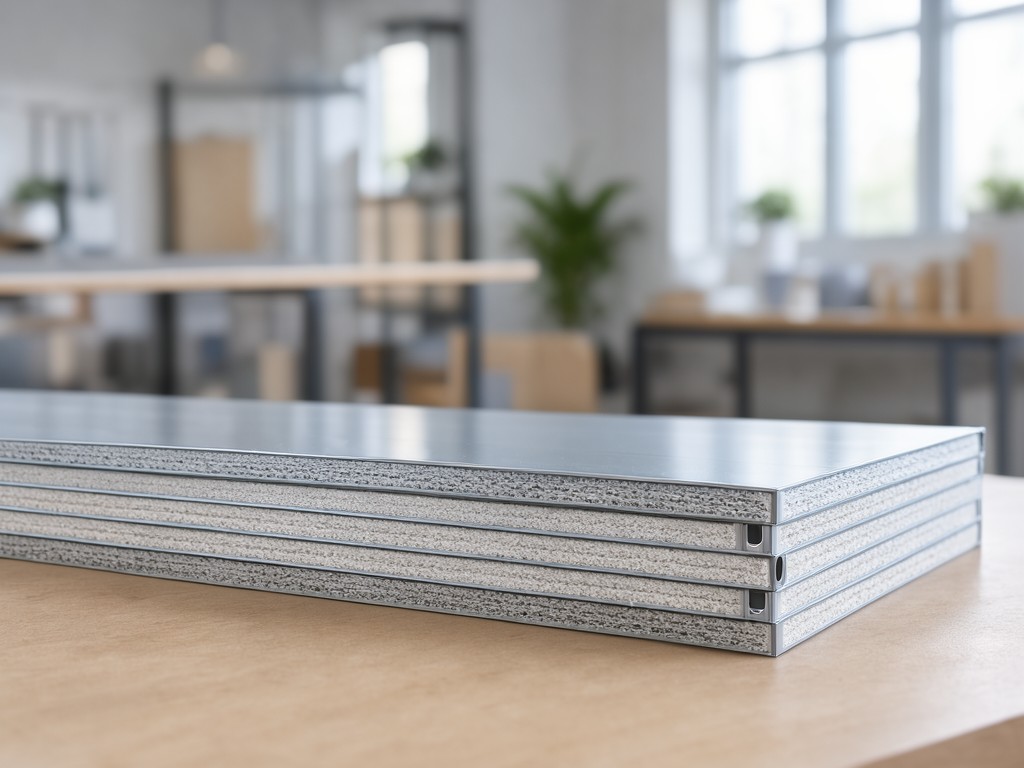
PU / PIR Core
Closed‑cell foam delivers R‑value 0.022 W/m·K per 25 mm, low water absorption, but limited fire rating unless faced with mineral wool.
Mineral Wool Core
Non‑combustible, Euroclass A1, higher density (120 kg/m³) improves impact resistance; thermal conductivity 0.035 W/m·K, so thicker panels needed for same U‑value.
| Service Condition | Common Failure Mode | Design Specification That Mitigates |
|---|---|---|
| Cold‑storage cycling (−30 °C to +30 °C) | Delamination at skin‑core bond | 150 mm PIR core with 0.8 mm skin and epoxy‑bonded interface |
| Coastal humidity & salt spray | Edge corrosion | Hot‑dip galvanized Z275 coating + sealed cut edges |
| Long‑span roof (≥9 m) | Excessive deflection > L/200 | 200 mm mineral wool core, 1.0 mm skin, stiffened purlin spacing ≤1.2 m |
| Frequent wash‑down (food plant) | Surface staining & coating wear | PVDF 25 µm topcoat with anti‑microbial additive |
Export Packaging and Handling Protection
Panels are stacked on treated timber bearers (100 mm × 100 mm) at 1.2 m centers, each layer separated by 3 mm polyethylene foam strips to prevent skin‑to‑skin abrasion. Edge protectors of 2 mm galvanized angle are bolted to the bearer ends, and the entire crate is wrapped in 150 µm UV‑stabilized stretch film. A desiccant sachet (30 g per m³) is placed inside the crate to control condensation during sea freight. Maximum stack height is three panels to keep compressive stress on the core below 0.15 MPa.
- Timber bearers rated for 2.5 t/m², inspected for knots and splits before use.
- Foam strips cut to panel width, secured with double‑sided tape to avoid movement.
- Angle protectors fastened with M8×30 mm bolts, torque‑checked at 12 Nm.
- Stretch film applied with 30 % overlap, sealed with heat‑shrink tape at seams.
Questions Buyers Ask Before Ordering
What is the typical lead time for a 5,000 m² order? Production runs 4‑6 weeks after drawing approval, plus 1‑2 weeks for export crating.
Can the panel system accommodate a 12 m clear span without intermediate supports? Yes, with a 200 mm mineral wool core, 1.0 mm skins, and purlins at 1.0 m centers; deflection stays under L/250.
What fire‑rating documentation is supplied? Each batch ships with a factory test report (EN 13501‑1) showing Euroclass B‑s1,d0 for PIR and A1 for mineral wool.
How are custom colours handled? RAL‑matched PVDF topcoat is applied in‑line; minimum order 1,000 m² per colour, 2‑week additional lead.
What warranty terms apply to the skin‑core bond? 10‑year limited warranty against delamination when installed per the supplied detailing guide and maintained per the cleaning schedule.
Request a sample panel or a full specification pack by contacting our technical sales team.
Submit a sample request


