Specifying Top Quality Fire Resistance Soundproof Steel Sandwich Panel Exporter for Wholesale and OEM Orders
When a brand extends an existing range into fire-rated wall and roof systems, the first container shipment reveals whether the specification held up under production reality. Panels that passed a lab test at 50 mm thickness can bow, delaminate, or fail the acoustic target once the line runs at 150 mm with a different core density. This page sets out the parameters we lock down before the coil hits the roll-former, so the shipment that arrives at your warehouse matches the datasheet your specifier approved.
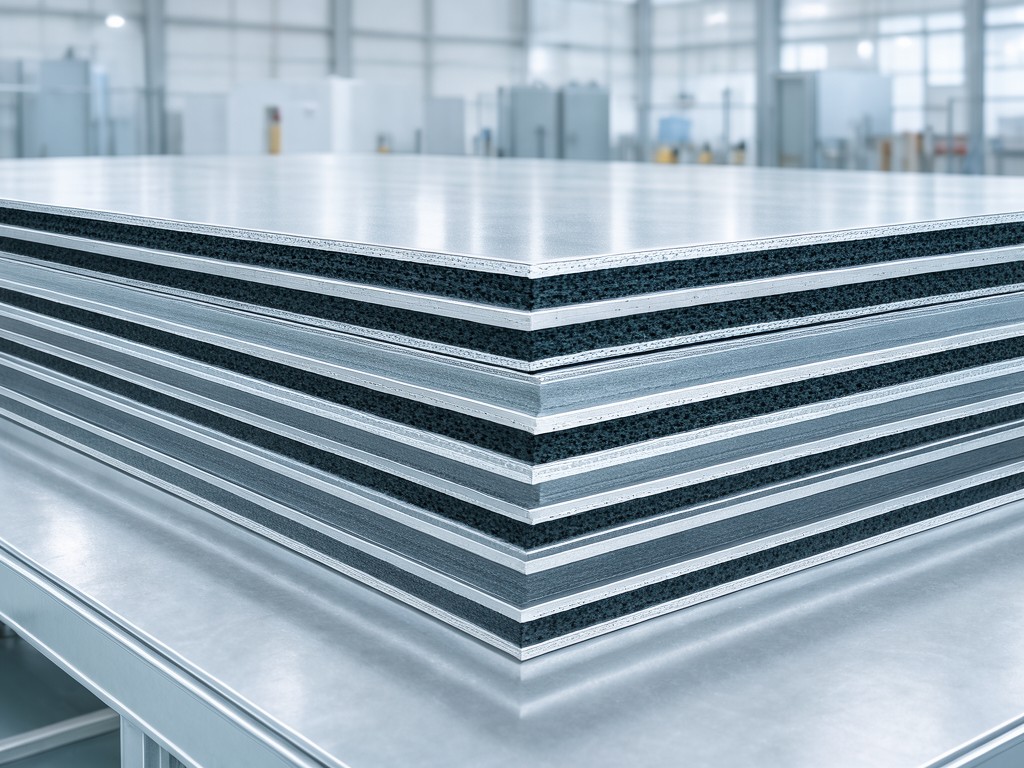
We supply steel sandwich panels with mineral wool or PIR cores, factory-applied coatings, and tongue-and-groove profiles engineered for continuous installation. Every order ships with mill certificates, core density reports, and a packing plan that protects the male/female joints during ocean transit. The sections below walk through the decisions that determine cost, lead time, and field performance.
Scope of Supply and Physical Form
Panels leave our facility as finished components — no site cutting of cores, no field-applied sealants required for the joint. Standard useful widths are 1000 mm and 1150 mm; lengths run from 2 m to 13.5 m in 50 mm increments, limited by container height and your site crane capacity. Thickness options: 50, 75, 100, 125, 150, 175, 200 mm. Core choices: rock wool (80–120 kg/m³) for fire ratings up to EI 120, or PIR (38–42 kg/m³) where thermal resistance drives the spec.
Facing steel: 0.4–0.7 mm hot-dip galvanized (Z180–Z275), pre-painted with polyester, SMP, or PVDF systems. Interior liner can differ from exterior — common spec is 0.5 mm PVDF exterior / 0.4 mm polyester interior. All panels carry a protective polyethylene film on the weather face; removal window is 60 days after installation.
Critical Specification Rule
Joint airtightness is verified at 50 Pa pressure differential per EN 12114. A 0.3 mm gap at the lock seam adds 3–5 dB transmission loss penalty at 500 Hz. We torque-test every 50th panel off the line; tolerance is ±0.15 mm on lock engagement depth.
Artwork & Branding Approval
Protective film accepts single-color logo print (max 300 × 100 mm) at 0.15 USD/m². Artwork vector files due at PO confirmation; proof returned within 48 hours. No print on PVDF faces — adhesive residue risk. Interior liner film is printable but removed before handover.
How It Is Built and What That Changes
Continuous double-belt lamination: steel coils feed through a pre-heater (120–140 °C for PIR, ambient for rock wool), adhesive bead applied via slot die, core mat laid in-line, top skin applied, then the assembly passes through a 12 m curing tunnel under 0.15 MPa pressure. Rock wool panels receive a secondary phenolic resin spray at the fiber interface to suppress dust release during cutting.
Profile roll-forming happens after lamination — this prevents core crush at the lock. Male/female profiles are cut from the same die set; die wear is tracked per 50,000 m and replaced at 0.08 mm flank wear. Adhesive: two-component polyurethane for PIR, water-based acrylic for rock wool. Peel strength minimum 0.45 N/mm (ASTM D1876 method) tested on every batch.
Cut-to-length saw uses carbide-tipped blades with dust extraction. Ends are squared to ±2 mm; cut faces receive a butyl sealant bead applied robotically. Panels stack on timber bearers at 1.2 m centers, wrapped in stretch hood with VCI inhibitor for marine shipments. Each pack labeled with heat number, core batch, production date, and QR code linking to the digital quality dossier.
Measured Performance in Real Use
Fire: 100 mm rock wool at 100 kg/m³ achieves EI 60 vertical, EI 90 horizontal per EN 13501-2. 150 mm reaches EI 120 both orientations. PIR cores char at 300 °C; 150 mm PIR rates EI 30 only — specify rock wool where code demands 60+ minutes. Acoustic: Rw 32 dB for 100 mm rock wool, 28 dB for 100 mm PIR (single panel, no flanking). Add 4–6 dB with 12.5 mm gypsum board on resilient channel.
Thermal: λ = 0.040 W/m·K (rock wool), 0.022 W/m·K (PIR). U-value at 100 mm: 0.40 vs 0.22 W/m²·K. PIR wins on thickness-constrained roofs; rock wool wins on fire compartment walls. Deflection under 0.6 kPa uniform load: L/200 at 3.0 m span (100 mm), L/200 at 4.2 m span (150 mm). Creep after 1000 hrs at 50 °C / 80% RH: <1.5 mm permanent set for rock wool, <0.8 mm for PIR.
Corrosion: Salt spray (ISO 9227) — 1000 hrs no red rust on PVDF, 500 hrs on SMP, 300 hrs on polyester. Cut edges are the failure point; we supply color-matched touch-up pens (RAL 9010, 7016, 9006 standard) at 1 per 500 m². Panel weight: 100 mm rock wool ≈ 16.5 kg/m², 100 mm PIR ≈ 11.2 kg/m². Factor this into purlin spacing and fastener schedule.
How to Choose Before Requesting a Quote
Start with the building code requirement — fire rating drives core type, thickness, and facing steel minimum. Then match the acoustic target: if the partition abuts a mechanical room, specify rock wool ≥100 kg/m³ and plan for resilient channels. For cold-store roofs, PIR 150 mm with 0.5 mm PVDF exterior / 0.6 mm polyester interior (vapor barrier side) is the baseline. Color selection affects solar absorption: dark PVDF on 150 mm PIR can push core temp to 85 °C; specify ventilated cavity or lighter shade.
Provide layout drawings with panel orientation, opening schedules, and flashing details. We return a shop drawing set within 5 business days showing panel numbers, cut lengths, joint stagger, and fastener positions. Approval signature on the shop drawing set locks the BOM — changes after sign-off incur retooling fees (die change 1,200 USD, saw reprogram 350 USD). Sample panel (1000 × 2000 mm) available at 180 USD + freight; refundable on first container order ≥2,000 m².
Capacity, Tooling and Scheduling
Two lamination lines: Line A (rock wool, up to 200 mm, 8,000 m²/day), Line B (PIR, up to 150 mm, 10,000 m²/day). Profile changeover: 4 hours between 1000 mm and 1150 mm widths. Color change on pre-painted coil: 1 shift for coil swap + 2 hrs line purge. We hold 12 standard RAL colors in 0.5 mm PVDF stock; custom colors require 14-day coil lead from the coater.
Standard pack: 12 panels (100 mm) or 8 panels (150 mm) per timber frame. 40 ft HC container takes 22 frames = 2,640 m² (100 mm) or 1,760 m² (150 mm). Max gross weight 26,500 kg. Vessel booking window: 14 days from production completion to port gate-in. Documentation package (mill certs, CoC, packing list, fumigation cert) shipped via courier at vessel departure.
| Order Profile | MOQ (m²) | Lead Time (Production) | Shop Drawing Turnaround | Sample Availability |
|---|---|---|---|---|
| Standard RAL, stock coil, 1000 mm width | 500 | 7–10 business days | 3 business days | Ex-stock (3 days) |
| Custom color, stock width, single thickness | 1,500 | 21–25 business days | 5 business days | After coil arrival (14 days) |
| Mixed thicknesses, custom width, project-specific flashings | 3,000 | 28–35 business days | 7 business days | After drawing approval |
| Repeat order, approved drawings on file | 300 | 5–7 business days | Not required | Not required |
Care, Storage and Service Life
Site storage: keep packs on level ground, bearers at 1.2 m centers, max stack height 2 frames. Cover with breathable tarpaulin — plastic sheeting traps condensation and causes white rust on galvanized edges within 14 days. Remove protective film within 60 days of installation; UV exposure beyond 90 days makes film brittle and leaves adhesive residue that requires solvent cleaning (voids coating warranty).
Fastener inspection at 12 months: check for backing out (thermal cycling), corrosion at washer face, and sealant integrity at cut edges. Re-torque to 3.5 Nm if movement >2 mm. Touch-up pen application: clean with isopropyl alcohol, apply thin coat, 2 hr cure before rain. Panel replacement: cut through lock seam with 1.6 mm abrasive disc, remove damaged panel, slide replacement in, seal new cut edges with butyl tape. Allow 4 hrs per panel for two-person crew.
Design service life: 25 years for PVDF-faced rock wool in C3 environments, 15 years for SMP-faced PIR in C4. Coating chalk rating (ISO 4628) after 10 years: PVDF ≤1, SMP ≤2, Polyester ≤3. Core settlement: rock wool <2% thickness loss over 20 years; PIR <1% but watch for facer delamination if roof ponding occurs. Warranty: 10 years coating adhesion, 5 years core thermal performance, 2 years joint airtightness — all contingent on installation per our manual and maintenance records.
Ready to Lock In Your Specification?
Send us the project specification section, layout drawings, and target ship date. We return a marked-up shop drawing set, a line-item BOM with panel numbers, and a firm production slot within 5 business days. Sample panel ships with the drawing package if requested.
Submit drawings and request a production slot


