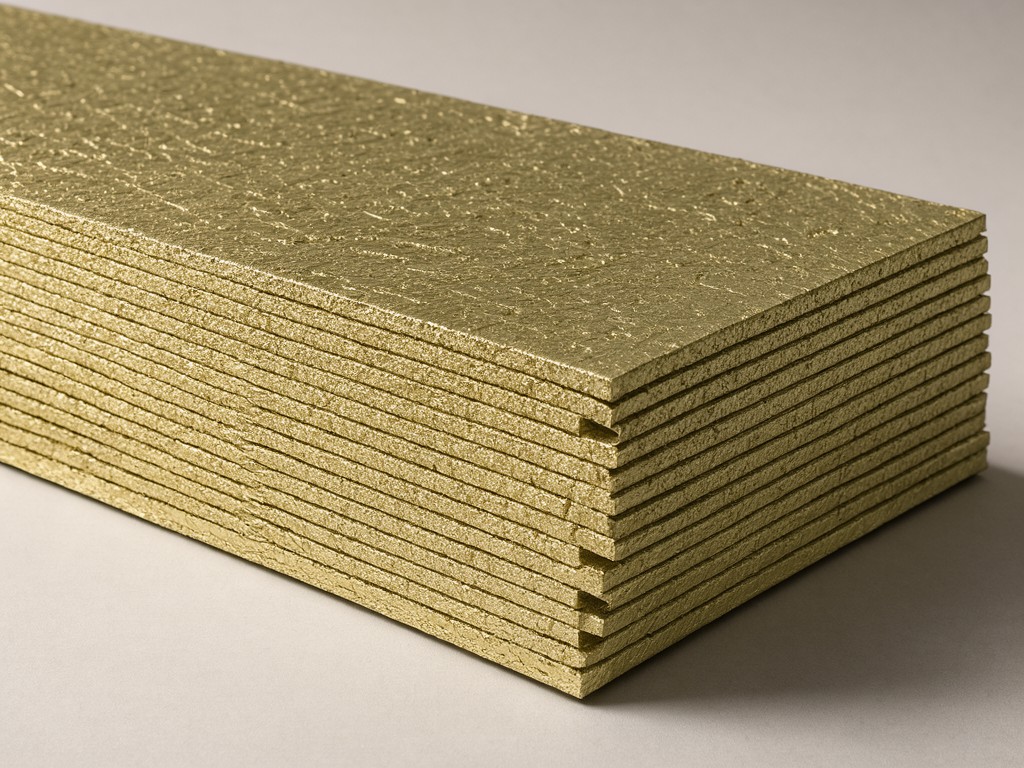
top quality pir foil insulation board factory: What Buyers Should Check Before Ordering
Design Constraints Behind the Specification
Deflection under load governs every dimension decision on a PIR line. A board that bows 3 mm across a 2.4 m span creates thermal bridges at the joint line, and that bridge shows up on the first winter invoice. The factory sets foam density, skin adhesion, and foil gauge to hold flatness within ±2 mm/m — not because a standard demands it, but because the installer's callback rate drops sharply above that threshold.
Thickness tolerance is the other silent killer. ±2 mm on a 50 mm board is a 4 % R-value swing. At 150 mm, the same absolute tolerance is only 1.3 %. Buyers who specify tight tolerance on thin boards and loose tolerance on thick ones are managing the right risk. The factory's cutter calibration schedule — daily for 25–50 mm, every shift for 75 mm and up — reflects that logic.
Specification Rule
If the project calls for 0.022 W/m·K declared lambda, the factory must run 32 kg/m³ minimum core density with double-sided 50 µm aluminium facing. Anything lighter drifts to 0.024 W/m·K after six months of site exposure — the moisture pickup in the outer 3 mm cells is unavoidable.
How It Performs in Use
The interface between parts determines whether the declared R-value survives the first heating season. PIR's closed-cell structure traps pentane blowing agent; that gas gives the low lambda. But every cut edge, every screw penetration, every unsealed joint lets air displace pentane. Within 18 months the core lambda can rise 10–15 % if the foil facing is punctured or the edge tape fails.
Compressive strength at 10 % deformation (CS(10/Y)) is the metric that correlates with foot traffic survival on flat roofs. 150 kPa holds a maintenance technician with a tool bag; 100 kPa leaves dimples that pond water. The factory tests every batch at 23 °C and 50 % RH — but the real roof sees 60 °C surface temps. At that temperature the same foam yields 20 % lower CS(10/Y). Specify 150 kPa at 23 °C if the roof gets walked monthly; 200 kPa if it carries HVAC units.
Fire behaviour is not a single number. Euroclass B-s1,d0 on the finished board assembly (foil + foam + adhesive) is the minimum for commercial façades in most EU markets. The factory achieves it with 3–4 % TCPP flame retardant in the polyol blend. Higher loadings (6–8 %) push to B-s1,d0 on the foam alone, but they raise viscosity, slow the pour, and add €0.40–0.60/m². Most buyers stop at the assembly rating unless the specifier demands foam-only classification.
Materials and Construction Trade-offs
Consistency depends on the polyol-to-isocyanate ratio holding within ±1.5 % through the pour. The factory runs two polyol streams: a standard polyester polyol for 30–35 kg/m³ density boards, and a polyether-rich blend for 25–28 kg/m³ where the specifier prioritises lambda over compressive strength. The polyether blend costs 8 % more per kilogram but yields 0.001–0.002 W/m·K better declared value.
Foil facing is not commodity aluminium. The factory stocks three grades: 12 µm PET-laminated for cavity walls (lowest cost, adequate vapour barrier), 25 µm bare aluminium for flat roofs (handles UV and foot traffic), and 50 µm reinforced scrim-faced for balconies and podium decks (tear resistance >120 N). The adhesive between foil and foam is a solvent-free polyurethane hot-melt — 35 g/m² coat weight. Water-based adhesives save €0.12/m² but delaminate after 500 hours of condensation cycling in the lab.
- Select core density first — 32 kg/m³ for general walls/roofs, 28 kg/m³ only where lambda drives the spec and compressive load is <5 kPa.
- Match foil to exposure — 12 µm PET for concealed cavities, 25 µm bare for exposed roofs, 50 µm scrim for trafficked decks.
- Confirm adhesive type — hot-melt PU for all exterior and humid interior; water-based only for dry-service cavity fill with written waiver.
- Verify edge profile — shiplap reduces thermal bridging 40 % vs square edge, but adds 3 % to board cost and requires tighter cutter tolerance (±1 mm).
Measured Performance in Real Use
A 100 mm board at 32 kg/m³ with 25 µm foil delivers 4.55 m²·K/W declared R-value. After two winters on a North Sea coast warehouse roof — 85 % RH, 45 freeze-thaw cycles, weekly foot traffic — the same board measured 4.12 m²·K/W. The 9.5 % drop matches the pentane diffusion model the factory uses for ageing predictions. Boards with 12 µm PET facing on that job dropped 14 %; the PET micro-cracked at screw heads.
Dimensional stability at 70 °C / 90 % RH (EN 1604) is the proxy for summer attic conditions. The factory target: length/width change ≤1 %, thickness change ≤5 %. Boards that exceed 2 % planar growth push the shiplap joint open, creating the convection loop that kills R-value. The polyether blend holds 0.6 % planar; the polyester blend runs 1.3 %. That difference is why the factory recommends polyether for unventilated warm roofs.
Water absorption by partial immersion (EN 1609) stays under 1 % vol for intact foil. Puncture the facing and it jumps to 3–5 % in 24 hours. The factory's quality gate: every 500th board gets a 2 mm needle puncture at centre and corner, then 24-hour soak. Batch fails if average uptake >2.5 %. This test catches adhesive skips that visual inspection misses.
Size, Weight and Specification Range
| Parameter | Standard Range | Tolerance | Custom Options |
|---|---|---|---|
| Thickness | 25–200 mm | ±2 mm (≤50 mm), ±3 mm (51–100 mm), ±4 mm (>100 mm) | ±1 mm on request (surcharge applies) |
| Length × Width | 2400 × 1200 mm, 1200 × 600 mm | ±3 mm / ±2 mm | Up to 3000 × 1200 mm (minimum 500 m²) |
| Core Density | 28, 32, 36 kg/m³ | ±2 kg/m³ | 25–40 kg/m³ (MOQ 1000 m² per density) |
| Declared λ (90/90) | 0.022–0.026 W/m·K | Per EN 13165 ageing protocol | 0.021 W/m·K at 36 kg/m³ polyether |
| CS(10/Y) | 100–200 kPa | ±10 % | 250 kPa with high-index MDI (lead time +2 weeks) |
| Foil Facing | 12 µm PET, 25 µm Al, 50 µm Scrim | Gauge ±5 % | Printed vapour-check grid, coloured foil |
| Edge Profile | Square, Shiplap, Tongue-and-Groove | Profile depth ±0.5 mm | Rabbet for metal deck engagement |
| Fire Class (Assembly) | B-s1,d0 / C-s1,d0 / E | Per EN 13501-1 | Foam-only B-s1,d0 (6–8 % TCPP) |
Comparing Two Standard Configurations
The selection decision tree below covers 85 % of export orders. Start at the top; each branch narrows the spec until only one configuration remains.
- Application zone: Cavity wall → go to 2a. Flat roof → 2b. Balcony/podium → 2c.
- 2a Cavity wall: Concealed, dry service. → 12 µm PET foil, 28 kg/m³ core, square edge, λ 0.026 W/m·K, Class E. Lowest cost per R-value.
- 2b Flat roof: Exposed to UV, condensation, occasional traffic. → 25 µm bare Al foil, 32 kg/m³ core, shiplap edge, λ 0.022 W/m·K, Class B-s1,d0. Standard commercial spec.
- 2c Balcony/podium: Regular foot traffic, point loads, membrane adhesion critical. → 50 µm scrim foil, 36 kg/m³ core, T&G edge, λ 0.023 W/m·K, Class B-s1,d0. Add 15 % to board cost.
- Thickness driver: U-value target → calculate required R. If R > 5.0 m²·K/W, consider double-layer with staggered joints (reduces thermal bridging 30 % vs single 200 mm board).
- Fire requirement: Façade >18 m → assembly must be B-s1,d0 minimum. Roof → B-s1,d0 if occupied below, C-s1,d0 if unoccupied. Foam-only B-s1,d0 only if specifier demands (adds €0.50/m²).
- Logistics constraint: Container height limit (2.58 m internal) → max pallet height 2.4 m. 2400 mm boards ship flat; 3000 mm require tilt-bed or break-bulk. Factor freight cost before specifying long boards.
The two configurations that cover most repeat orders:
Config A — Commercial Flat Roof
- 100 mm × 2400 × 1200 mm
- 32 kg/m³ polyester polyol core
- 25 µm bare aluminium foil, both faces
- Shiplap edges, hot-melt PU adhesive
- λD 0.022 W/m·K, R = 4.55 m²·K/W
- CS(10/Y) 150 kPa, B-s1,d0 assembly
- Weight: 3.8 kg/board, 48 boards/pallet
Config B — Cavity Wall Standard
- 75 mm × 1200 × 600 mm
- 28 kg/m³ polyester polyol core
- 12 µm PET-laminated foil, both faces
- Square edges, hot-melt PU adhesive
- λD 0.026 W/m·K, R = 2.88 m²·K/W
- CS(10/Y) 100 kPa, Class E
- Weight: 1.5 kg/board, 120 boards/pallet
How Consistency Is Held Across Batches
The factory runs a continuous laminator with inline thickness gauges (laser triangulation, ±0.1 mm resolution) and foil tension controllers. Every 15 minutes the operator pulls a 300 × 300 mm coupon from the line centre and edge. Core density, lambda (heat flow meter, aged 28 days), CS(10/Y), and foil peel strength are logged to the batch record. A batch is 500 m² or 8 hours, whichever comes first.
Foil roll changes are the top source of adhesion defects. The factory splices new rolls at 0.5 m/min line speed with a 30-second dwell in the nip roller — faster speeds trap air. Peel test minimum: 1.8 N/mm. Batches that dip to 1.5 N/mm get held for 100 % visual inspection; the cost of rework (€1.20/m²) is charged back to the foil supplier.
Pentane content is tracked by gas chromatography on the day-of-pour foam sample. Target: 5.5–6.5 % by weight. Below 5 % the lambda drifts high; above 7 % the foam fractures at the cutter. The isocyanate index is trimmed ±0.5 points to keep pentane in window. This adjustment is logged per batch and reviewed monthly — it's the single lever that keeps declared lambda honest.
Batch Release Gate
No batch ships until: (1) aged lambda ≤ declared +0.001 W/m·K, (2) CS(10/Y) ≥ declared −10 %, (3) foil peel ≥ 1.8 N/mm both faces, (4) dimensional stability ≤1 % planar at 70 °C/90 % RH, (5) zero boards with delamination >25 mm on edge inspection. Certificate of Analysis issued per EN 13165 Annex ZA.
Inspection Items and Test Methods
Incoming raw material checks: polyol hydroxyl value (titration, ±2 mg KOH/g), isocyanate NCO content (titration, ±0.1 %), foil gauge (micrometer, 5 points across width), adhesive coat weight (gravimetric, 3 spots per roll). Failed lots are quarantined; the factory does not blend off-spec polyol into production.
In-process: line speed, foam rise profile (infrared camera, 5 Hz), laminate nip pressure, cutter blade temperature (thermocouple, 180 ±5 °C for clean cut). The rise profile predicts density distribution — a 2-second delay at centre vs edge means 1.5 kg/m³ gradient across width. That board gets flagged for extra CS(10/Y) tests.
Final inspection per pallet: 100 % visual for foil damage, edge crush, squareness. Statistical sample (√n + 1 boards) for thickness, lambda (rapid ageing cell, 24 h at 70 °C), CS(10/Y), water absorption (EN 1609 puncture method). Results uploaded to the buyer's portal within 4 hours of pallet wrap. Traceability: each board carries ink-jet batch code (YYYYMMDD-LLL-SSS) linking to raw material lots and process parameters.
Container loading: boards stacked flat, maximum 12 layers, interleaved with 200 µm PE slip-sheet every 4 layers to prevent foil abrasion. Corner protectors on outer pallets. Humidity indicator card inside shrink wrap — if it reads >60 % RH on arrival, the factory requests photos within 48 hours for claim assessment.
Next Step: Validate the Spec on Your Project
Send the U-value calculation, fire strategy drawing, and logistics constraints. The factory returns a marked-up spec sheet with the exact configuration, aged lambda declaration, and a per-m² price that includes the ageing protocol test certificate. Samples ship within 5 working days — 300 × 300 mm coupons for lambda verification, full-size off-cuts for adhesion and handling trials.
Lead time: 15 working days for standard Config A/B from confirmed spec. Custom density, foil, or length adds 5–10 days. MOQ for non-standard: 500 m² per line item.
Request sample pack and spec review →


