top quality prefabricated sandwich panel system solution: Specification, Ordering and Quality Notes
Where Cheaper Alternatives Fall Short
Deflection under load governs every complaint that reaches a second-source inquiry. Buyers who switched on price alone report core delamination at the panel-to-panel joint within eighteen months, facing corrosion where the protective film lifted during transit, and flatness deviations that exceed 6 mm over a 3 m length — enough to reject a cold-store installation at handover. The root cause is usually a discontinuous press cycle that cannot hold adhesive cure temperature across the full panel width, combined with a facing coil that skipped the primer coat to save two dollars per square metre.
Balance and load analysis shows that a 100 mm PIR panel rated for 2.5 kN/m² uniform load will bow 12 mm at mid-span when the core density drifts from 40 kg/m³ to 36 kg/m³. That drift is invisible on the packing list but decisive on site. Cheaper lines also tend to run a single-sided adhesive bead rather than a full-width roll coat, so the bond line fails first at the female joint where moisture ingress starts.
How to Choose Before Requesting a Quote
| Parameter | Standard Range | Tightened Tolerance (On Request) | Impact on Lead Time |
|---|---|---|---|
| Core density (PIR/PUR) | 38–42 kg/m³ | 40 ± 1 kg/m³ | +3–5 days |
| Facing thickness (steel) | 0.45–0.60 mm | 0.50 ± 0.02 mm | +2 days (coil allocation) |
| Flatness (3 m span) | ≤ 6 mm | ≤ 3 mm | +2 days (extra cooling station) |
| Joint air permeability | ≤ 0.5 m³/(h·m²) @ 50 Pa | ≤ 0.15 m³/(h·m²) @ 50 Pa | +1 day (gasket profile change) |
| Color match (ΔE vs master) | ≤ 1.5 | ≤ 0.8 | +4 days (coil batch hold) |
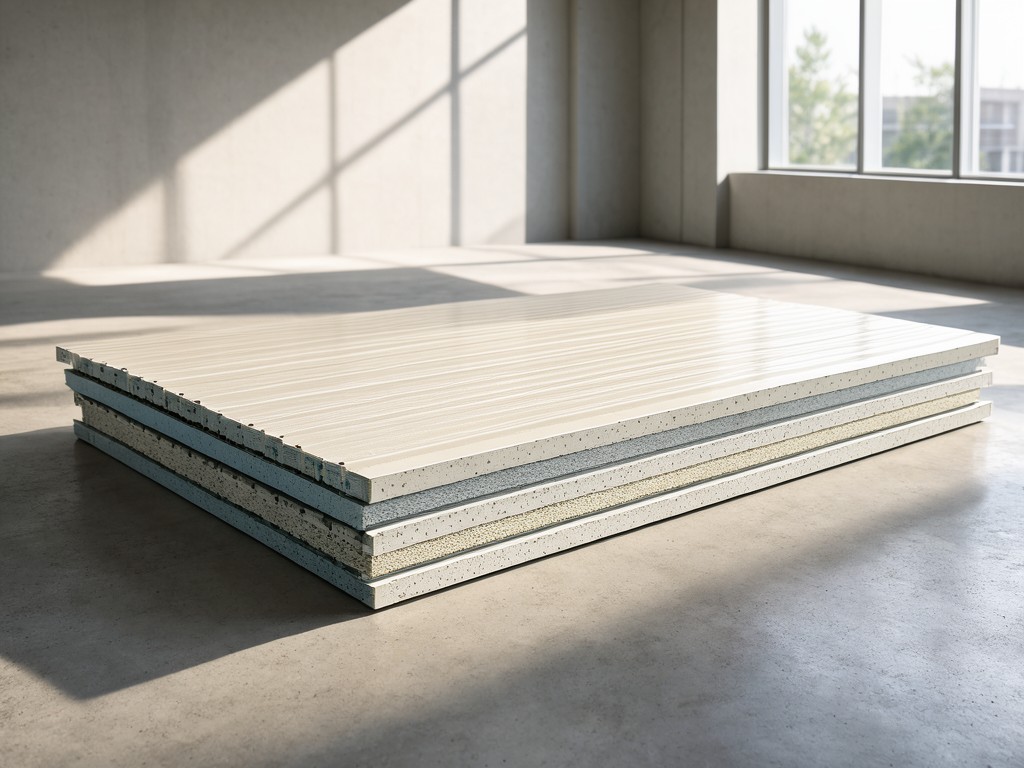
Consistency depends on locking the coil batch, core formulation, and press recipe before the first panel enters the line. A quotation review that skips the sample approval step — signed off on flatness, joint fit, and color under D65 lighting — is the single biggest predictor of a rejected shipment.
Requirements by Buyer Segment
Private-Label Buyer
Needs unbranded packaging, generic protective film (no mill logo), and a certificate of conformity that references only the buyer's part number. Traceability must stop at the buyer's SKU — no factory lot codes visible on the panel label.
MOQ typically 500 m² per color per profile to justify a dedicated coil slit.
Retail / Distributor Buyer
Requires retail-ready bundles: 12 panels per pack, strapped with edge protectors, labeled with EAN barcode and fire-class sticker. Stock turnover demands 15-day lead time on standard RAL colors; custom colors shift to 30 days.
Returns clause: panels with film damage or edge burrs > 0.5 mm are replaced at factory cost.
Facility / Project Buyer
Cold-store or cleanroom projects need panel-by-panel U-value declaration, fire test report (EN 13501-1), and joint detail drawings stamped by the factory engineer. Delivery sequencing must match the erection schedule — late panels halt the crane.
Warranty negotiation centers on delamination coverage: 10 years is standard, 15 years requires adhesive upgrade and adds 4% to unit price.
How Consistency Is Held Across Batches
The press line runs a statistical process control chart on core density every 30 minutes; if two consecutive readings fall outside 40 ± 1.5 kg/m³, the line stops for foam recalibration. Facing coil is inspected at the decoiler for primer thickness (minimum 5 µm per side) and topcoat DFT (20 ± 2 µm). Any coil that fails is segregated and sold as B-grade — it never reaches the panel line.
Adhesive application weight is monitored by inline gravimetric sensor targeting 180 g/m² ± 10 g/m². A drift beyond ± 15 g/m² triggers an automatic purge and re-prime of the roll coater. Joint profile dimensions are checked on the first, middle, and last panel of each production run using a go/no-go gauge set; the gauge set itself is calibrated monthly against a master kept in the quality lab.
Color consistency across batches is managed by holding a master coil sample from the first approved run. Every subsequent coil is measured against that master on a spectrophotometer (D65/10°); ΔE > 0.8 triggers a hold for visual panel review under standardized lighting before release.
Inspection Items and Test Methods
Incoming inspection on every production lot covers five mandatory checks. Dimensional: length ± 2 mm, width ± 1 mm, thickness ± 1 mm, squareness ≤ 1 mm/m. Visual: facing defects (scratches, coil breaks, color streaks) mapped against the buyer's acceptance criteria — typically zero defects in zone A (visible face), ≤ 3 minor defects per panel in zone B (hidden face). Flatness: measured on a 3 m straight edge at mid-span and quarter-points; recorded to 0.1 mm. Adhesion: 50 mm wide tensile peel test at 180° on three specimens per panel; minimum 0.45 N/mm for PIR, 0.35 N/mm for mineral wool. Thermal: guarded hot-box U-value spot check on one panel per 500 m²; result must fall within ± 5% of declared value.
Fire reaction testing follows EN 13501-1 on the declared system (core + facing + joint). The factory maintains a current classification report; buyers receive a copy with the first shipment. Air permeability is tested per EN 12114 on a representative joint assembly; water penetration per EN 12865. Both tests are run once per profile design change, not per batch, unless the buyer specifies batch testing in the quality agreement.
All inspection records are stored for five years and linked to the panel's unique production code (date + line + coil lot + press recipe). Buyers can request the full traceability pack at order placement; it ships with the commercial documents at no extra charge.
Request a Quotation Review
Send your panel schedule, performance specification, and target delivery window. We return a marked-up drawing set, a sample approval plan, and a firm lead-time commitment within two business days.
Start the quotation review →


