wholesale concealed screw metal roof sandwich panels exporter: Specification, Ordering and Quality Notes
The core trade-off sits between panel span capability and thermal bridge control. A 100 mm PIR core with 0.6 mm outer skins typically clears 4.5 m purlin centres at 1.0 kN/m² snow load, but the concealed clip system adds 12–15 % to the installed cost versus through-fixed alternatives. Buyers who specify the clip profile early — before roll-forming tooling is cut — avoid the 3–4 week re-tool penalty that appears when the clip geometry changes after first article approval.
Construction Method and Its Effect on Consistency
Material choice starts with the conditions the product will meet: coastal salt spray, interior humidity class, or fire compartment requirements. The outer skin is almost always G550 Z275 or AZ150 pre-painted steel; the inner skin drops to G300 Z180 when the panel sits behind a vapour barrier. Core density for PIR ranges 38–42 kg/m³ — lower densities save freight weight but increase the risk of core crush during clip insertion.
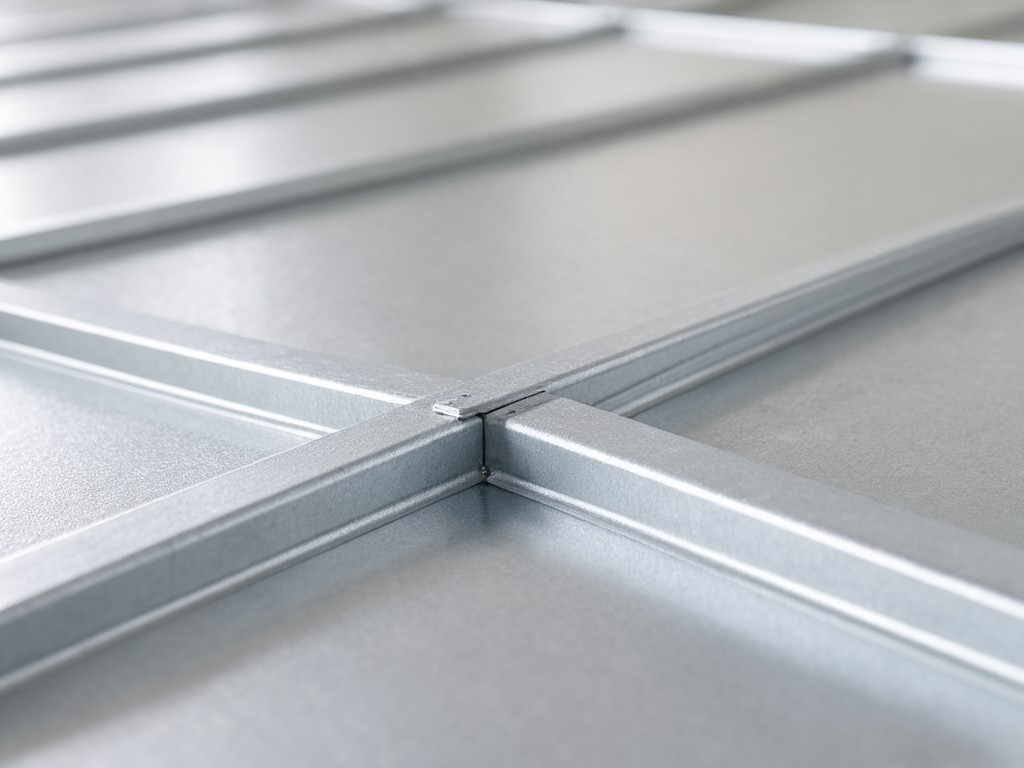
The concealed screw system uses a roll-formed female clip that engages a male rib on the panel. Clip spacing is fixed at 600 mm centres for spans up to 3.6 m; beyond that, a secondary clip row at mid-span is mandatory. Each clip carries two self-drilling screws into the purlin, so the purlin flange width must be ≥ 45 mm to maintain edge distance. Tolerances on clip height are ±0.3 mm; anything wider creates a visible oil-canning wave across the sheet.
Who Uses It and Where It Matters
Distribution yards serving industrial shed builders order 500–2,000 m² per release, typically in 1,200 mm cover width. They need panels that nest without core damage during forklift handling — hence the 0.5 mm minimum inner skin for export packs. Cold-store contractors specify 150–200 mm cores with a vapour-seal tape factory-applied to the female joint; they reject panels where the tape adhesion drops below 8 N/25 mm after 72 h at 40 °C / 90 % RH.
Architectural specifiers on commercial façades demand colour consistency ΔE ≤ 1.0 across batches. That forces a single coil allocation per project and a held-stock agreement of 5 % overage. The concealed clip also eliminates fastener caps, so the façade reads as a continuous metal plane — a detail that fails if the clip leg height varies more than 0.2 mm along a 12 m run.
OEM and ODM Programme Structure
Private-label buyers supply their own coil paint spec (RAL or custom) and receive a first-article panel with full dimensional report, peel adhesion, and thermal conductivity certificate. Tooling for a new clip profile costs US$ 8,000–12,000 and is amortised over 50,000 m²; the mould belongs to the buyer but remains in our press line. Artwork for protective film logos requires vector files at 300 dpi, approved 10 working days before coil slit.
ODM development starts with a joint load-span table. We model the panel in FEA using the actual clip stiffness curve, then validate with a four-point bend test at 1.5× design load. If the client needs a non-standard cover width — say 1,050 mm to match a legacy roof — the roll-form changeover adds two days per colour run. Minimum order for a custom width is 3,000 m² to justify the slit-coil setup.
Inspection Items and Test Methods
Every production lot undergoes: dimensional check (length ±2 mm, cover width ±1 mm, squareness ≤ 3 mm), peel adhesion at 180° (min 6 N/25 mm), and foam density via 50 mm cube core samples (three per 1,000 m²). Thermal conductivity is tested to EN 12667 on a 300 × 300 mm specimen; declared λ must not exceed nominal + 0.002 W/m·K. Salt spray resistance follows ISO 9227 NSS 1,000 h for coastal grades — blister density ≤ 2 (S2) and creep from scribe ≤ 2 mm.
Clip pull-through is verified on a 10-panel mock roof: each clip loaded to 2.5 kN for 60 s. Permanent deformation of the clip leg must stay under 0.5 mm. Fire performance to EN 13501-1 (typically B-s2,d0 for PIR) is certified per thickness; the certificate covers the exact core density and skin combination shipped.
Ordering, Tooling and Lead-Time Questions
What drawings or samples are needed before first production?
A signed GA drawing showing purlin centres, clip type, and flashing details. If the clip is non-standard, a 3D STEP file of the clip profile plus a physical clip sample for hardness check (target 450 HV). We return a first-article panel within 15 working days of drawing approval.
How is colour consistency controlled across multiple containers?
Single coil allocation per project. We hold the master coil in our slitter and release sub-coils only after spectrophotometer verification (D65/10°, ΔE ≤ 0.7 vs master). Each container carries a colour chip from the actual coil end; the buyer signs off on the chip before shipment.
What are the MOQ and lead-time breakpoints?
Standard colours (RAL 9010, 9006, 7016): 500 m², 10 working days ex-works. Custom colours: 2,000 m², 20 working days including paint lead-time. Custom clip tooling adds 25 working days for the first order; repeat orders revert to standard lead-time. Export packaging (seaworthy timber crates, VCI film, corner protectors) adds 2 days.
How are warranty claims handled on concealed-clip systems?
Warranty covers skin perforation (15 yr), paint adhesion (10 yr), and thermal performance (10 yr). Claims require site photos, batch traceability stickers from the panel label, and a clip extraction report showing screw pattern. We replace panels ex-works; freight and labour are negotiated per project agreement.
| Finish System | Coating Thickness (μm) | UV Warranty (years) | Typical End Use | Stock Availability |
|---|---|---|---|---|
| Standard Polyester (SP) | 25 | 10 | Industrial sheds, agricultural | Ex-stock 9010 / 9006 |
| High Build Polyester (HBP) | 35 | 15 | Coastal warehouses, cold stores | 4-week lead |
| PVDF 70/30 | 27 | 20 | Architectural façades, airports | 6-week lead |
| PUR / PA (Polyurethane / Polyamide) | 50 | 25 | Extreme marine, chemical plants | 8-week lead |
Cost and durability pull in opposite directions once the project moves beyond standard industrial spans. A 200 mm PIR panel with PVDF finish and custom clip tooling lands at roughly US$ 42/m² FOB — double the SP baseline — but delivers a 25-year colour warranty and the clip geometry that satisfies the architect’s flat-plane requirement. The buyer who locks the clip drawing, coil allocation, and test protocol before the first coil hits the slitter is the one who avoids the re-roll, re-coat, and re-ship cycle that erodes margin on repeat orders.
Ready to lock your specification? Send the GA drawing, purlin schedule, and target RAL code. We return a first-article panel with full test pack in 15 working days.
Start project discussion


