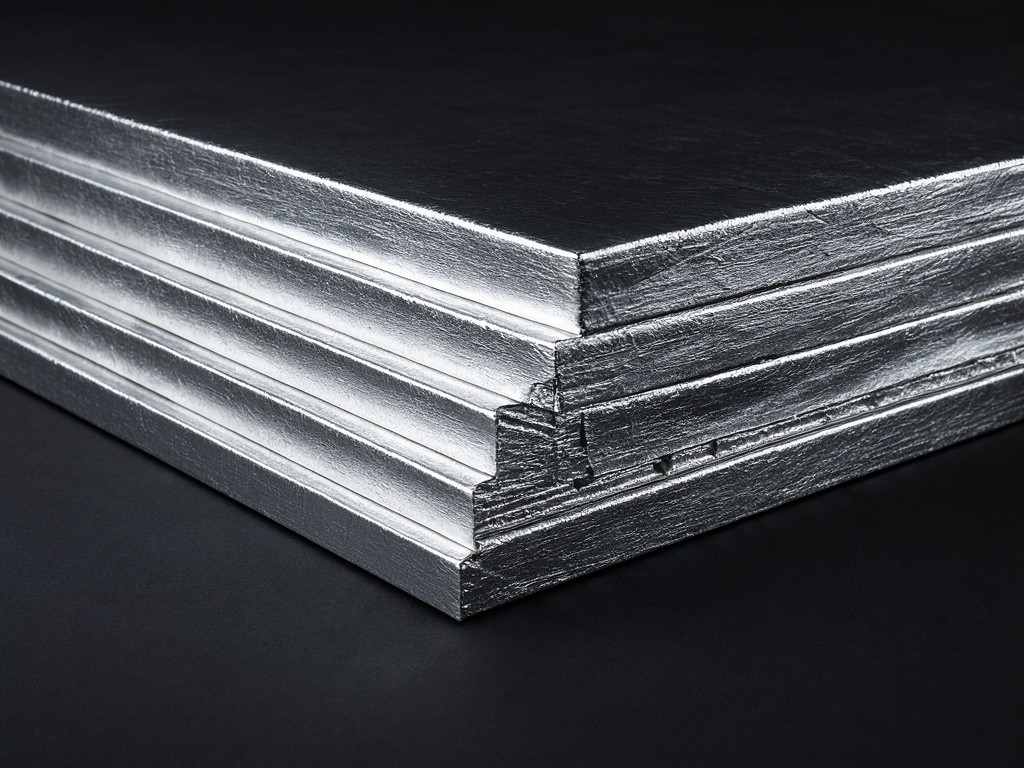
wholesale foil faced pir rigid insulation panels exporter - Bulk Supply and Specification Guide
What This Product Is and Where It Fits
The limiting factor is rarely the headline lambda value printed on the datasheet. It is the foil adhesion after six months of site exposure, the dimensional shift when the stack sees 40°C in a metal container, and the compressive creep under point loads from mechanical fixings. This guide covers the specification decisions that keep those failures out of your repeat orders.
Foil-faced polyisocyanurate (PIR) rigid panels serve as the thermal envelope backbone for commercial roofing systems, insulated wall cavities, and cold-store construction. Buyers in distribution, specialist facade contractors, and OEM sandwich-panel fabricators order by the container load — typically 2,400 mm × 1,200 mm sheets in 25–150 mm thicknesses — and judge supply consistency on three metrics: thermal drift after ageing, foil peel strength after UV/condensation cycling, and flatness tolerance that keeps standing-seam clips from telegraphing.
The product family splits into two construction grades. Grade R (roofing) uses a heavier foil laminate — usually 50 µm aluminum with a polyethylene copolymer tie layer — to survive bitumen torch-on or single-ply membrane adhesion. Grade W (wall/cavity) runs a lighter 25–30 µm foil with an anti-corrosion primer, optimized for brick-tie clearance and vapor control. Both grades share a closed-cell PIR core target of ≥ 90 % cell closure, blown with pentane, density locked at 30–32 kg/m³ for the compressive strength-to-weight ratio that keeps handling damage below 2 % per truckload.
Design Constraints Behind the Specification
Repeat loading drives the failure. A panel that passes initial λ = 0.022 W/m·K at 10 °C mean temperature can drift to 0.026 W/m·K after two years if the blowing-agent diffusion path isn't controlled by foil integrity. The design constraint is therefore vapor permeance of the facing system: ≤ 0.5 g/m²·day (ASTM E96 wet cup) for Grade R, ≤ 1.0 g/m²·day for Grade W. Thicker foil lowers permeance but increases roll cost and reduces drape over profiled decks — a trade-off your project engineer must sign off before we cut tooling.
Dimensional stability is the second constraint. EN 1604 requires ≤ 1 % length/width change after 48 h at 70 °C / 90 % RH. We achieve this by balancing isocyanate index (typically 1.15–1.20) against polyol hydroxyl number so the cross-link density resists post-cure shrinkage without making the foam brittle at −20 °C installation temperatures. The result is a core that holds ± 2 mm on a 2,400 mm sheet across the full pallet, which keeps mechanical fastener patterns repeatable for your install crews.
Complaint-Prevention Matrix
| Site Condition | Typical Failure Mode | Spec Lock-In |
|---|---|---|
| Rooftop UV + condensation cycling (coastal) | Foil delamination at lap joints, corrosion streaks | 50 µm foil + 15 g/m² PE copolymer tie layer; salt-spray ≥ 1,000 h (ISO 9227) |
| Cold-store floor, forklift point loads | Core crush, thermal bridging at joints | Compressive strength ≥ 150 kPa (EN 826); 150 mm min. thickness |
| Container transit 45 °C / 80 % RH, 30 days | Panel bow > 5 mm, foil wrinkling | Dimensional stability ≤ 0.5 % at 70 °C/90 % RH; edge seal tape factory-applied |
| Retrofit cavity wall, damp substrate | Foil blistering, mold behind panel | Vapor permeance ≤ 1.0 g/m²·day; anti-corrosion primer on foil interior face |
Materials and Construction Trade-offs
Weight and stiffness trade off against each other in the facing laminate. A 50 µm foil with 25 g/m² adhesive coat adds 180 g/m² to the panel but raises peel strength from 3.5 N/mm to 6.2 N/mm (T-peel, 180°). For Grade W projects where the panel sits behind a ventilated rainscreen, the lighter 25 µm foil with 12 g/m² coat saves 90 g/m² and cuts container weight by 1.2 t per 40 ft HC — often the difference between a 24 t and a 26 t payload limit.
Grade R — Roofing / Torch-On
- Foil: 50 µm aluminum, both sides
- Tie layer: 25 g/m² PE copolymer
- Core: 32 kg/m³, pentane blown
- Edge profile: Shiplap or tongue-and-groove
- Typical λ₁₀: 0.022 W/m·K (aged 0.024)
Grade W — Wall / Cavity / Cold Store
- Foil: 25–30 µm aluminum, internal face primed
- Tie layer: 12 g/m² PE copolymer
- Core: 30 kg/m³, pentane blown
- Edge profile: Square or shiplap
- Typical λ₁₀: 0.023 W/m·K (aged 0.025)
The polyol blend is the hidden variable. We run a polyester-polyether co-polyol (OH 350–380 mg KOH/g) for Grade R to maximize char yield and fire performance (Euroclass B-s1,d0 at 50 mm). Grade W uses a pure polyester polyol (OH 420 mg KOH/g) for lower viscosity during the discontinuous panel pour, which gives tighter cell structure and better dimensional stability at the cost of 15 s longer demould time per station. Your order spec locks the polyol batch; we hold 40 t safety stock per grade to avoid mid-run substitution.
What Gets Checked Before Shipment
Every production lot passes through a three-gate release. Gate 1: inline lambda measurement on a 300 mm × 300 mm coupon cut from the centre of the first, middle, and last panel of each bunk. Acceptance window 0.021–0.023 W/m·K at 10 °C. Gate 2: T-peel on five random foil-core interfaces per bunk; minimum 4.0 N/mm for Grade R, 3.0 N/mm for Grade W. Gate 3: dimensional check on 10 % of sheets — length, width, thickness, squareness, and flatness (straightedge + feeler gauge).
| Test Parameter | Method | Frequency | Acceptance Criteria |
|---|---|---|---|
| Thermal conductivity (λ) | Guarded hot plate (EN 12667) | 3 per bunk (start/mid/end) | 0.021–0.023 W/m·K @ 10 °C |
| Foil peel adhesion | T-peel 180° (EN 12289) | 5 per bunk | ≥ 4.0 N/mm (Grade R), ≥ 3.0 N/mm (Grade W) |
| Compressive strength | EN 826 (10 % deformation) | 1 per 500 m² | ≥ 150 kPa (Grade R), ≥ 120 kPa (Grade W) |
| Dimensional stability | EN 1604 (48 h, 70 °C / 90 % RH) | 1 per production shift | ΔL, ΔW ≤ 1.0 %; ΔT ≤ 2.0 % |
| Vapor permeance | ASTM E96 (wet cup) | 1 per foil roll change | ≤ 0.5 g/m²·day (R), ≤ 1.0 g/m²·day (W) |
| Flatness | Straightedge + feeler gauge | 10 % of sheets | ≤ 5 mm over 2,400 mm |
Failed bunks are segregated, re-faced if peel is the only defect, or down-graded to non-structural fill panels. We do not ship marginal lots — your container receives a single lot number with a consolidated CoA covering all six gates.
Capacity, Tooling and Scheduling
The discontinuous panel line runs two 2,400 × 1,200 m moulds on a 12-station carousel. Cycle time: 4 min 20 s for 50 mm, 5 min 10 s for 100 mm, 6 min 40 s for 150 mm. Annual nameplate capacity is 3.2 million m² at 50 mm equivalent; practical throughput with grade changeovers averages 2.7 million m². Current booking horizon: 3 weeks for standard Grade R/W in 50/75/100 mm, 5 weeks for non-standard thicknesses or custom foil prints.
Tooling changes are limited to foil roll swaps (20 min) and edge-profile insert changes (45 min). We do not re-tool core density mid-order — the polyol batch and isocyanate index are fixed per grade. If your project needs a hybrid (e.g., Grade R foil on Grade W core for a warm-roof retrofit), that requires a trial bunk (500 m²) and a signed deviation waiver before we allocate line time.
Lead-time rule: Standard grades ex-works 10 working days after PO confirmation and artwork approval for printed foil. Add 5 days for container stuffing and VGM certification. Peak season (Q3) adds 7–10 days; we publish a rolling 8-week capacity forecast every Monday — request the current sheet.
Packing, Marking and Freight Configuration
Panels stack flat on 2,400 × 1,200 mm timber bearers (ISPM-15 stamped), 30 sheets per bunk for 50 mm, 15 sheets for 100 mm, 10 sheets for 150 mm. Each bunk is stretch-hooded with 100 µm UV-stabilized LDPE, corner boards top and bottom, and two polyester strapping bands tensioned to 450 kgf. Gross bunk weight maxes at 950 kg for 40 ft HC floor-loading limits.
Marking: each sheet carries a laser-etched batch code (YYMMDD-GRADE-THICKNESS-LOT) on the foil face at 300 mm from the long edge. Bunk labels duplicate the code plus net m², gross kg, and a QR link to the lot CoA. Container loading plan is sent 48 h before stuffing — you approve the bay sequence to match your warehouse unloading flow.
Durability Guide — Freight & Site Handling
| Handling Stage | Risk | Mitigation Spec |
|---|---|---|
| Forklift entry (bunk level) | Tine puncture through bottom foil | Bearer height 100 mm; tine spread ≥ 900 mm; no tine tilt > 2° |
| Crane lift (single sheet) | Edge crush, foil tear | Vacuum lifter with 300 mm pad; max 1 sheet per lift |
| Rooftop staging (48 h max) | UV degradation, condensation under hood | Re-cover with breathable membrane; stack ≤ 3 bunks high |
| Site cutting (dust/abrasion) | Foil score lines, particulate embedment | Hand saw or hot knife only; no angle grinders |
Setup, Use and Replacement Parts
Installation consistency determines whether the thermal model holds. Mechanical fixings: use 80 mm stainless screws with 50 mm diameter pressure plates for Grade R at 300 mm centres; Grade W accepts 60 mm screws at 400 mm centres into timber or steel stud. Adhesive bonding (bitumen or PU foam) requires foil surface wipe with isopropanol — dust or release-agent residue drops bond strength 40 %.
Joint sealing: shiplap edges get 6 mm × 6 mm butyl tape; square edges need 100 mm wide aluminum tape over a 3 mm PU bead. Tape adhesion fails below 5 °C substrate temp — schedule accordingly. Replacement panels from the same lot number are traceable for 24 months; after that, lambda drift between lots can exceed 0.001 W/m·K, which may breach your U-value calculation tolerance. Order 2 % overage per project and store flat, dry, under UV cover.
Warranty baseline: 10-year thermal performance (λ ≤ declared aged value + 0.002 W/m·K), 15-year foil adhesion (peel ≥ 50 % of initial), 25-year structural integrity (no core fracture under design load). Claims require site photos, fixing pattern verification, and a 200 mm × 200 mm core sample — we cover return freight if the lot CoA is out of spec.
Quotation Review
Send the project specification — thickness, grade, foil print, edge profile, and destination port — and we return a line-item quotation with lot-specific CoA references, container loading plan, and the current 8-week capacity window. Start the review here.



