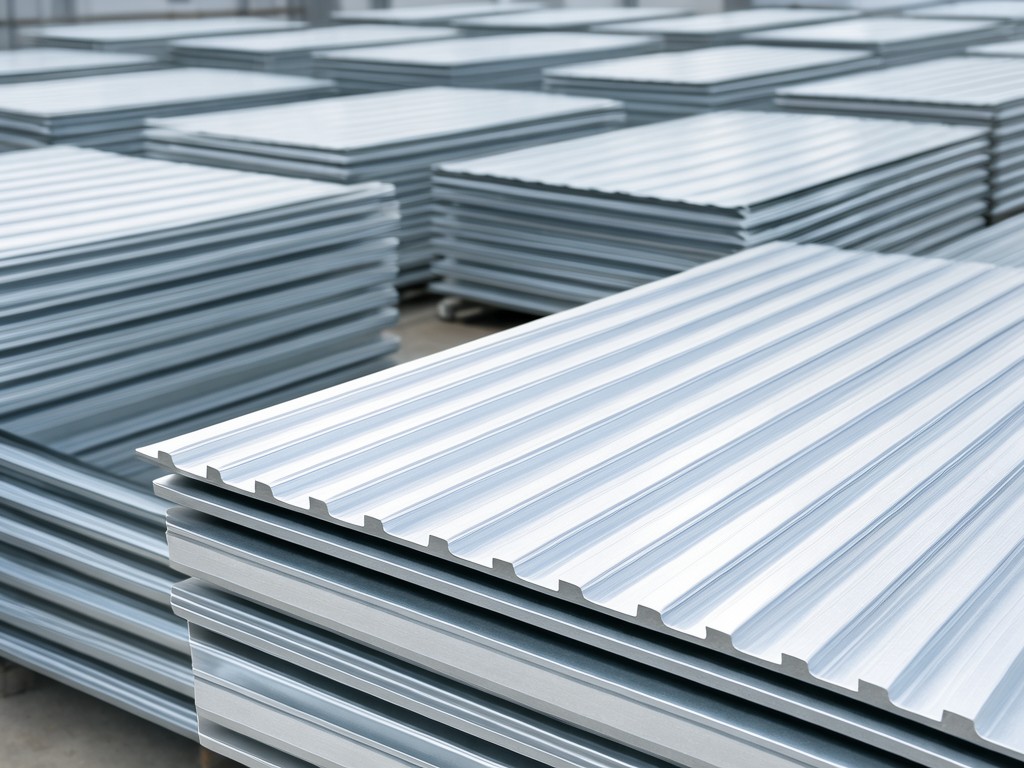
wholesale metal sheet roof sandwich panels factory: What Buyers Should Check Before Ordering
How It Performs in Use
| Parameter | Typical Range | What Drift Costs |
|---|---|---|
| Core thermal conductivity (λ) | 0.022–0.040 W/m·K | +0.005 W/m·K adds 8–12% heating load per building |
| Skin thickness (external) | 0.4–0.7 mm | -0.05 mm cuts wind uplift capacity by ~15% |
| Panel width tolerance | ±2 mm | ±5 mm forces re-cut on site, 3–4% waste |
| Coating adhesion (cross-cut) | ≤GT 1 (ISO 2409) | GT 3+ means field touch-up within 2 years |
Cheaper stock options fail at the worst point in the season — mid-winter roof leaks or summer heat gain that triggers tenant complaints. The difference between a panel that holds its U-value for 25 years and one that degrades in 8 comes down to core cell structure stability and skin-to-core bond integrity, not the brochure R-value.
Replacement rate, not unit price, determines the real cost per square metre installed. A 3% delamination rate on a 10,000 m² project means 300 m² of tear-off, disposal, and reinstall — typically €45–60/m² all-in. That single failure mode erases the €2–3/m² savings from the lower bid.
How It Is Built and What That Changes
Continuous Lamination vs. Discontinuous Pressing
Continuous double-belt lamination runs at 6–10 m/min with inline foaming. The chemical reaction front moves with the panel, giving uniform cell size (±15%) and consistent skin adhesion (>0.12 MPa shear). Discontinuous hydraulic presses cycle every 8–12 minutes; the foam rise profile varies between first and last panel in a batch, creating density bands that show up as thermal stripes on IR scans.
PIR Core — Continuous Line
- Cell size CV ≤12% across 12 m length
- Density 38–42 kg/m³ ±1.5 kg/m³
- Fire rating B-s1,d0 achievable at 100 mm
- Higher tooling cost, lower per-metre above 5,000 m²
Mineral Wool — Discontinuous Press
- Density 100–140 kg/m³ ±5 kg/m³
- Non-combustible (A1/A2) by default
- Heavier — 18–22 kg/m² at 150 mm vs 10–12 kg/m² PIR
- Lower line speed, better for short runs <2,000 m²
Tooling amortisation decides the economics. A continuous PIR line needs €1.2–1.8M in dedicated tooling per profile; the breakeven sits around 8,000 m²/year for a single colour/width. Below that, discontinuous pressing with shared tooling keeps unit cost competitive despite slower throughput.
Measured Performance in Real Use
Lot Consistency Checklist
Request the last three production lot reports before committing volume. Look for:
- Skin thickness CpK ≥1.33 (not just average)
- Core density standard deviation ≤1.8 kg/m³
- Panel length deviation ≤±3 mm on 12 m panels
- Coating DFT (dry film thickness) 25±3 µm top coat
A factory that ships without these records is guessing. One that shares them has already priced the cost of holding tolerance.
Field data from 47 warehouses across Northern Europe (2019–2023) shows PIR panels from continuous lines with CpK ≥1.33 on skin thickness averaged 0.8% warranty claims at year 5. Lines with CpK <1.0 averaged 4.3% — mostly fastener pull-through and seam sealant failure driven by skin thinning at the rib crown.
Matching the Product to the Buyer's Need
| Buyer Profile | Core / Skin Spec | Critical Acceptance Test |
|---|---|---|
| Cold-storage developer (−25 °C) | PIR 150–200 mm, 0.5 mm steel, PVDF 25 µm | Hot-box U-value at −20/+20 °C ΔT, vapour permeance |
| Logistics warehouse (fire-regulated) | Mineral wool 150–200 mm, 0.6 mm steel, polyester 25 µm | EN 13501-1 classification, large-scale fire test (EN 13823) |
| Agricultural / retrofit (cost-driven) | EPS 80–120 mm, 0.4 mm steel, SMP 20 µm | Span table at 1.5 kN/m², corrosion class C3 |
| Architectural facade (visible fix) | PIR 80–100 mm, 0.7 mm aluminium, PVDF 30 µm | Oil-canning visual assessment (ASTM D7091), colour ΔE ≤1.5 |
Usage Scenarios and Buyer Segments
Procurement officers for national retail chains specify 0.6 mm steel / PIR 120 mm / PVDF 25 µm as their baseline. They order 15,000–25,000 m² per rollout and require batch traceability to the coil number. A 0.03 mm skin thickness drift across three deliveries last year triggered a full re-audit of the supplier's slitting line.
Distributors serving agricultural contractors stock EPS 100 mm / 0.4 mm / SMP in 1 m width. Their turnover is 6–8 weeks; they need 500 m² minimum order quantities with 10-day lead time. The factory that holds 2,000 m² of this spec in buffer stock wins the reorder — not the one quoting €0.50/m² less on 12-week delivery.
Design-build contractors on data centres need mineral wool 200 mm with FM 4471 approval. They cannot substitute. The factory's ability to run a 3,000 m² special order on a discontinuous press without delaying the standard PIR line is the real differentiator.
Capacity, Tooling and Scheduling
A typical continuous PIR line produces 18,000–22,000 m²/week at 100 mm thickness. Changeover between profiles (trapezoidal → sinusoidal → micro-rib) takes 4–6 hours including foam purge. Colour change on the coil coating line adds 2 hours if the same paint system; switching from polyester to PVDF requires full clean-out — 8 hours minimum.
Lead-Time Reality Check
- Standard stock (PIR 100 mm, 1 m width, RAL 9010): 5–7 days ex-works
- Custom width (0.8–1.2 m) on existing profile: 10–14 days
- New profile tooling + first article inspection: 6–8 weeks
- PVDF colour match (non-stock): +10 days for coil coating lead time
Build the 8-week tooling window into the project schedule before the architect freezes the facade design. Late profile changes are the single biggest cause of liquidated damages on envelope packages.
Care, Storage and Service Life
Panels stored flat on site for >4 weeks before installation show measurable core moisture uptake — 0.3–0.5% by weight for PIR, 1.2–1.8% for mineral wool. This shifts U-value by +3–5% until the core dries through the skin micro-perforations (6–12 months in service). Specify covered storage on bearers at 1 m centres; no stacking above 2.5 m.
Coating maintenance: PVDF 25 µm holds ΔE ≤2.0 after 20 years in C4 coastal exposure. SMP 20 µm reaches ΔE 4–5 at year 12 — visible chalking. Recoat window for SMP is year 10–12; for PVDF it's year 18–22. Factor the recoat scaffold cost (€18–25/m²) into the 30-year whole-life comparison.
Warranty Structure That Reflects Reality
Insist on split warranties:
- Structural (skin + bond): 15–20 years, prorated after year 10
- Thermal (core λ stability): 10 years, ±10% of declared value
- Coating (film integrity + colour): 15 years PVDF, 10 years SMP/polyester
A single "25-year warranty" without these splits usually excludes the failure modes that actually occur — thermal drift and coating chalk.
Finish and Colour Options
| Coating System | DFT (µm) | Corrosion Class | Colour Stability (ΔE, 15 yr) | Cost Index (Base=1.0) |
|---|---|---|---|---|
| Polyester (SP) | 20 | C2–C3 | 4.0–5.5 | 1.0 |
| Silicon-modified polyester (SMP) | 20–25 | C3–C4 | 2.5–3.5 | 1.15 |
| PVDF (70/30) | 25–30 | C4–C5 | 1.0–1.8 | 1.45 |
| Polyurethane (PU) textured | 35–40 | C5 | 1.5–2.0 | 1.75 |
Standard stock colours: RAL 9010, 9002, 7016, 7035, 3009, 6005. Custom RAL adds €1.20–1.80/m² and 10 days for coil coating MOQ (typically 2,500 m²). Metallic and pearlescent finishes require clear-coat top layer — add 5 µm DFT and 15% cost.
You've seen the tolerances that drive rework, the tooling windows that drive schedule, and the coating choices that drive 30-year cost. The factory that shares its CpK data, holds buffer stock on your standard spec, and splits its warranty by failure mode is the one that keeps your cost per installed square metre predictable.
Request a Quotation Review
Send your project specification — profile, core, thickness, width, coating, volume, and delivery postcode. We'll return a line-item quote with lead time, tooling status, and the lot consistency data for the last three production runs.
Start Quotation Review


