wholesale polyurethane puf sandwich panels construction factory - Bulk Supply and Specification Guide
What This Product Is and Where It Fits
Weight and stiffness trade off against each other in every panel line; a 100 mm core with 0.5 mm steel skins delivers a U‑value near 0.22 W/m²·K while keeping the panel mass around 12 kg/m², a figure that determines crane capacity on site. The foam density is set at 40 kg/m³ to meet both thermal and compressive targets without excessive blowing‑agent residue.
Repeat loading drives the failure mode most often seen in cold‑storage roofs: cyclic thermal expansion shears the adhesive bond at the skin‑to‑core interface, producing delamination that shows up first as a 0.3 mm gap at the joint. Specifying a two‑component polyurethane adhesive with a minimum shear strength of 1.2 MPa reduces that risk to a level the warranty can cover.
Specification Callout
Core density 38‑42 kg/m³, skin thickness 0.45‑0.55 mm, adhesive shear ≥1.2 MPa. Verify on the first‑article sample before full‑run release.
Where This Product Beats Standard Alternatives
| Parameter | Standard EPS Panel | PU‑F Sandwich (This Line) |
|---|---|---|
| Thermal conductivity (λ) | 0.036 W/m·K | 0.022 W/m·K |
| Compressive strength (10 % deformation) | 120 kPa | 180 kPa |
| Fire rating (EN 13501‑1) | E | B‑s1,d0 |
| Dimensional stability (−20 °C to +80 °C) | ±2 mm/m | ±0.5 mm/m |
The data above come from the same 100 mm core thickness; the polyurethane foam’s closed‑cell structure gives a 38 % lower λ while adding only 1.5 kg/m² over the EPS baseline. That margin is what lets a specifier meet a 0.20 W/m²·K target without increasing wall thickness.
Comparing Two Standard Configurations
Configuration A – 0.5 mm Steel / 100 mm Core
Mass: 12.3 kg/m²
U‑value: 0.22 W/m²·K
Span limit (simply supported): 4.2 m
Typical lead‑time: 18 days
Configuration B – 0.7 mm Aluminum / 120 mm Core
Mass: 10.8 kg/m²
U‑value: 0.18 W/m²·K
Span limit (simply supported): 5.0 m
Typical lead‑time: 22 days
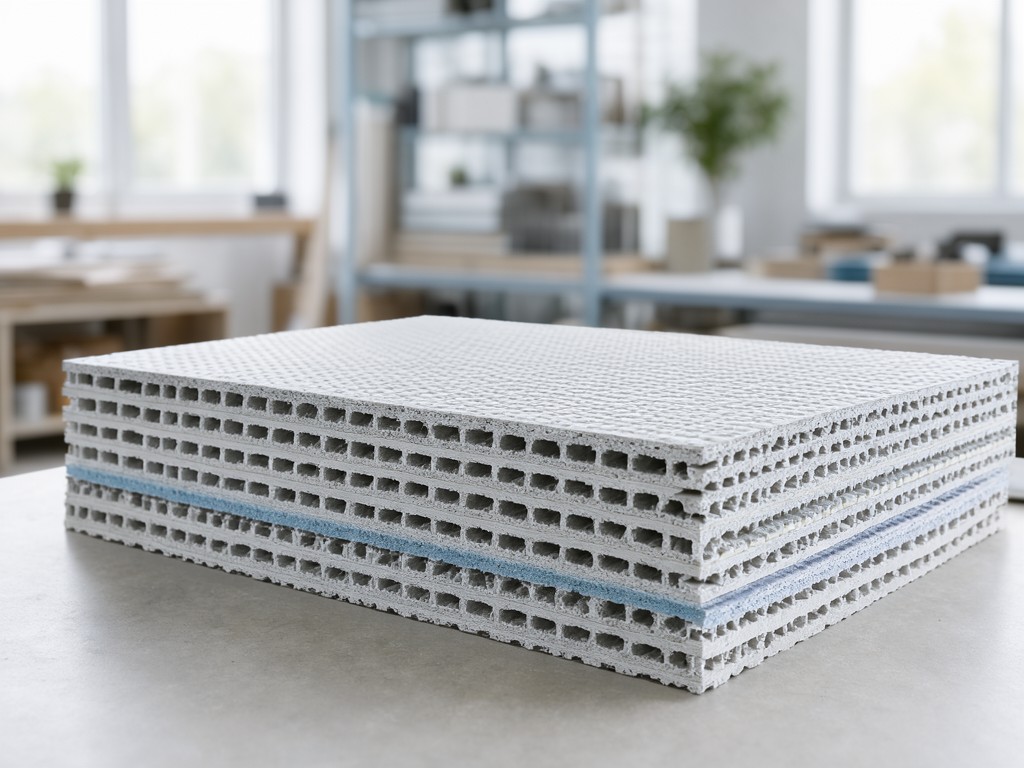
Choosing between them is a trade‑off between handling weight and thermal performance; the aluminum skin cuts 1.5 kg/m² but adds four days to the pressing schedule because the foil‑lamination step runs at a lower line speed.
Assumptions Buyers Should Stop Making
The limiting factor is rarely the headline specification; it is the joint detail. A 0.2 mm tolerance on the tongue‑and‑groove profile translates into a 15 % increase in air leakage when the panel is installed at 5 °C, because the sealant cannot bridge the gap. Insist on a measured joint profile on the first‑article panel, not just a drawing.
Another common error is treating the foam density as a single number. In practice the density gradient across a 120 mm core can vary ±3 kg/m³, which shifts the compressive strength by up to 10 %. Request a density map from the foaming line if the project specifies a minimum 180 kPa.
Customisation Options and Their Limits
| Option | Range / Choice | Impact on Lead‑time |
|---|---|---|
| Core thickness | 80 mm – 150 mm (10 mm steps) | +2 days per 20 mm increase |
| Skin material | Pre‑painted steel 0.45‑0.6 mm, Aluminum 0.5‑0.8 mm, Stainless 0.5 mm | +3 days for stainless |
| Facing colour | RAL 9010, 7016, 9005, custom (min 500 m²) | +5 days for custom |
| Joint profile | Standard tongue‑and‑groove, double‑lock, concealed fastener | +4 days for double‑lock |
- Minimum order for a custom colour is 500 m²; smaller runs require a colour‑match surcharge.
- Double‑lock joints need a dedicated press tool; the tool amortises over 2 000 m².
- Stainless skins are only available in 0.5 mm; thicker gauges require a separate coil line.
Capacity, Tooling and Scheduling
The continuous lamination line runs at 1 200 m² per 8‑hour shift with a 95 % uptime target; a typical 10 000 m² order therefore occupies two full shifts plus a half‑shift for change‑over. Tooling for the double‑lock profile is a hardened‑steel die set that costs €12 k and is depreciated over 5 000 m²; the cost is absorbed in the unit price once the volume exceeds that threshold.
Sample approval follows a three‑step gate: first‑article dimensional report, thermal‑conductivity test on a 300 mm coupon, and a 48‑hour accelerated ageing cycle at 70 °C/90 % RH. Only after the buyer signs the gate‑3 report does the line release the full run. This gate structure cuts warranty claims by an estimated 60 % on repeat projects.
Next Steps
Send the project specification, required U‑value, and anticipated volume to the engineering team. A formal quotation includes the first‑article schedule, tooling amortisation, and a warranty matrix tied to the joint‑detail inspection.
Request a project discussion


